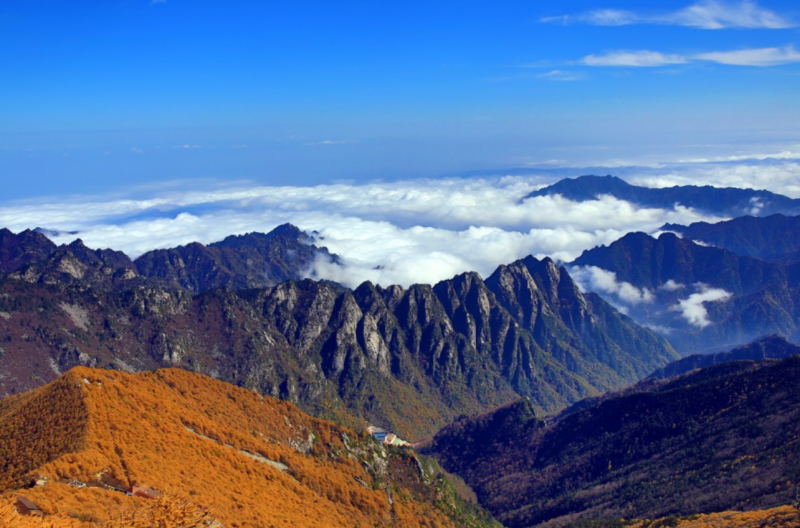
The Taibai Mountain Scenic Area is located across the three counties of Mei County, Taibai County, and Zhouzhi County in Baoji City, Shaanxi Province. It is the main peak of the Qinling Mountains and the highest peak in inland China east of the Qinghai-Tibet Plateau. The scenic area is a national 5A-level tourist attraction with a total area of approximately 565 square kilometers (including a core scenic area of 106.36 square kilometers). Its features integrate height, coldness, steepness, wonder, beauty, and seclusion, with natural landscapes such as Quaternary glacial relics, alpine lakes, and vertical natural vegetation zones, as well as a profound historical and cultural heritage. Within the scenic area, above an altitude of 3,000 meters, there are six alpine lakes including Daye Sea and Erye Sea, which are glacial relics; there are also facilities such as the Tianxia Ropeway (total length 2,936 meters, drop 1,209 meters), the Fuyun Pavilion Ropeway, as well as the Visitor Service Center, Bansi New Village, and other supporting buildings.
Historical Culture
The history of Taibai Mountain can be traced back to ancient times. It was called "Dunwu Mountain" in The Book of Documents: Tribute of Yu, and was first recorded as "Taiyi Mountain" in The Book of Han. During the Wei and Jin periods, it was named "Taibai Mountain" because its summit is covered with snow all year round. The scenic area preserves a large number of cultural relics, such as Baxian Terrace, said to be the place where Jiang Ziya conferred titles upon deities and reviewed his troops, where the Conferred Deities Platform ruins still exist; Taibai Temple was built during the Zhenguan period of the Tang Dynasty, and when Su Shi served as the magistrate of Fengxiang Prefecture, he climbed Taibai Mountain to pray for rain and wrote The Taibai Mountain Rain-Praying Text. In addition, Taibai Mountain is an important birthplace of Taoist culture. Existing Taoist buildings on the mountain include the Laojun Temple and the Sanguan Hall, reflecting the deep integration of nature and humanity.
Main Attractions
Tianyuan Difang
Located at an altitude of 3,511 meters, it is the geographical dividing line between northern and southern China. Here visitors can experience the wonder of "one foot straddling north and south, rivers flowing separately." The Yangtze River system and the Yellow River system divide here. The scenic area has an observation platform with a broad field of view, allowing visitors to gaze into the distance at Baxian Terrace and closely observe alpine meadows. It is a landmark check-in spot of Taibai Mountain.
Baxian Terrace
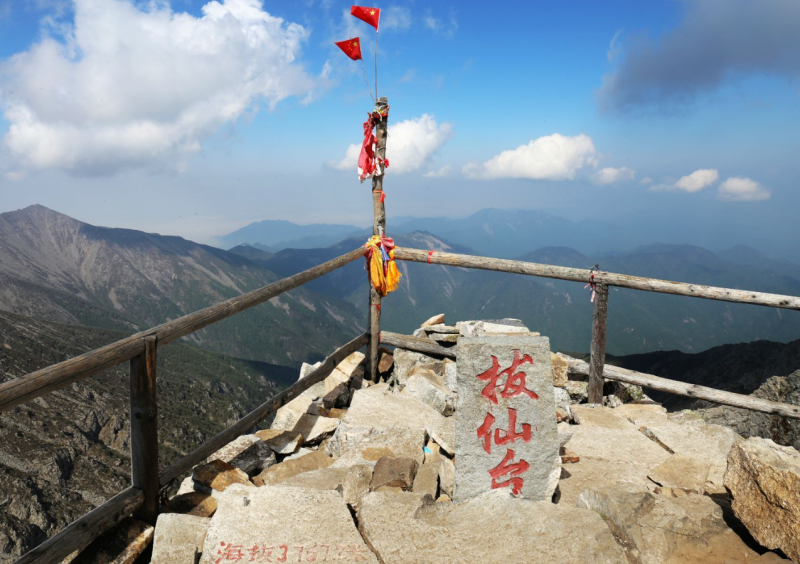
The main peak of Taibai Mountain, at an altitude of 3,771.2 meters, is the highest peak in eastern mainland China. At the top of the terrace are the remains of the Baxian Temple, said to be Jiang Ziya's platform for conferring titles upon deities. From the summit, visitors can overlook the peaks of the Qinling Mountains and view alpine lakes such as Daye Sea and Erye Sea. In summer, glacial relic stone seas can be seen, while in winter the snow scenery is vast and boundless, enjoying the reputation of "Taibai snow in the sixth month."
Daye Sea
The highest alpine lake in Taibai Mountain, located at 3,650 meters, with a surface area of about 5,000 square meters. It is a Quaternary glacial cirque lake. The lake water is clear and blue, never drying up all year round, and rare birds inhabit the surrounding area. It is known as the "Pearl of the Qinling Mountains." By the lakeside there are buildings such as the Yaowang Hall, said to be the place where Sun Simiao gathered herbs and refined medicines.
Tianxia Ropeway
One of the ropeways with the largest altitude difference in Asia, with a total length of 2,936 meters, running directly from Honghuaping to Tianyuan Difang, taking about 25 minutes one way. When riding, visitors can overlook the vertical vegetation spectrum of the Qinling Mountains, enjoying mountain flowers in spring, escaping the summer heat in summer, appreciating red leaves in autumn, and viewing snow scenery in winter, experiencing the unique scenery of "four seasons in one day."
Food
Qishan Saozi Noodles
A classic noodle dish of Baoji, featuring thin, chewy, and smooth noodles paired with saozi (stir-fried diced pork, tofu, wood ear mushrooms, etc.) and a sour and spicy soup base. It has more soup and less noodles, and is sour, spicy, and appetizing. The traditional way of eating emphasizes "one bite of fragrance," that is, served in small bowls with generous soup and little noodles, allowing one to eat several bowls in succession.
Mei County Ganmianpi
A type of noodle skin made by steaming wheat flour, with a chewy texture, paired with oil-splashed chili, Qishan aromatic vinegar, garlic paste, and other seasonings. It is bright red in color and sour, spicy, and refreshing. It is often eaten as an appetizing snack and can also be paired with a Chinese meat burger.
Douhua Paomo
Made with tender douhua prepared from specially made soy milk, paired with toasted pieces of mo, added with bone broth and seasonings such as oil-splashed chili and cilantro. The douhua is delicate and soft, and the mo pieces absorb the soup, making it salty, fragrant, and rich. It is the first choice for local breakfast.
Recommended Nearby Foods
Around Taibai Mountain, visitors can taste the "Taibai Mountain Medicinal Cuisine Banquet" (dishes prepared with medicinal herbs such as codonopsis and astragalus), potato ciba (mashed potato dipped in seasonings), vinegar noodles (cold mixed noodles made from buckwheat vinegar residue), and other wild mountain flavors, as well as specialties such as dried kiwi fruit and Taibai liquor.
Tickets:
Ticket: 180 yuan per person (including round-trip sightseeing bus).
You can search for the official public account "Taibai Mountain" on WeChat to obtain the latest updates or purchase tickets online.
Opening Hours:
Peak season (March 1 - November 30): Visitor Center ticket sales 8:00-16:00, transportation buses 8:00-19:00, Tianxia Ropeway 8:30-17:30, Fuyun Pavilion Ropeway 8:30-17:00. Off-season (December 1 - end of February the following year): Visitor Center ticket sales 8:30-15:00, transportation buses 9:00-17:00, ropeway operating hours adjusted to 9:00-16:30.
Tour Routes:
One-Day Easy Tour: Take the transportation bus from the Visitor Center to Honghuaping (about 1 hour) → take the Tianxia Ropeway to Tianyuan Difang (3,511 meters, sightseeing 2 hours) → walk to Baixian Terrace and Shangbansi (about 1.5 hours) → take the Fuyun Pavilion Ropeway down the mountain → return. Suitable for families and leisure tourists, about 6-7 hours in total.
Two-Day Hiking Summit Tour: Day 1: Visitor Center → Honghuaping → Tianxia Ropeway → Tianyuan Difang → Xiaowengong Temple (accommodation, about 4 hours of hiking); Day 2: Xiaowengong Temple → Dawengong Temple → Daye Sea → Baxian Terrace (summit, about 5 hours of hiking) → return by the original route or cross through Paomaliang and Dudumen (professional guide required). This route requires camping equipment and is suitable for experienced hiking enthusiasts.
Transportation:
Self-Driving:
From Xi'an: via the Ring Expressway → Lianhuo Expressway (G30) → Lanjiacun Exit → Meitai Line → Taibai Mountain Visitor Center, about 100 kilometers in total, 1.5 hours by car.
From Baoji: via Lianhuo Expressway (G30) → Changxing Exit → Meitai Line, or via the Mei County Weihe River Bridge → Taibai Mountain, about 60 kilometers in total, 1 hour by car.
High-Speed Rail/Bullet Train:
Take the high-speed rail to Yangling South Station, then transfer to the scenic area shuttle bus (daily 8:00-16:00, about one bus every 30 minutes, fare 20 yuan) directly to the Visitor Center.
Take the high-speed rail to Qishan Station, transfer to a bus to Mei County Bus Station, then transfer to Bus No. 203 to the scenic area (about 1.5 hours in total).
Long-Distance Bus:
Xi'an Textile City Passenger Station and Chengxi Passenger Station have multiple daily buses directly to Taibai Mountain Scenic Area, with fares of about 35-40 yuan and a travel time of 2 hours.
Baoji West Bus Station and Mei County Bus Station both have special scenic area buses, with fares of 5-10 yuan.
Must-Visit Attractions:
Tianyuan Difang: A marker of the north-south geographical divide, at an altitude of 3,511 meters, where visitors can experience the geographical wonder of "crossing north and south in one day," suitable for photos and check-ins.
Baxian Terrace: The summit of the Qinling Mountains, at an altitude of 3,771.2 meters. From the top, visitors can see all the other mountains as small, view glacial relics in summer, and enjoy snow scenery in winter. It requires a certain amount of physical strength.
Daye Sea: An alpine cirque lake at an altitude of 3,650 meters. The lake water is pure, and the surrounding ecology is primitive, suitable for photographing lake and mountain scenery.
Tianxia Ropeway: An aerial panoramic view of the Qinling Mountains, with a drop of 1,209 meters. The one-way experience is stunning and is the first choice for saving energy.
Travel Suggestions:
Check the weather forecast in advance. In summer, rain is frequent, so bring a raincoat. In winter, it is cold, so wear a down jacket and non-slip shoes. The temperature at the summit is 10-15°C lower than at the foot of the mountain.
For a one-day tour, it is recommended to arrive at the Visitor Center before 8 a.m. to avoid the peak crowd; for hiking to the summit, bring high-calorie food (such as chocolate and energy bars) and at least 2 liters of drinking water.
When riding the ropeway, keep personal belongings safe. People with high blood pressure or heart disease should be cautious about entering high-altitude areas.
For a deeper experience, you can stay in Bansi New Village or a homestay near Daye Sea, and watch the sunrise the next day (summer sunrise time is about 5:30-6:00).
Precautions:
Smoking and open fires are strictly prohibited in the scenic area. Violators may be fined up to 2,000 yuan.
Non-professional hikers should not attempt undeveloped routes (such as Paomaliang and the Aotai Line). In the past five years, there have been many rescue incidents involving people getting lost.
The oxygen content in high-altitude areas is about 70% of that on the plains. If symptoms such as dizziness or nausea occur, stop climbing immediately and go down the mountain to rest.
Children must visit accompanied by adults. Seniors over 60 years old are advised to bring their ID cards to verify eligibility for discounts.
After descending the mountain, you can experience Taibai Mountain hot springs in Tangyu Town (such as Phoenix Hot Spring and Shangjing Hot Spring) to relieve climbing fatigue. Hot spring tickets are about 150-200 yuan per person.