The Xi'an City Wall · Beilin Historical and Cultural Scenic Area is located in the city center of Xi'an, Shaanxi Province, and is a National 5A Tourist Attraction. The scenic area consists of the well-preserved Ming Dynasty city wall and the Beilin Museum, China's largest treasure house of stone tablet art, forming a unique cultural experience of "viewing history on the wall and appreciating steles within the city." The Xi'an City Wall is the largest and best-preserved ancient city wall in China, with a circumference of 13.74 kilometers, a height of 12 meters, a top width of 12-14 meters, a bottom width of 15-18 meters, and a total of 18 city gates. The Beilin Museum covers an area of 31,900 square meters and houses more than 4,000 stone tablets. Together, the two major scenic areas showcase Xi'an's historical and cultural heritage as the ancient capital of thirteen dynasties.
History and Culture
The Xi'an City Wall was first built in the third year of Hongwu in the Ming Dynasty (1370). It was expanded on the basis of the imperial city of Tang Chang'an and took 8 years to complete. It has a history of more than 650 years. The city wall was built with rammed earth and faced with blue bricks on the outside, forming a strict defense system and witnessing the highest achievements of ancient Chinese urban construction and military defense.
The Beilin Museum was founded in the second year of Yuanyou in the Northern Song Dynasty (1087). It was initially established to preserve the Tang Dynasty "Kaicheng Stone Classics." Through continuous expansion in the Song, Yuan, Ming, and Qing dynasties, it now has 7 stele rooms, 8 stele corridors, and 8 stele pavilions, housing more than 4,000 stone tablets and epitaphs from the Han Dynasty to modern times. It is known as the "Oriental Stone Library." Among them, the "Shitai Xiaojing" and the "Nestorian Stele" are national treasure-level cultural relics.
Main Attractions
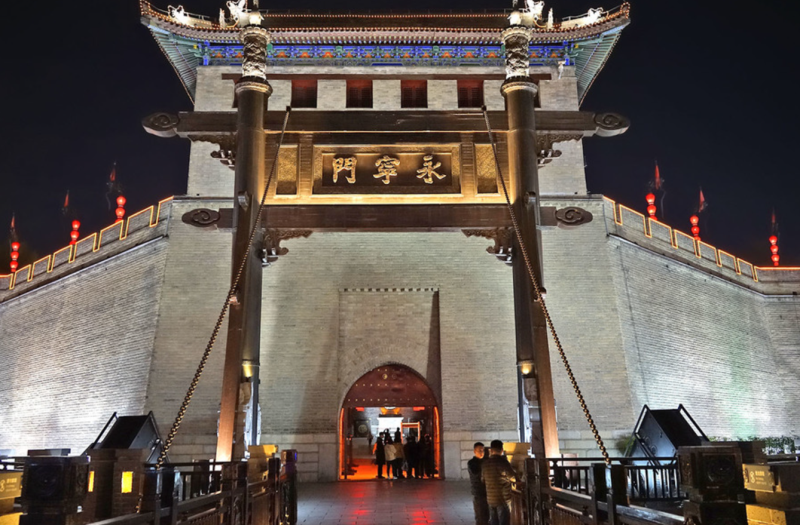
Yongning Gate (South Gate)
The main south gate of the Xi'an City Wall, first built in the Sui Dynasty and rebuilt in the Ming Dynasty. It is the most completely preserved gate complex among the four main gates of the city wall. It consists of three layers of gate towers: the闸楼 (sluice tower), the arrow tower, and the main tower. Outside the gate is the site of a drawbridge. An imitation ancient city-opening ceremony is held daily, and the themed performance "Dream of Chang'an" is staged at night.
Changle Gate (East Gate)
The east gate of the Ming Dynasty city wall. The existing gate tower was rebuilt in the Qing Dynasty. The three characters "Changle Gate" on the lintel are original from the Ming Dynasty. Inside the gate passage, the slide rail remains of the ancient defensive facility known as the "thousand-jin gate" are preserved. Climbing the gate tower offers a panoramic view of Xi'an Railway Station.
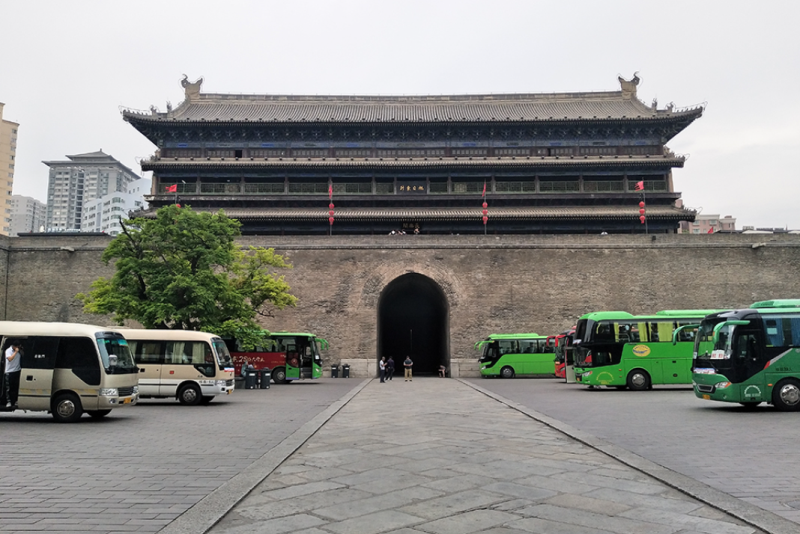
Anding Gate (West Gate)
The west gate of the Ming Dynasty city wall. The barbican is well preserved, and the site of the Tang Dynasty imperial city wall can be seen on the inner side of the city wall. The west gate area has a city wall ruins exhibition area, displaying the construction techniques of city walls through archaeological sections.
Anyuan Gate (North Gate)
The north gate of the Ming Dynasty city wall, rebuilt in the Qing Dynasty. Inside the gate tower is an exhibition on the history of the city wall, showing the construction techniques and military functions of the Xi'an City Wall through models and cultural relics. The north gate arrow tower is one of the best locations for photographing the full view of the city wall.
Beilin Exhibition Room One
Displays the "Kaicheng Stone Classics," 114 stones carved in the second year of Kaicheng in the reign of Emperor Wenzong of Tang (837). It includes 12 Confucian classics such as the "Book of Changes" and the "Book of Documents," totaling 650,000 characters. It is the most complete extant official carved classics in China.
Beilin Exhibition Room Two
Concentrates on famous Tang Dynasty calligraphy steles, including Ouyang Xun's "Huangfu Dan Stele," Yan Zhenqing's "Duobao Pagoda Stele," and Liu Gongquan's "Xuanmi Pagoda Stele," making it a textbook of Chinese calligraphy art.
Nestorian Stele
Carved in the second year of Jianzhong in the Tang Dynasty (781), it records in Chinese and Syriac the history of the spread of the Nestorian sect of Christianity during the Tang Dynasty. It is one of the four great famous steles in the world.
Food
Yangrou Paomo
A traditional famous dish of Xi'an, made with high-quality mutton and specially made broken steamed bread pieces, cooked with bone broth. The century-old brands Laosunjia and Tongshengxiang near the South Gate are nearby, with an average consumption of about 40-60 yuan.
Hulu Chicken
A traditional famous dish of Shaanxi, named for its gourd-like shape. It is made from sanhuang chicken through three processes: boiling, steaming, and frying, and is crispy outside and tender inside. The most authentic version is made at Xi'an Restaurant near the Beilin Museum, about 98 yuan each.
Roujiamo
A Shaanxi specialty fast food, made by stuffing braised pork into a baiji bun. Qinyu Roujiamo outside the West Gate of the city wall is a popular local shop, with the regular version at 8 yuan each and the premium version at 12 yuan each.
Recommended Nearby Foods
Around the scenic area, there are also specialty restaurants such as Jia San Soup Dumplings (South Gate), Chunfasheng Hulutou Paomo (Beilin District), and Defachang Dumpling Banquet (Bell Tower), with per capita consumption ranging from 30-80 yuan.
Tickets:
Xi'an City Wall tickets are 54 yuan per person. You can search for the official WeChat public account "Xi'an City Wall" to get the latest updates or buy tickets online.
Beilin Museum tickets are 85 yuan per person. You can search for the official WeChat public account "Xi'an Beilin Museum" to get the latest updates or buy tickets online.
Opening Hours:
Xi'an City Wall opening hours: peak season (March 1-November 30) 8:00-22:00; off-season (December 1-end of February the following year) 8:00-20:00. Beilin Museum opening hours: peak season 8:00-18:30 (ticket sales stop at 17:45); off-season 8:00-18:00 (ticket sales stop at 17:15). Opening hours may be adjusted during holidays, so it is recommended to check the scenic area's official website before traveling.
Suggested Tour Route:
It is recommended to visit the Beilin Museum in the morning (about 2-3 hours), then ascend the city wall from Wenchang Gate and walk south along the wall to Yongning Gate (about 1.5 kilometers), overlooking the Shuyuanmen Cultural Street and Xiangzi Temple Street along the way. In the afternoon, tour other sections of the city wall. You can choose to cycle (single bicycle 45 yuan/3 hours, tandem bicycle 90 yuan/3 hours) or take a sightseeing bus (80 yuan per person for the full route). In the evening, watch the "Dream of Chang'an" performance at Yongning Gate (performance times vary by season, ticket prices range from 280-880 yuan).
Transportation:
Subway: Take Metro Line 2 to Yongningmen Station (Exit A1/D1) to reach the South Gate; take Metro Line 6 to Guangjijie Station (Exit D) to reach the West Gate.
Bus: South Gate Station (Routes 12, 26, 36, etc.); Beilin Museum Station (Routes 14, 23, 40, etc.).
Self-driving: There are multiple parking lots around the scenic area, including the South Gate Underground Parking Lot (8 yuan/hour) and the Beilin Museum Parking Lot (6 yuan/hour).
Must-Visit Attractions:
Yongning Gate Tower: Admire the complete Ming Dynasty city gate defense system and watch the imitation ancient city-opening ceremony.
City Wall Barbicans: Observe the protruding defensive structures of the city wall and learn about ancient city defense wisdom.
"Kaicheng Stone Classics": The most complete extant Tang Dynasty official carved classics in China, a treasure of Confucian culture.
Tang Dynasty Calligraphy Steles: Original steles and authentic works of calligraphy masters such as Ouyang Xun, Yan Zhenqing, and Liu Gongquan.
Nestorian Stele: A world-class cultural relic witnessing ancient cultural exchanges between China and foreign countries.
Travel Tips:
The best seasons for visiting are spring and autumn (April-May, September-October), avoiding high summer temperatures and winter smog.
For touring the city wall, it is recommended to wear comfortable sports shoes, as some wall bricks have smooth surfaces and require attention to safety.
For visiting the Beilin Museum, it is recommended to rent an audio guide or book a guide service (Chinese commentary 100 yuan per time).
For cycling on the city wall, it is recommended to choose morning or evening to avoid the strong midday sun.
Photography enthusiasts are advised to go up the wall at dawn or dusk, when the light is most suitable for shooting the ancient city scenery.
Notes:
Smoking and littering are prohibited on the city wall; violators will be fined 50-200 yuan.
The use of flash photography for steles is prohibited in the Beilin Museum, and some precious steles may not be touched.
Cycling on the city wall requires being at least 12 years old. When cycling, keep to the right side and watch out for pedestrians.
There are many cultural relic protection units in the scenic area. Please do not carve or write on the buildings.
In case of rain or snow, some sections of the city wall may be temporarily closed. Please pay attention to scenic area announcements.