The Yungang Grottoes are located at the southern foot of Wuzhou Mountain and on the north bank of the Wuzhou River, about 16 kilometers west of Datong City, Shanxi Province. They are a national 5A-level tourist attraction and a World Cultural Heritage site. As one of China's three major grottoes, they are renowned worldwide for their grand scale, exquisite carving techniques, and profound cultural connotations. The grotto complex was carved into the mountain, stretching about 1 kilometer from east to west. There are currently 45 main caves, 252 large and small niches, and more than 51,000 stone statues, with a total area of about 3.48 square kilometers. The statues here blend Chinese and foreign artistic styles and are an outstanding representative of Buddhist art during the Northern Wei Dynasty. They display both the majestic momentum of royal grottoes and contain rich historical and religious value, and are praised as the "treasure house of Eastern stone carving art."
Historical Culture
The carving of the Yungang Grottoes began in the early Heping years of Emperor Wencheng of the Northern Wei Dynasty (460 AD), led by the famous monk Tanyao. It continued through the reigns of Emperor Xianwen, Emperor Xiaowen, and others, lasting about 64 years. During this period, the Northern Wei Dynasty established its capital at Pingcheng (present-day Datong). In order to consolidate its rule and promote Buddhism, it concentrated the country's manpower and material resources to carve this grand project. Among them, the five caves carved under the leadership of Tanyao (Caves 16 to 20) are called the "Tanyao Five Caves," symbolizing the five emperors of the Northern Wei Dynasty and closely combining imperial power with divine authority.
After the Northern Wei moved its capital to Luoyang (494 AD), the carving of the Yungang Grottoes gradually declined, but small-scale repairs and carving continued until the Qing Dynasty. Over the long course of history, the grottoes suffered damage from natural weathering, wars, and other causes, and have received systematic protection in modern times. In 1961, the Yungang Grottoes were listed as a Major Historical and Cultural Site Protected at the National Level; in 2001, they were inscribed on the UNESCO World Heritage List, which evaluated them as "representing the highest achievement of Chinese Buddhist art from the 5th to 6th centuries AD" and noted their profound influence on subsequent Chinese grotto art (such as the Longmen Grottoes) and the development of East Asian Buddhist culture.
Main Attractions
Tanyao Five Caves (Caves 16-20)
The Tanyao Five Caves are the earliest-carved and most imposing caves in the Yungang Grottoes. They were built under the leadership of Tanyao between 460 and 465 AD. The main Buddha of Cave 16 is a standing statue of Shakyamuni, 13.5 meters high, with delicate facial features and wearing a robe covered with a thousand Buddhas; the main Buddha of Cave 17 is a cross-legged Maitreya Bodhisattva, 15 meters high, with finely carved attendant Bodhisattvas on both sides; the main Buddha of Cave 18 is a standing statue of Shakyamuni, 15 meters high, wearing a robe covered with a thousand Buddhas, with disciple statues on both sides having different expressions; the main Buddha of Cave 19 is a seated statue of Shakyamuni, 16.8 meters high, the second-largest Buddha statue in the Yungang Grottoes, with a small cave on each side outside the cave; the main Buddha of Cave 20 is a seated statue of Shakyamuni, 13.7 meters high, with a full face, a high nose bridge, and broad shoulders. It is the landmark Buddha statue of the Yungang Grottoes. Because the rock wall in front of the cave collapsed, it is exposed to the open air, making it appear even more solemn. The statue style of these five caves was influenced by Western Region Gandhara art and also incorporated Central Plains cultural elements, laying the artistic foundation of the Yungang Grottoes.
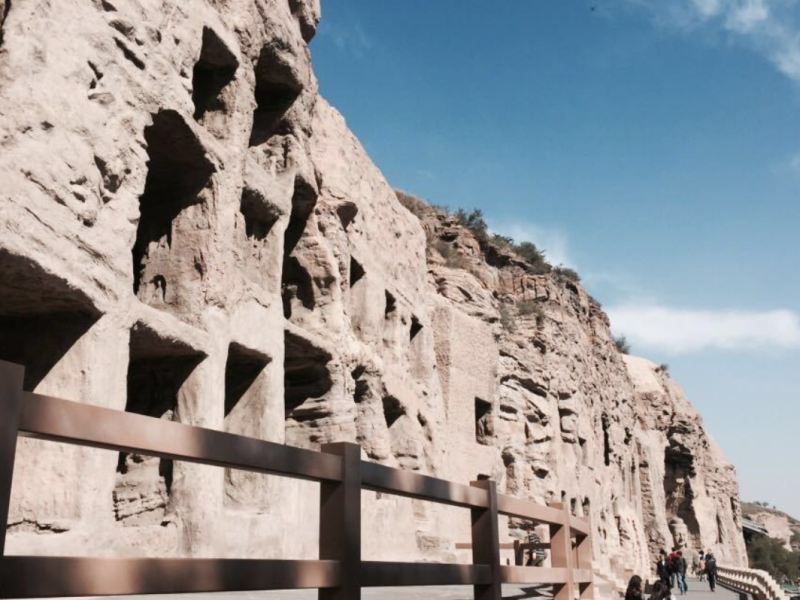
Caves 5 and 6
Caves 5 and 6 are a pair of caves built during the reign of Emperor Xiaowen of the Northern Wei Dynasty (471-494 AD) and represent the peak of the middle-period art of the Yungang Grottoes. Cave 5, also known as the "Great Buddha Cave," has a main seated statue of Shakyamuni, 17 meters high, which is the largest Buddha statue in the Yungang Grottoes. Its foot alone is 1.6 meters long, and its shoulders are 15 meters wide. The Buddha's facial lines are soft and the carving is delicate. The inner walls of the cave are covered with Buddhist niches and statues, with rich content. Cave 6, also known as the "Shakyamuni Buddha Cave," has a square pillar in the center connecting to the ceiling. The pillar is 15 meters high, with Buddha statues and Buddhist biographical stories carved on all four sides, such as "Riding an Elephant into the Womb" and "Birth under the Tree." On the cave walls are 33 relief sculptures of Buddhist biographical stories. The scenes are vivid and the figures are lifelike, demonstrating the exquisite carving techniques of the Northern Wei period, and the presence of Central Plains cultural elements (such as architecture and clothing) is more obvious.
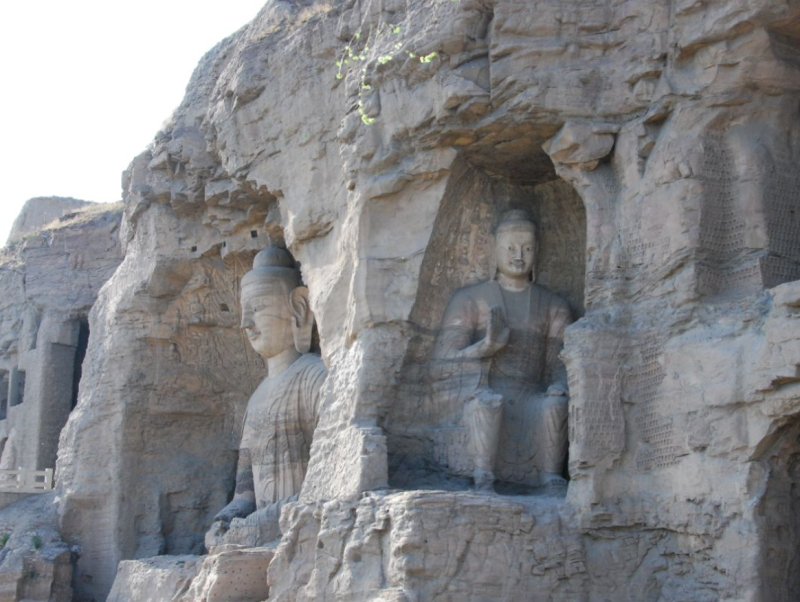
Caves 7 and 8
Caves 7 and 8 are also a pair of caves and belong to the middle-period works of the Yungang Grottoes. They are known for their rich carving content and significant integration of Chinese and foreign art. In the front room of Cave 7, six-tusked white elephants and peacocks are carved on both sides, typical elements of Indian Buddhist art. Inside the main cave, the Buddhas of the Three Times are carved, surrounded by thousands of Buddhas and Buddhist niches, and the ceiling is carved with a fine lotus caisson. On both sides of the lintel of Cave 8 are Greek-style column capitals. Inside the cave are statues of "Kumara" and "Maheshvara," the former riding a peacock and the latter riding a bull. Their unique forms reflect the blending of Persian, Greek, and Buddhist art. The carving style of the two caves is ornate and the details are complicated, making them important physical materials for studying cultural exchange between China and foreign countries.
Yungang Museum
The Yungang Museum is located within the scenic area, with a building area of about 14,000 square meters, and opened to the public in 2010. With the theme "Civilization Treasures, Buddhist Kingdom Art," the museum systematically introduces the historical background, carving process, artistic characteristics, and protection history of the Yungang Grottoes through cultural relic displays, multimedia presentations, and other methods. The museum exhibits a large number of stone carving fragments, inscriptions, mural reproductions, and other cultural relics related to the grottoes, including some fine carvings that have been relocated from the grottoes for protection. In addition, the museum uses 3D technology to restore the original appearance of some caves, helping visitors more intuitively understand the evolution of grotto art. It is an important place for an in-depth understanding of the history and culture of the Yungang Grottoes.
Lingyan Temple
Lingyan Temple is located within the Yungang Grottoes scenic area. It is a reconstructed temple in the Northern Wei style based on historical records, covering an area of about 30,000 square meters. The temple adopts an axial layout, with buildings such as the mountain gate, Hall of Heavenly Kings, Mahavira Hall, and Sutra Library in sequence. Buddha statues are enshrined in the halls, and the style is simple and solemn. Lingyan Temple is surrounded by green trees and complements the grotto complex, reproducing the historical pattern of "grottoes accompanied by a temple" and providing visitors with a place to experience the Buddhist cultural atmosphere and rest while sightseeing.
Food
Datong Knife-Cut Noodles
Datong knife-cut noodles are a specialty noodle dish of Datong, Shanxi, and one of the most representative foods around the Yungang Grottoes. Their production method is unique: a special knife is used to cut dough into boiling water, and the noodles are willow-leaf shaped, smooth on the outside and chewy inside, with a firm texture. They are paired with different sauces (such as pork sauce, tomato and egg sauce, fried bean sauce, etc.), and then garnished with cilantro, chopped scallions, chili oil, and other seasonings, giving them a full flavor. In restaurants around the Yungang Grottoes scenic area, a bowl of knife-cut noodles costs about 8-15 yuan and is generous in portion, making it the first choice for tourists to experience local flavors.
Datong Hot Pot
Datong hot pot is a local traditional food with a long history, named for being cooked in a copper hot pot. The hot pot is layered, with charcoal fire burning below and ingredients placed above. It usually includes pickled cabbage, meatballs, fried tofu, pork belly, vermicelli, and more, with a reasonable combination of meat and vegetables and a rich, delicious broth. Eating it in cold seasons warms the heart and stomach. In restaurants around the scenic area, a Datong hot pot suitable for 2-3 people costs about 80-120 yuan, making it a good choice for group dining.
Yellow Rice Cold Cake
Yellow rice cold cake is a specialty dessert in the Datong area. It uses yellow rice as the main ingredient. After steaming, it is mixed with glutinous rice, with fillings such as red dates and bean paste in the middle. After being cut into pieces, it is eaten dipped in white sugar or honey. It has a soft, glutinous, sweet taste and is cool and refreshing, suitable for eating in summer. In snack shops around the scenic area, a portion of yellow rice cold cake costs about 10-15 yuan, making it a good choice for dessert after a meal.
Nearby Food - Hunyuan Liangfen
Hunyuan County is about 70 kilometers from the Yungang Grottoes. Its specialty, Hunyuan liangfen, is a famous Shanxi snack. The jelly is made from potato starch, with a delicate production process and a smooth, tender texture. It is paired with special chili oil, vinegar, garlic paste, cilantro, dried tofu, and other seasonings, making it sour, spicy, and refreshing. In restaurants in Hunyuan County and Datong city, a bowl of Hunyuan liangfen costs about 6-10 yuan. If tourists have enough time, they can go and taste it.
Tickets:
Tickets are 120 yuan per person.
You can search for the official public account "Yungang Grottoes Official WeChat" on WeChat to get the latest updates or buy tickets online.
Opening Hours:
Opening hours are slightly adjusted according to the season: from April 1 to October 15 is the peak season, with opening hours from 8:30 to 17:30 (last entry at 17:00); from October 16 to March 31 of the following year is the off-season, with opening hours from 9:00 to 17:00 (last entry at 16:30). The scenic area is open all year round. During major holidays (such as the Spring Festival and National Day), opening hours may be appropriately extended, subject to official announcements. In addition, the opening hours of the Yungang Museum within the scenic area are the same as those of the grottoes, and the opening hours of Lingyan Temple are 8:30-17:00 (9:00-16:30 in the off-season).
Tour Route:
After entering the scenic area, visitors are advised to first visit the Yungang Museum (about 1 hour), to understand the historical background and artistic characteristics of the grottoes through the exhibitions and prepare for the subsequent visit to the grotto complex. After coming out of the museum, follow the main road to the grotto complex and first visit the Tanyao Five Caves (Caves 16-20). This is the core of the Yungang Grottoes, and the suggested visit time is 1.5 hours, focusing on the open-air Great Buddha of Cave 20. After that, visit Caves 5 and 6 in sequence (1 hour) and Caves 7 and 8 (40 minutes) to experience the artistic style of the middle-period grottoes.
Continue eastward to visit other caves (Caves 9-15, etc.). Although these caves are smaller in scale, each has its own characteristics, and the visit takes about 1 hour. After visiting the grotto complex, go to Lingyan Temple (30 minutes) to experience the tranquil atmosphere of the temple. Finally, you can buy souvenirs or rest in the commercial street within the scenic area. The overall visit is recommended to be arranged for 4-5 hours. If time is tight, you can prioritize the Tanyao Five Caves and Caves 5 and 6 to ensure the experience of the core attractions.
Transportation:
Bus: Within Datong city, you can take Bus No. 603 directly to the entrance of the Yungang Grottoes scenic area. The journey takes about 1 hour and the fare is 2 yuan. Bus No. 603 departs from Datong Station and passes attractions such as the Datong Ancient City Wall and Huayan Temple. Tourists can take it according to their itinerary.
Tourist Line: There is a tourist line from the Datong Tourist Distribution Center (located outside the south gate of Datong Ancient City) directly to the Yungang Grottoes. It departs every hour from 8:00 to 16:00, and the journey takes about 40 minutes. The round-trip fare is 10 yuan per person. With the ticket, you can enjoy a discount on the scenic area ticket (subject to the announcement of the tourist line).
Self-driving: The scenic area has a parking lot with an area of about 20,000 square meters and can accommodate about 500 small cars. The parking fee is 5 yuan per time (unlimited duration). From Datong city, drive west along Yungang Road for about 16 kilometers and follow the signs to arrive; from the direction of Taiyuan, take the Erguang Expressway (G55) and get off at the Datong exit, then turn onto Yungang Road. The total journey is about 300 kilometers.
Taxi: Taking a taxi from Datong city (such as Datong Ancient City) to the Yungang Grottoes takes about 30 minutes and costs about 30-40 yuan.
Must-Visit Attractions:
Tanyao Five Caves (Caves 16-20): The earliest-carved and most representative caves of the Yungang Grottoes, with 5 large Buddha statues. Among them, the open-air Great Buddha of Cave 20 is 13.7 meters high and is the symbol of the Yungang Grottoes, showing the carving style of the early Northern Wei period.
Caves 5 and 6: The peak works of the middle-period grottoes. The 17-meter-high Great Buddha of Cave 5 is the largest Buddha in Yungang, and the pillar and Buddhist biographical reliefs of Cave 6 are exquisitely carved, reflecting the integration of Chinese and foreign art.
Yungang Museum: With a building area of 14,000 square meters, it displays the history and art of the Yungang Grottoes through cultural relics and multimedia, helping visitors systematically understand grotto culture.
Travel Suggestions:
It is recommended to hire a scenic area guide or rent an electronic guide device (rental 20 yuan per unit, deposit 200 yuan) to gain an in-depth understanding of the historical background and carving details of the caves. Electronic guide devices can be rented at the visitor center.
The lighting inside the grottoes is dim, and some caves require flashlight illumination (strong flashlights are prohibited in the scenic area). It is recommended to carry a small flashlight (with soft light).
In the peak season (May-October), there are many tourists. It is recommended to enter the park from 8:30-10:00 in the morning or after 15:00 in the afternoon to avoid the peak period from 10:00-14:00.
The sunlight in the scenic area is strong, especially in summer. It is recommended to wear a hat, sunglasses, and apply sunscreen to take sun protection measures.
There are few dining options within the scenic area. You can eat in Datong city before going, or bring a small amount of snacks and water (non-glass packaging).
Precautions:
Photography and video recording are prohibited inside the caves, especially with flash, to avoid damaging the stone carvings. There are clear signs in the scenic area, and violations will be fined.
Do not touch the Buddha statues and murals inside the caves. Some caves are equipped with guardrails, and visits must be conducted outside the guardrails to protect the safety of cultural relics.
Smoking and littering are prohibited in the scenic area. Public hygiene regulations must be observed to keep the environment clean.
Wear comfortable sports shoes. There is a lot of walking in the scenic area, and some sections are stone-paved roads, so avoid wearing high heels.
In winter (December-February), the temperature in the scenic area is relatively low, and the caves are even colder. It is recommended to wear warm clothing; in summer, the caves are relatively cool, so you can bring a light jacket.
Keep personal belongings safe. There are many tourists in the scenic area, especially during holidays, so be careful to prevent loss of items.