Mianshan Scenic Area is located in Mianshan Town, Jiexiu City, Jinzhong City, Shanxi Province. It is a national 5A-level tourist attraction, a famous historical and cultural mountain in China, and a sacred site of the Quanzhen school of Taoism. The scenic area is characterized by the deep integration of natural landscapes and cultural attractions, combining Buddhist culture, Taoist culture, and the cold food culture associated with Jie Zitui. It features abundant sights such as ancient temple complexes, inscriptions, rock caves, and cliffside walkways. The total area of the scenic area is about 40 square kilometers, with an elevation ranging from 740 meters to 2,566 meters. The core scenic area covers 18 square kilometers. More than 30 ancient buildings from the Ming and Qing dynasties still exist, including halls, pavilions, and terraces, among which more than 20 are religious buildings. Some have been restored while retaining their original architectural style. The vegetation coverage rate in Mianshan is over 90%. The mountain is steep, and the landscapes differ in each season. It has both the natural features of strange pines and odd rocks and a profound historical and cultural heritage. It is known as the "Jiuzhaigou of the North" and the "Hometown of China's Cold Food and Qingming Culture."
Historical Culture
The core of Mianshan's historical culture originates from the story of Jie Zitui, who "cut flesh from his thigh to feed his lord" and "burned to death on Mianshan." During the Spring and Autumn Period, when Prince Chong'er of the State of Jin was in exile, his follower Jie Zitui once cut flesh from his own thigh to feed him. After Chong'er restored the state and became Duke Wen of Jin, Jie Zitui did not seek fame or reward and withdrew to Mianshan with his mother. To force him to come out, Duke Wen ordered the mountain to be set on fire, and Jie Zitui and his mother died embracing a tree. Deeply grieved, Duke Wen ordered that no fire be used and only cold food be eaten on the day of Jie Zitui's death, which formed the "Cold Food Festival." It later merged with Qingming Festival, and Mianshan thus became the birthplace of Cold Food and Qingming culture.
Religious culture occupies an important place in the history of Mianshan. Since the Northern Wei Dynasty, Mianshan gradually became a place of practice for the Chan school of Buddhism and the Quanzhen school of Taoism. Many eminent monks and Taoist priests practiced here through the dynasties, leaving behind numerous temples and monasteries. Among them, Buddhist temples such as Yunfeng Temple and Zhengguo Temple were first built in the Northern Wei Dynasty and underwent repeated repairs in the Tang, Song, Ming, and Qing dynasties. The existing buildings are mostly relics from the Ming and Qing dynasties. The temples preserve precious cultural relics such as Tang Dynasty painted sculptures and Ming Dynasty murals. In Taoism, Mianshan still has Taoist temples such as Daluo Palace, an important venue for Quanzhen activities, reflecting the coexistence and integration of Buddhist and Taoist culture at Mianshan.
Mianshan's military culture is also distinctive. Because of its dangerous terrain, it was a strategically contested place in successive dynasties. Ancient plank roads, fortresses, and other military remains are preserved on the mountain. Among them, the "Tianqiao" plank road was built in the Northern Wei Dynasty. More than 300 meters long, it hangs over a cliff. It was both a transportation route and a defensive fortification, bearing witness to the wisdom of ancient military defense. In 1940, the Eighth Route Army once carried out guerrilla warfare here, leaving traces of revolutionary struggle.
Main Attractions
Daluo Palace
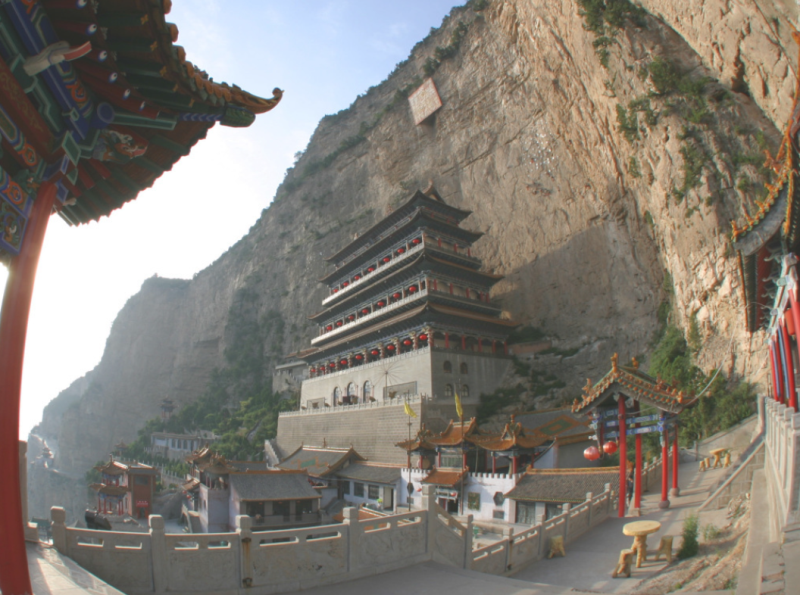
Daluo Palace is the largest Taoist architectural complex in Mianshan. It was first built in the Tang Dynasty and rebuilt in 1998. It covers an area of 30,000 square meters, with a building area of 10,000 square meters. It has 13 floors and is 110 meters high. Built against the mountain, it is magnificent and is known as the "Number One Taoist Temple Under Heaven." The palace enshrines Taoist deities such as the Three Pure Ones and the Jade Emperor. The sculptures are exquisite and the murals are rich. Among them, the "Bagua Diagram" and the "Sixty Jiazi Deities" are distinctive sights. From the top, visitors can overlook the panorama of Mianshan. It is a model of the combination of Taoist culture and architectural art.
Yunfeng Temple
Yunfeng Temple, originally named Baofu Temple, was first built in the Northern Wei Dynasty. It is located under Baofu Rock in Mianshan and is named because the Baofu Rock in the temple can accommodate a thousand people. The temple covers an area of 5,000 square meters. The existing buildings were built in the Ming and Qing dynasties and include the Mahavira Hall and the Guanyin Hall. The temple preserves cultural relics such as Tang Dynasty painted sculptures and Ming Dynasty inscriptions. Among them, the "Kongwang Buddha" statue is 10 meters high and is a Tang Dynasty work. Outside the temple is the "Tianqiao" plank road, more than 300 meters long and less than 1 meter wide, hanging over a cliff of 100 meters. It was a military and transportation route in the Northern Wei Dynasty and is now a popular place for tourists to experience thrilling scenery.
Zhengguo Temple
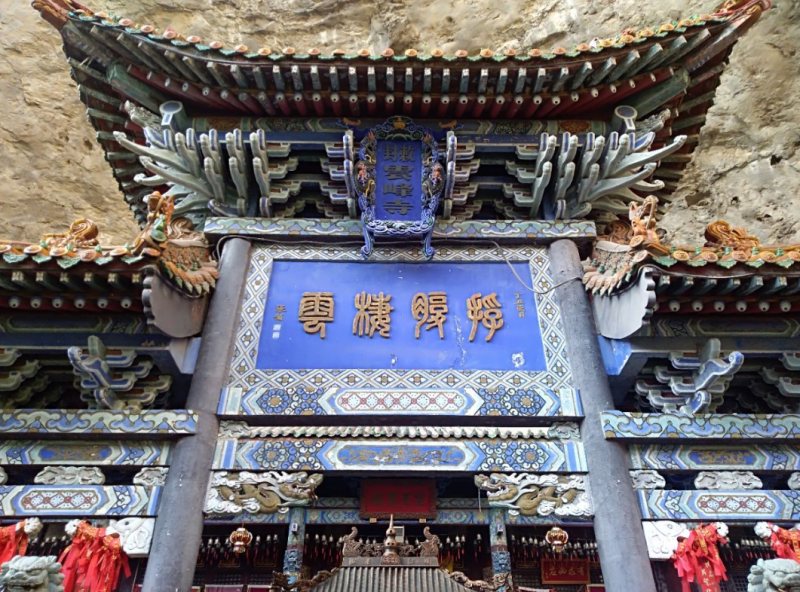
Zhengguo Temple is located in the central part of Mianshan. It was first built in the Tang Dynasty and is famous for preserving 12 flesh-body statues with wrapped bones. These flesh-body statues are Buddhas made from the bodies of eminent monks after their death in the Ming and Qing dynasties. They have remained uncorrupted for hundreds of years and are rare Buddhist flesh-body cultural remains in China. The temple covers an area of 3,000 square meters. The existing halls were rebuilt in the Ming Dynasty. The temple also has Tang Dynasty ancient cypresses and Ming Dynasty murals. Among them, the "Three Bodies Buddha" mural is bright in color and smooth in lines, with high artistic value.
Qixian Valley
Qixian Valley is said to be the place where Jie Zitui and his mother lived in seclusion. It is 3 kilometers long. Inside the valley, strange rocks stand in great numbers and streams murmur. It is known as the "Nine Turns and One-Line Sky." Suspended plank roads and hanging bridges are set up in the valley. Tourists need to pass through the canyon along the plank roads. Along the way, they can view sights such as the "Statues of Jie Zitui and His Mother" and "Candle Peak." The valley is densely vegetated, and the average summer temperature is 23°C. It is a good place for summer retreat and leisure, and it vividly presents the natural environment of Jie Zitui's reclusion.
Longtou Temple
Longtou Temple is the first temple at the entrance of Mianshan. It was first built in the Eastern Han Dynasty. It was originally named Tayantou and is named because the mountain shape resembles a dragon's head. The temple covers an area of 2,000 square meters. The existing buildings were rebuilt in the Qing Dynasty and include the Hall of Heavenly Kings and the Mahavira Hall. In the temple there is a "Tang Cypress," about 1,300 years old, 20 meters high, with a trunk circumference of 3.5 meters and luxuriant branches and leaves. Outside the temple is the "Wangfeng Pavilion," from which visitors can gaze at the main peak of Mianshan in the distance. It is a landmark sight upon entering Mianshan.
Cold Food Square
Cold Food Square is located in the core area of Mianshan and covers an area of 12,000 square meters. It is an important place for commemorating Jie Zitui and carrying forward Cold Food culture. In the center of the square stands a 9.9-meter-high statue of Jie Zitui. Around it are relief walls reflecting Cold Food Festival customs, vividly displaying traditional activities such as "banning fire," "tomb sweeping," and "spring outings." Every year during Qingming Festival, the square holds the "Cold Food Culture Festival," including sacrificial ceremonies, folk performances, and other activities, attracting a large number of tourists.
Food
Mianshan Cold Food Banquet
Mianshan Cold Food Banquet originates from the story of Jie Zitui banning fire. It mainly consists of cold and vegetarian food and is a representative of local food culture. The banquet includes dishes such as cold food porridge, sesame slices, and Zitui cakes. Among them, Zitui cakes are made of jujube paste and flour and are shaped like ears, symbolizing the story of Jie Zitui "cutting flesh from his thigh to feed his lord." In restaurants within the scenic area, a simple Cold Food Banquet costs about 60-80 yuan per person. Visitors can experience the traditional custom of "not lighting a fire and eating cold food" and feel the meaning of Cold Food culture.
Jiexiu Guanchang
Jiexiu Guanchang is a traditional snack around Mianshan. It is made from buckwheat flour, steamed, and cut into strips. It can be eaten cold or stir-fried. Cold guanchang is mixed with vinegar, mashed garlic, chili oil, and other seasonings, and has a smooth texture. Stir-fried guanchang is paired with garlic sprouts and chili and has a rich aroma. It is sold at snack stalls in the scenic area and in restaurants in Jiexiu city. One portion costs about 5-8 yuan. It is a daily food loved by local people.
Mianshan Fried Cake
Mianshan Fried Cake is made by wrapping jujube paste or red bean paste filling in yellow rice dough and frying it until golden. The outer skin is crisp, and the filling is sweet. At snack shops in Mianshan Scenic Area, one portion of fried cakes (4 pieces) costs about 8-10 yuan. It is often eaten as breakfast or dessert and is a traditional food during local festivals, symbolizing "rising step by step."
Nearby Food - Pingyao Beef
Pingyao Beef is a specialty of Pingyao County, Jinzhong City, about 80 kilometers from Mianshan. It is a food worth tasting near Mianshan. It is made from local yellow cattle and prepared through processes such as salting, braising, and boiling. The meat is tender, red in color, and mellow in taste. In Pingyao Ancient City and specialty shops in Mianshan Scenic Area, vacuum-packed Pingyao Beef costs about 80-120 yuan per jin. It is a popular choice for tourists to give to relatives and friends.
Tickets:
Ticket: 160 yuan per person (including shuttle ticket).
You can search for the official WeChat public account "Mianshan Scenic Area" to get the latest updates or buy tickets online.
Opening Hours:
Opening hours adjust with the seasons: from April 1 to October 31, it is peak season, with opening hours from 8:00 to 18:00 (last entry at 17:00); from November 1 to March 31 of the following year, it is off-season, with opening hours from 8:30 to 17:00 (last entry at 16:00). The opening hours of attractions within the scenic area are consistent with those of the scenic area. The last sightseeing bus is one hour before closing. During holidays such as Spring Festival and Qingming Festival, opening hours may be extended, subject to the scenic area's announcement on the day.
Suggested Tour Route:
Recommended route: On the first day, enter from the scenic area entrance in the morning and take the sightseeing bus to Longtou Temple (30 minutes), visiting the Tang Dynasty ancient cypress and temple buildings; then go to Daluo Palace (1.5 hours), climb to the top to overlook the panorama, and experience Taoist culture; have lunch at a restaurant near Daluo Palace. In the afternoon, go to Yunfeng Temple (2 hours), experience the Tianqiao plank road, and visit Baofu Rock and Tang Dynasty painted sculptures; afterward go to Zhengguo Temple (1 hour) to view the flesh-body statues and Ming Dynasty murals.
On the second day, take the sightseeing bus to Qixian Valley in the morning (1.5 hours), walk through the canyon along the plank road, and enjoy the natural scenery; then go to Cold Food Square (1 hour) to learn about Cold Food culture; taste the Cold Food Banquet at noon. In the afternoon, depending on time, you can visit other attractions such as Zhujiawa and Guteng Valley, or buy local specialties, and end the trip. The suggested total tour time is 2 days. If time is tight, you can prioritize the three core attractions of Daluo Palace, Yunfeng Temple, and Qixian Valley, which can be completed in 1 day.
Transportation:
Tourist bus: There is a direct tourist bus to Mianshan from Jiexiu Railway Station, running every hour from 7:00 to 17:00, with a journey of about 30 minutes and a fare of 5 yuan per person; Jinzhong Passenger Transport Terminal also has buses to Mianshan, running every 2 hours from 8:00 to 16:00, with a journey of about 1.5 hours and a fare of 20 yuan per person.
Self-driving: The scenic area parking lot covers about 15,000 square meters and can accommodate 500 small cars. Parking fee is 10 yuan per time (unlimited time). From Jiexiu city, drive south along the Mianshan Tourist Route for about 10 kilometers; from Taiyuan, drive south along the Beijing-Kunming Expressway (G5) to the Jiexiu exit, then turn onto the Mianshan Tourist Route, about 130 kilometers in total, about 2 hours by car.
High-speed rail bus: Take high-speed rail to Jiexiu East Station, then transfer to Jiexiu Bus 302 to Jiexiu Railway Station, then transfer to the tourist bus to Mianshan. The high-speed rail from Taiyuan to Jiexiu East Station takes about 40 minutes, and the bus journey is about 1 hour in total, with a total cost of about 50 yuan per person.
Tourist special line: Tourist distribution centers in cities such as Taiyuan and Xi'an have direct tourist special lines to Mianshan. The journeys are about 2.5 hours and 5 hours respectively. The round-trip fare including tickets is about 260 yuan per person, and can be booked online in advance.
Must-Visit Attractions:
Daluo Palace: 110 meters high, 13 floors, one of the largest Taoist architectural complexes in China. Visitors can climb to the top for sightseeing and experience Taoist culture. Tour time is about 1.5 hours.
Yunfeng Temple: Has a 300-meter-long Tianqiao plank road and Baofu Rock, which can accommodate a thousand people. The Tang Dynasty painted sculptures in the temple are precious cultural relics. It is a representative of the combination of nature and culture. Tour time is about 2 hours.
Qixian Valley: A 3-kilometer-long canyon plank road, with streams and strange rocks along the way. It is the core area for experiencing natural scenery and Jie Zitui's reclusion culture. Tour time is about 1.5 hours.
Travel Suggestions:
The scenic area has many mountain roads and plank roads. It is recommended to wear slip-resistant sports shoes and carry trekking poles (available for rent at the scenic area entrance, 10 yuan each).
During peak season (April-October), there are many tourists. It is recommended to buy tickets online one day in advance to avoid queuing on site. During Qingming Festival, the Cold Food Culture Festival is held, and the flow of people is large, so itineraries should be planned in advance.
The temperature difference between day and night in the mountains is large. Even in summer, a light jacket should be carried. In winter, some sections freeze, so it is recommended to wear ice claws (available for purchase in the scenic area, 20 yuan per pair).
It is recommended to hire a guide (fee 100 yuan for up to 5 people) to explain the historical background at attractions such as Daluo Palace and Yunfeng Temple. The explanation lasts about 3 hours and deepens the travel experience.
There are many accommodation options in the scenic area, ranging from economy guesthouses (about 150-200 yuan per night) to star-rated hotels (about 400-600 yuan per night). It is recommended to book in advance, especially during holidays.
Notes:
The Tianqiao plank road is narrow and steep, and some sections have no railings. Hold the railings firmly when visiting, do not chase or play, and those afraid of heights should proceed with caution.
Smoking and open flames are prohibited in the scenic area, especially in forest areas and temple areas. Violators will be fined 500-2000 yuan.
Photography, touching statues, and touching cultural relics are prohibited in religious places. Etiquette must be observed, and quiet must be maintained.
Carry drinking water and dry food with you. Food and beverages in the scenic area are relatively expensive (for example, bottled water 5 yuan per bottle, boxed meals 30 yuan per portion), and there are no dining spots in areas such as Qixian Valley.
Keep the sightseeing bus pass safe, as it allows multiple rides. Keep your phone sufficiently charged. Signal is weak in some areas, so it is recommended to download offline maps in advance.
In summer, heavy rain or landslides may occur in the mountains. Pay attention to weather forecasts. In severe weather, follow the instructions of scenic area staff and evacuate promptly.