Mount Wutai Scenic Area is located in Wutai County, Xinzhou City, Shanxi Province. It is a national 5A-level tourist attraction, one of China's four great Buddhist mountains (the bodhimanda of Manjushri Bodhisattva), and a World Cultural Heritage site. With Buddhist culture at its core, the scenic area integrates natural landscapes with cultural landscapes and boasts numerous temple complexes, ancient architectural sites, and spectacular peaks and ridges. The scenic area covers a total area of about 607 square kilometers and is formed by five peaks encircling it: East Peak Wanghai, West Peak Guayue, South Peak Jinxiu, North Peak Yedou, and Central Peak Cuiyan. The main peak, North Peak Yedou, has an elevation of 3,061.1 meters, making it the highest peak in North China and earning it the title "Roof of North China." There are 47 existing temples, including 39 inside the platform and 8 outside, most of which are buildings from the Tang, Song, Yuan, Ming, and Qing dynasties. These include 13 nationally protected key cultural heritage sites such as Xiantong Temple, Tayuan Temple, and Pusading Temple, representing a concentrated expression of Chinese Buddhist temple architectural art.
Historical Culture
The Buddhist culture of Mount Wutai dates back to the Eastern Han Dynasty. In the 11th year of Yongping (68 AD), Emperor Ming of Han ordered the construction of Dafu Lingjiu Temple (present-day Xiantong Temple) to commemorate the Indian monks Kasyapa Matanga and Dharmaratna for spreading Buddhism there. This was one of China's earliest Buddhist temples and marked the beginning of Mount Wutai's Buddhist culture. Thereafter, through the development of the Wei, Jin, Southern and Northern Dynasties, it reached its peak during the Sui and Tang dynasties and became a royal bodhimanda. Empress Wu Zetian once sent envoys to Mount Wutai to make offerings to the Buddha, and multiple Tang emperors ordered the reconstruction of temples. The existing Main Hall of Nanchan Temple (built in 782 AD) and the East Main Hall of Foguang Temple (built in 857 AD) are both surviving Tang Dynasty architectural remains and are among China's earliest existing wooden structures, possessing extremely high historical and artistic value.
From the Song Dynasty to the Ming and Qing dynasties, Buddhism at Mount Wutai continued to flourish. Each dynasty bestowed gifts and carried out repairs, forming a pattern in which Han Buddhism and Tibetan Buddhism coexisted. In the Qing Dynasty, emperors such as Kangxi and Qianlong made multiple pilgrimages to Mount Wutai, ordered the construction of temples such as Pusading, and converted them into Yellow Temples (Tibetan Buddhist temples), making Mount Wutai an important hub for cultural exchange between Han and Tibetan Buddhism. The temples preserve a large number of cultural relics, including Buddhist scriptures, stone inscriptions, sculptures, and murals. Among them, the Ming Dynasty bronze Avatamsaka Sutra Pagoda, Tang Dynasty painted sculptures, and Qing Dynasty gilded bronze Buddha statues are especially precious, recording the spread and evolution of Buddhism in China.
In addition to Buddhist culture, Mount Wutai also contains rich folk culture. The "Mount Wutai Horse Fair," held every year in the sixth lunar month, originated in the Qing Dynasty and combines religious sacrifices, material exchange, and folk art performances, becoming a highly distinctive local folk event that demonstrates the integration of Buddhist culture and secular life.
Main Attractions
Xiantong Temple
Xiantong Temple is one of the largest and oldest temples at Mount Wutai. It was first built in the Eastern Han Dynasty under the original name Dafu Lingjiu Temple. Most of its existing buildings were reconstructed during the Ming and Qing dynasties, covering an area of about 80,000 square meters. The main buildings in the temple include the Mahavira Hall, the Beamless Hall, and the Bronze Hall. The Bronze Hall was built in the Ming Dynasty and is 8.3 meters high, 4.7 meters wide, and 4.5 meters deep. It is entirely made of bronze components and enshrines a statue of Manjushri Bodhisattva. It is one of the largest existing bronze structures in China. The Beamless Hall is a brick-and-stone structure with no beams or columns, 20.3 meters high, 28.2 meters wide, and 16 meters deep. It is a model of ancient Chinese brick-and-stone architecture. The temple also preserves precious cultural relics such as a Tang Dynasty bell tower and a Ming Dynasty thousand-bowl bronze statue of Manjushri. In 2001, it was listed as a nationally protected key cultural heritage site.
Tayuan Temple
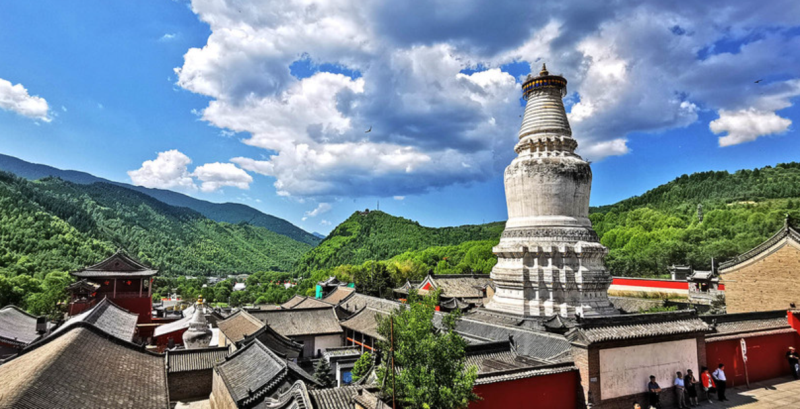
Tayuan Temple is located to the south of Xiantong Temple and is named after the white pagoda inside it. It was first built in the Yuan Dynasty and reconstructed in the Ming Dynasty, covering an area of about 15,000 square meters. The landmark building in the temple, the Great White Pagoda (the Stupa of the True Body Relics of Sakyamuni Buddha), was built in the Yuan Dynasty and is 56.4 meters high. It is entirely white and consists of three parts: the base, the body, and the finial. The body of the pagoda hangs 252 wind bells, which ring in the wind, making it the symbol of Mount Wutai. Tayuan Temple also contains buildings such as the Mahavira Hall and the Scripture Repository Pavilion. The Scripture Repository Pavilion preserves thousands of volumes of Ming Dynasty Buddhist scriptures. As the highest point of Mount Wutai, the Great White Pagoda offers a panoramic view of Taihuai Town from the top and is a must-visit landmark attraction for tourists.
Pusading Temple
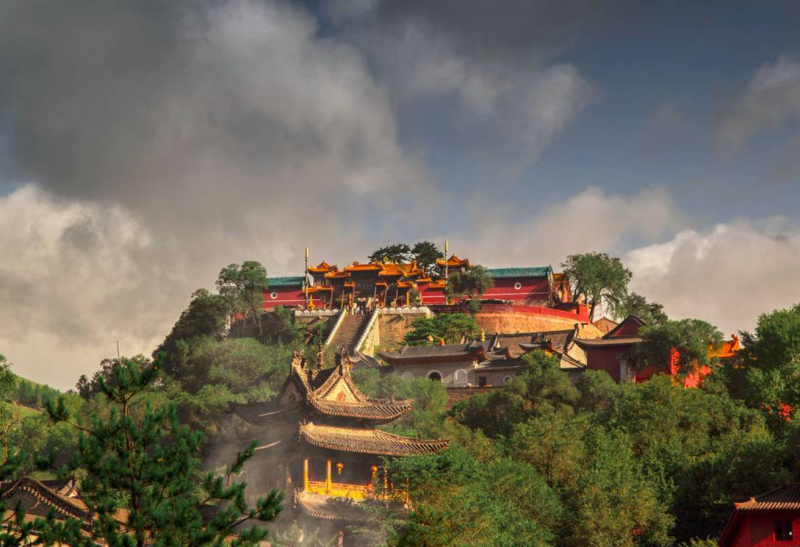
Pusading Temple is located on Lingjiu Peak to the north of Taihuai Town. It was first built in the Northern Wei Dynasty and converted into a Yellow Temple in the Qing Dynasty, becoming the largest Tibetan Buddhist temple at Mount Wutai, covering an area of about 45,000 square meters. The temple is built against the mountain and stands high, earning it the name "Little Potala Palace." Its main buildings include the mountain gate, the Hall of Heavenly Kings, and the Mahavira Hall, all covered with yellow glazed tiles, highlighting the grandeur of a royal temple. In front of the mountain gate are 108 stone steps, symbolizing the 108 afflictions in Buddhism. Climbing the steps leads directly to the mountain gate. The Mahavira Hall in the temple enshrines statues of Sakyamuni, Manjushri, and Samantabhadra Bodhisattva. The offering table in front of the statues is gilded bronze with exquisite craftsmanship. Qing Dynasty emperors Kangxi and Qianlong once stayed here, and relics such as the imperial inscription "Wutai Sacred Realm" still survive.
Nanchan Temple
Nanchan Temple is located in Lijiazhuang Village, Yangbai Township, Wutai County. It was first built in the Tang Dynasty and is China's earliest existing wooden structure, built in the third year of Jianzhong of Emperor Dezong of Tang (782 AD). In 1961, it was listed as a nationally protected key cultural heritage site. The temple covers an area of about 3,078 square meters. Its main building, the Great Buddha Hall, is an original Tang Dynasty structure. It is three bays wide and three bays deep, with a total height of 9.6 meters. It uses a single-eave hip-and-gable roof and a concise beam-frame structure, reflecting the Tang Dynasty architectural characteristic of "taking the material as the standard." The hall preserves 17 Tang Dynasty painted sculptures. The main Buddha, Sakyamuni, is 2.4 meters high, and the statues of disciples and bodhisattvas on both sides are vivid and lifelike, making them masterpieces of Tang Dynasty sculpture. Because the temple is relatively remote, it has not suffered large-scale destruction over a thousand years and completely retains its Tang Dynasty appearance.
Foguang Temple
Foguang Temple is located in Doucun Town, Wutai County. It was first built in the Northern Wei Dynasty. The existing East Main Hall was rebuilt in the 11th year of Dazhong of the Tang Dynasty (857 AD). It is one of the largest existing Tang Dynasty wooden structures in China and, together with Nanchan Temple, is known as one of the "Twin Jewels of Chinese Tang Dynasty Architecture." The East Main Hall is seven bays wide (34 meters), four bays deep (17.66 meters), and 19 meters high, with a single-eave hip roof. The beam frame inside the hall bears a clear inscription of the construction date, making it an important basis for dating Tang Dynasty architecture. The hall preserves 35 Tang Dynasty painted sculptures. The main Buddha, Maitreya, is seated and 5.3 meters high, while the bodhisattvas and guardian warriors on both sides are well-proportioned with flowing drapery. The temple also contains Tang Dynasty stone sutra pillars, tomb pagodas, and the Ming Dynasty Manjushri Hall. In 2001, it was listed as a nationally protected key cultural heritage site. Liang Sicheng and Lin Huiyin once conducted an investigation of it and called it "China's First National Treasure."
Dailuoding
Dailuoding is located to the east of Taihuai Town. It is named because the mountain shape resembles a spiral shell. It has an elevation of 1,040 meters and is an excellent place to overlook the panorama of Mount Wutai. The temple at the summit was first built in the Ming Dynasty and reconstructed in the Qing Dynasty, covering an area of about 12,000 square meters. Its main buildings include the Mahavira Hall and the Hall of the Five Directions' Manjushri. The Hall of the Five Directions' Manjushri enshrines statues of the five forms of Manjushri corresponding to the five peaks, symbolizing that climbing Dailuoding is equivalent to paying homage to all five peaks, hence the name "Little Pilgrimage." From the foot of the mountain to the summit are 1,080 stone steps, about 500 meters long, with multiple rest platforms along the way. Tourists can hike to the top or take the cableway (one way 50 yuan, round trip 85 yuan). From the top, one can gaze at the five peaks in the distance, a spectacular sight.
North Peak Yedou
North Peak Yedou is the main peak of Mount Wutai, with an elevation of 3,061.1 meters. It is the highest peak in North China. Because the summit is covered with snow year-round, it is also called "Qingliang Mountain." At the summit stands Lingying Temple, first built in the Sui Dynasty, with existing buildings reconstructed in the Qing Dynasty. It mainly includes the Manjushri Hall and the Dragon King Hall. The Manjushri Hall enshrines a statue of Stainless Manjushri Bodhisattva. From the summit, one can observe wonders such as the "sea of clouds above the platform" and "millennium ice margins." The average summer temperature is 17°C, making it a summer resort, but the climate is changeable, often with strong winds and fog, so attention should be paid to keeping warm. It is about 25 kilometers from Taihuai Town to the summit of North Peak. Visitors can drive or take the scenic area sightseeing bus (round trip 80 yuan). Along the way, one can enjoy unique natural landscapes such as alpine meadows and cold-resistant plants.
Food
Mount Wutai Vegetarian Cuisine
Mount Wutai vegetarian cuisine is a representative of local Buddhist dietary culture. It uses tofu products, vegetables, and mushrooms as ingredients and imitates the appearance and taste of meat dishes, embodying the concept of "compassion and protecting life." Common dishes include vegetarian chicken, vegetarian duck, vegetarian fish, and Luohan Zhai. Among them, "vegetarian noodles" use ingredients such as Mount Wutai tai mushrooms, tofu, and green vegetables, and have a fresh and savory taste. In the dining halls of temples such as Xiantong Temple and Pusading, or in vegetarian restaurants within the scenic area, a vegetarian meal costs about 50-80 yuan per person. Some temples provide vegetarian meals (advance reservation required, about 20 yuan per person), allowing visitors to experience simple monastic food.
Tai Mushrooms
Tai mushrooms are wild mushrooms native to Mount Wutai. They grow in the grass on the platform tops of Mount Wutai. Because of the cool and humid climate, they are thick and fleshy with a delicious taste and are rich in nutrients such as amino acids. Tai mushrooms can be stir-fried, used in soup, or made into dried goods. Special dishes in restaurants within the scenic area include "stir-fried tai mushrooms" and "tai mushroom stewed chicken" (vegetarian chicken). A portion of stir-fried tai mushrooms costs about 40-60 yuan. Dried tai mushrooms are sold in specialty stores in the scenic area at about 150-200 yuan per jin and are excellent gifts for relatives and friends.
Youmian Kaolaolao
Youmian Kaolaolao is a specialty noodle dish of northern Shanxi and is also a common food around Mount Wutai. It is made from naked oat flour, rolled into rolls, and steamed. It can be eaten with tomato sauce, meat sauce, or a seasoning mixed with vinegar. It has a chewy texture and is nutritious. In restaurants in Taihuai Town, a portion of youmian kaolaolao costs about 15-25 yuan. It is a daily staple for local people and reflects the characteristics of northern cuisine.
Nearby Food - Dingxiang Steamed Meat
Dingxiang steamed meat is a specialty of Dingxiang County, Xinzhou City, about 70 kilometers from Mount Wutai, and is a nearby food worth tasting. It is made from pork, potatoes, and flour and is produced through pickling and steaming. The meat is tender and the aroma is rich. In Dingxiang County and restaurants around the Mount Wutai scenic area, a portion of Dingxiang steamed meat costs about 30-50 yuan and can be eaten with youmian or steamed buns. It is a common dish at local banquets.
Tickets:
Ticket: 135 yuan per person.
You can search for the official public account "Mount Wutai Visitor Service Center" on WeChat to get the latest updates or buy tickets online.
Opening Hours:
Opening hours adjust with the seasons: peak season (April 1 to October 31) is 6:30-20:00; off-season (November 1 to March 31 of the following year) is 7:30-19:00. The opening hours of individual temples vary slightly, generally 8:00-17:00 (extended to 18:00 in summer). Dailuoding cableway operating hours: peak season 8:00-18:00, off-season 9:00-17:00. Platform-top sightseeing bus operating hours: peak season 7:00-18:00, off-season 8:00-16:00. Operations may be suspended in extreme weather, and the specific situation is subject to the scenic area's announcement on the day.
Suggested Itinerary:
Suggested itinerary (3-day tour): On the first day, arrive at Taihuai Town in the morning and first visit Tayuan Temple (1 hour) to see the Great White Pagoda; then walk to Xiantong Temple (1.5 hours) to see the Bronze Hall and Beamless Hall; have lunch in Taihuai Town. In the afternoon, go to Pusading Temple (1 hour), climb the 108 stone steps, and experience the architectural features of Tibetan Buddhism; afterward visit Dailuoding (2 hours, choose hiking or cableway) to overlook the panorama of Taihuai Town, and stay overnight in Taihuai Town.
On the second day, go to Foguang Temple in the morning (about 1 hour by car, 2 hours visiting) to see the Tang Dynasty East Main Hall and painted sculptures; in the afternoon, go to Nanchan Temple (about 10 kilometers from Foguang Temple, 1 hour visiting) to admire China's earliest wooden structure; after returning to Taihuai Town, you can take a night stroll around Taihuai Town and enjoy the night view.
On the third day, take the sightseeing bus to North Peak Yedou in the morning (about 1 hour by car, 1.5 hours visiting) to experience the scenery of the Roof of North China; in the afternoon, return to Taihuai Town, visit the remaining temples (such as Bishan Temple and Wanfo Pavilion), or buy specialties, and end the trip. If time is tight, it can be compressed into a 2-day tour, focusing on Xiantong Temple, Tayuan Temple, Pusading Temple, Dailuoding, and Foguang Temple in Taihuai Town.
Transportation:
Long-distance bus: Taiyuan East Passenger Station has direct long-distance buses to Mount Wutai, one every hour from 6:30 to 16:00, about 3.5 hours, ticket 85 yuan per person; Xinzhou North Passenger Station to Mount Wutai runs every half hour, about 2 hours, ticket 50 yuan per person; Datong to Mount Wutai has 4 buses daily, about 4 hours, ticket 100 yuan per person.
Train: The nearest railway station to Mount Wutai is Shahe Station in Fanshi County, about 50 kilometers from the scenic area. From Shahe Station, you can take a minibus (25 yuan per person, about 1 hour) to Taihuai Town. Beijing, Taiyuan, and other places have direct trains to Shahe Station. Taiyuan to Shahe Station takes about 3 hours, and Beijing to Shahe Station takes about 4.5 hours.
Self-driving: There are parking lots in Taihuai Town and around the main attractions in the scenic area. The charging standard is 5-10 yuan per time (depending on vehicle type). From Taiyuan, take the Erguang Expressway and transfer to the Cangyu Expressway, exit at Mount Wutai, about 230 kilometers in total, about 3 hours by car; from Beijing, take the Jingzang Expressway and transfer to the Daguang Expressway, exit at Mount Wutai, about 380 kilometers in total, about 5 hours by car.
Airplane: The nearest airport is Xinzhou Wutai Mountain Airport, about 80 kilometers from the scenic area. It has opened flights to Beijing, Shanghai, Guangzhou, and other cities. There is a direct tourist shuttle from the airport to the scenic area (60 yuan per person, about 1.5 hours).
Must-Visit Attractions:
Xiantong Temple: The largest temple at Mount Wutai, with China's largest existing bronze hall and rich architectural remains from the Tang Dynasty to the Ming and Qing dynasties. Visiting time is about 1.5 hours.
Tayuan Temple: Marked by the Great White Pagoda, it is the symbol of Mount Wutai. From the top, one can overlook Taihuai Town. Visiting time is about 1 hour.
Foguang Temple: China's largest existing Tang Dynasty wooden structure. The East Main Hall and Tang Dynasty painted sculptures are "national treasure-level" cultural relics. Visiting time is about 2 hours.
Dailuoding: Climb 1,080 stone steps to reach the top for the "Little Pilgrimage" and also enjoy a panorama of Mount Wutai. Visiting time is about 2 hours (including round-trip transportation).
North Peak Yedou: The highest peak in North China, where visitors can experience alpine climate and natural landscapes. Visiting time is about 1.5 hours (including round-trip drive).
Travel Tips:
Mount Wutai has a high altitude and a large temperature difference between day and night. Even in summer, a jacket should be carried; in winter it is cold, with temperatures as low as -20°C, so down jackets and slip-resistant shoes are needed.
It is recommended to hire a local guide (guide fees for temples in Taihuai Town are about 50-100 yuan per time) to gain an in-depth understanding of temple history and Buddhist cultural connotations and avoid a superficial visit.
There are many restaurants and accommodation options in Taihuai Town. Economy hotels cost about 150-300 yuan per night, and star-rated hotels about 400-800 yuan per night. In peak season (July-August, holidays), booking 3-5 days in advance is required.
If planning to visit Nanchan Temple and Foguang Temple, self-driving or chartered cars are recommended (round-trip charter fee from Taihuai Town to the two temples is about 200-300 yuan). Public transportation is limited and schedules are unstable.
Respect Buddhist etiquette: remove hats and avoid noise when entering temples, do not touch Buddha statues, pay attention to signs before taking photos (photography is prohibited in some areas), and burn incense only in designated areas.
Notes:
Smoking and littering are strictly prohibited in the scenic area. Platform tops and forest areas are key fire prevention zones, and open flames are strictly prohibited. Violators will be fined 500-2,000 yuan.
The climate on platform tops such as North Peak is changeable, and strong winds, rain, or heavy fog may suddenly appear. It is recommended to carry a raincoat (umbrellas are inconvenient in strong mountain winds) and warm clothing, and avoid going alone to undeveloped areas.
Religious etiquette must be observed in religious venues: enter with hats removed, do not casually touch offerings or ritual objects, do not enter monks' living areas without permission, and pay attention to prohibition signs before taking photos.
Taihuai Town and the areas around temples are crowded. Keep personal belongings safe, especially valuables such as mobile phones and cameras, and guard against pickpocketing.
Some sections in the scenic area are stone steps or mountain roads, especially the 1,080 steps of Dailuoding and the platform-top areas. They are slippery on rainy days. It is recommended to wear slip-resistant sports shoes. The elderly and frail can use trekking poles.
Dining in the scenic area is relatively expensive. Specialties such as tai mushrooms should be purchased in regular shops, and avoid buying high-priced or counterfeit goods from mobile vendors.
Respect local religious customs. When encountering monks or lamas, politely give way and do not strike up conversations or take photos at will. On religious festivals such as the first and fifteenth days of the lunar month, there are many activities in temples, so follow the guidance of staff.
In winter, some roads may freeze, and sightseeing bus operating hours may be shortened. It is recommended to check weather and traffic information in advance and prepare for slip prevention and warmth.