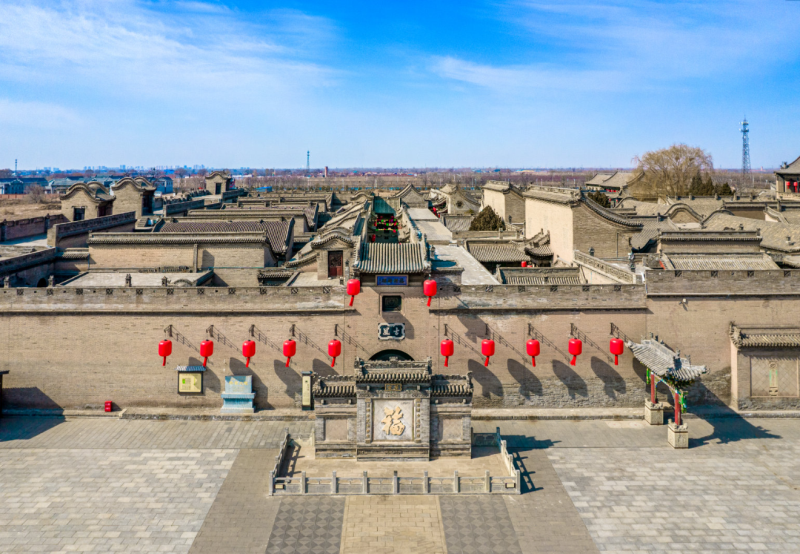
The Qiao Family Compound Cultural Park is located in Qiaojiabao Village, Dongguan Town, Qi County, Jinzhong City, Shanxi Province. It is a national 5A-level tourist attraction and an outstanding representative of northern Chinese residential architecture in the Qing Dynasty. With the Qiao Family Compound as its core, the scenic area integrates Shanxi merchant culture exhibitions, traditional residential sightseeing, and folk custom experiences, and is known as "a pearl of northern residential architecture." The Qiao Family Compound was first built in 1756, with a total area of about 4,175 square meters. It consists of 6 large courtyards, 20 small courtyards, and 313 rooms. Its overall layout forms the shape of the Chinese character "double happiness." Its architectural style combines the rigorous regularity of northern residences with the luxury and refinement of Shanxi merchants. The "three carvings" art of brick carving, wood carving, and stone carving is found throughout the compound, with exquisite craftsmanship and rich themes. The scenic area has now expanded into a cultural park that includes the Qiao Family Compound itself, the Shanxi Merchant Folk Museum, the Shanxi Merchant Theater, and more, with a total area of 2.87 square kilometers. It is an important window for understanding Shanxi merchant culture and traditional northern residences.
Historical Culture
The Qiao Family Compound was the residence of the Qiao family, a Shanxi merchant family. The Qiao family rose to prominence during the Qianlong period of the Qing Dynasty and became famous for businesses such as tea, draft banks, and pawnshops. By the late Qing Dynasty, it had become one of the eight great surnames of Shanxi merchants, with a commercial network spanning the entire country and even extending to places such as Russia and Mongolia. The Qiao family upheld the family motto of "honesty as the foundation, diligence and thrift in managing the household." While doing business, they also attached importance to education. Famous Shanxi merchant representatives such as Qiao Zhiyong emerged from the family, and his business philosophy of "connecting the world through remittance" had a profound impact on the development of China's modern financial industry.
The architectural history of the Qiao Family Compound reflects the rise and fall of the Shanxi merchant family. It was first established during the Qianlong period of the Qing Dynasty and was expanded many times during the Jiaqing, Daoguang, Xianfeng, Tongzhi, and Guangxu periods, forming its current scale. During the Republic of China period, although the Qiao family gradually declined, the compound remained intact and became a typical specimen of northern residential architecture. In 1985, the Qiao Family Compound was opened as the Qi County Folk Museum. In 1990, it became widely known because of the filming of the movie Raise the Red Lantern. The compound houses more than 30,000 cultural relics from the Ming and Qing dynasties to the Republic of China period, including furniture, porcelain, calligraphy and paintings, and coins, systematically displaying Shanxi merchant life and northern folk culture. Among them, the "Rhinoceros Gazing at the Moon Mirror," the "Nine-Dragon Lantern," and the "Myriad-Person Ball" are known as the "Three Treasures of the Qiao Family."
Main Attractions
The Qiao Family Compound Proper
The Qiao Family Compound proper is the core of the scenic area. It faces south and is surrounded by a 10-meter-high blue-brick wall with battlements and watchtowers, making it resemble a castle. The compound is divided into east and west parts by a north-south central axis. The eastern part consists of the Northeast Courtyard and Southeast Courtyard, while the western part consists of the Northwest Courtyard and Southwest Courtyard. The central part contains the ancestral hall and garden. The overall layout forms a "double happiness" pattern, symbolizing good fortune. Each courtyard follows the "siheyuan" layout, consisting of a main house, side houses, and an inverted house. Most buildings have hard-mountain-style roofs and are decorated with exquisite brick-carved gate towers and wooden-carved window lattice. Among them, the "Minglou" of the Northwest Courtyard is the tallest building in the entire compound, 15 meters high and three stories tall. It was originally the Qiao family's accounting office, and from the top one can overlook the entire compound. Among the "three carvings" art in the compound, the brick-carved "Hundred Longevity Chart" screen wall, the wood-carved "Grapes and a Hundred Sons" hanging ornament, and the stone-carved "Fortune, Prosperity, Longevity, and Happiness" column bases are the most famous, demonstrating the superb level of Qing Dynasty folk craftsmanship.
Shanxi Merchant Folk Museum
The Shanxi Merchant Folk Museum is located on the west side of the Qiao Family Compound, covering an area of about 8,000 square meters. It consists of five exhibition halls and systematically displays Shanxi merchant culture through objects, models, multimedia, and other means. The first exhibition hall, "Origins of Shanxi Merchants," introduces the historical background and geographical factors of the rise of Shanxi merchants. The second exhibition hall, "Commercial Network," uses maps and shop models to show the trade routes of Shanxi merchants "traveling west." The third exhibition hall, "Legend of Draft Banks," restores the counter and accounting office scenes of the Qiao family's draft bank and displays the prototype of China's earliest bank. The fourth exhibition hall, "Family Life," displays furniture, clothing, tableware, and other items used by the Qiao family, reflecting the lifestyle taste of Shanxi merchants. The fifth exhibition hall, "Folk Customs," shows the traditional folk customs of the Jinzhong region through restored scenes such as weddings, festivals, and temple fairs. The museum also has an interactive experience area where visitors can participate in activities such as simulated draft bank remittances and traditional abacus calculations.
Qiao Family Ancestral Hall
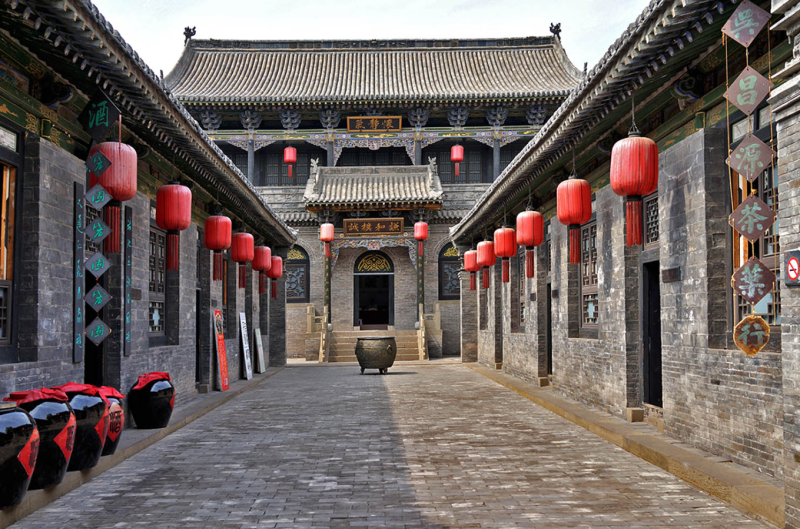
The Qiao Family Ancestral Hall is located at the northern end of the compound's central axis and was the place where the Qiao family worshipped their ancestors. It covers an area of about 500 square meters and consists of a gate tower, main hall, and side rooms. The gate tower has a single-eave hip-and-gable roof, with the inscription "Glorify the Past and Enrich the Future" on the lintel and brick carvings of the "Twenty-Four Filial Exemplars" on both sides, with delicate craftsmanship. The main hall enshrines the ancestral tablets of successive generations of the Qiao family. In the center is the tablet of the Qiao family's founding ancestor, Qiao Guifa. Sacrificial vessels such as bronze tripods and incense burners are placed on both sides. The ancestral hall originally held ancestor worship ceremonies every Qingming and winter solstice. This tradition has now been restored, and visitors can watch ritual performances and learn about the patriarchal system and filial piety culture of Shanxi merchant families. In the courtyard in front of the ancestral hall are two ancient cypress trees, about 200 years old, with luxuriant branches and leaves, symbolizing the prosperity of the family.
Garden
The garden is located south of the ancestral hall and connected to various courtyards. It covers an area of about 1,200 square meters and was a place for leisure and entertainment for the Qiao family. The garden combines the styles of northern and southern gardens, with landscapes such as rockeries, ponds, pavilions, and covered corridors. Koi are raised in the pond, and the "Inviting the Moon Pavilion" is built on the rockery, where one can enjoy the moon and the scenery. The garden is planted with flowers and trees such as crabapple, magnolia, and peony. In spring, flowers bloom in abundance, contrasting beautifully with the blue bricks and gray tiles of the buildings. The "Listening to Rain Studio" on the east side of the garden was where the Qiao family master enjoyed tea and discussed matters. It is furnished with Qing Dynasty tables and chairs, and a map of the Qiao family's business routes hangs on the wall, showing the elegant life of Shanxi merchants beyond their busy commercial affairs.
"Encore Pingyao" Theater (Related Attraction)
Although the "Encore Pingyao" Theater is not located within the Qiao Family Compound, as an important extension of the Shanxi merchant cultural experience, it is about 30 kilometers away from the Qiao Family Compound and is a large-scale live-performance venue directed by the famous director Wang Chaoge. The theater covers an area of about 15,000 square meters. The performance is based on a legendary story of a Shanxi merchant draft bank and allows the audience to travel back to the ancient city of Pingyao in the Qing Dynasty through an immersive experience, feeling the honesty and sense of responsibility of Shanxi merchants. The performance lasts about 90 minutes and is held at 14:00 and 19:00 every day. Together with the Qiao Family Compound, it forms a linked route of "residential sightseeing cultural experience." Many tourists combine the two in one trip.
Food
Pingyao Beef
Pingyao beef is the most famous food around the Qiao Family Compound. It is a traditional famous dish of Jinzhong, Shanxi, with a history of more than 1,000 years. It is made from locally raised yellow cattle and prepared through the processes of "pickling, boiling, and smoking." The finished product is red and glossy, with tender meat that remains chewy without being tough and has no gamy or muttony smell. In restaurants in Qiaojiabao Village, Pingyao beef can be served as a cold sliced platter (about 200 grams per plate, priced at 30 yuan), or used in stir-fries and soups. The Shanxi Merchant Restaurant in the scenic area offers "beef hot pot," in which beef is cooked together with local pickled vegetables and tofu. The flavor is unique and suitable for autumn and winter. A portion for four people costs about 180 yuan.
Youmian Kaolaolao
Youmian Kaolaolao is a traditional noodle dish in northern and central Shanxi and is commonly found in farm restaurants around the Qiao Family Compound. It is made from naked oat flour, rolled by hand into rolls shaped like a honeycomb, and eaten after steaming with mutton soup or tomato and egg gravy. It has a chewy texture and is rich in protein and dietary fiber. Naked oats are a cold-resistant local crop suitable for growing in mountainous areas and were also a portable dry food for Shanxi merchants when traveling. A portion of Youmian Kaolaolao is about 300 grams and costs 18 yuan. It can be eaten with vinegar or chili. In summer, it is refreshing when mixed with shredded cucumber.
Taigu Cake
Taigu Cake is a specialty of Taigu County, Shanxi, about 50 kilometers from the Qiao Family Compound, and is a souvenir that tourists often bring back. It is made from flour, white sugar, and flaxseed oil and baked into a round shape about 10 centimeters in diameter and 2 centimeters thick. The outer crust is crisp, the inside is soft, and it has a sesame aroma. Taigu Cake has a shelf life of about 15 days. In shops in the Qiao Family Compound scenic area, each bag (10 pieces) costs about 25 yuan. It is said to have been a household snack of Taigu Shanxi merchants in the Qing Dynasty. Because it is easy to carry and sweet in taste, it became a snack for Shanxi merchants when traveling for business.
Tickets:
Tickets are 115 yuan per person.
You can search for the official public account "Qiao Family Compound Cultural Park" on WeChat to get the latest updates or buy tickets online.
Opening Hours:
Opening hours are: April 1 to October 31 (peak season) 8:00-18:30, with last entry at 17:30; November 1 to March 31 of the following year (off-season) 8:30-17:30, with last entry at 16:30. The guided tour service hours in the scenic area are consistent with the opening hours. Opening hours may be extended on holidays, subject to the scenic area's announcements.
Tour Routes:
Half-day tour route: Enter from the South Gate of the scenic area and first visit the Qiao Family Compound proper. Along the central axis, visit the Southeast Courtyard (folk customs exhibition), Southwest Courtyard (calligraphy and painting exhibition), ancestral hall, garden, Northwest Courtyard (Qiao family history exhibition), and Northeast Courtyard (treasures exhibition), focusing on the "Three Treasures of the Qiao Family" and the "three carvings" art. This takes about 2 hours. Then go to the Shanxi Merchant Folk Museum to learn about the development history of Shanxi merchants and participate in interactive experience projects, which takes about 1 hour. Finally, buy specialties such as Taigu Cake on the scenic area commercial street. The entire route takes about 3.5 hours.
One-day tour route: In the morning, tour the Qiao Family Compound according to the half-day route. At noon, taste Pingyao beef, Youmian Kaolaolao, and other foods in Qiaojiabao Village. In the afternoon, go to Pingyao Ancient City (about 40 kilometers from the Qiao Family Compound, about 1 hour by car) and visit attractions such as the Pingyao Ancient City Wall, Rishengchang Draft Bank, and the County Government Office to experience the continuation of Shanxi merchant culture. In the evening, watch the live performance "Encore Pingyao" to enrich the cultural experience.
Transportation:
Self-driving: From Taiyuan, take the Beijing-Kunming Expressway (G5), exit at Qi County, turn onto Provincial Road 221 and drive about 10 kilometers to reach the Qiao Family Compound. The total distance is about 80 kilometers, and the drive takes about 1.5 hours. From Pingyao Ancient City, drive about 40 kilometers along the Beijing-Kunming Expressway toward Taiyuan, exit at Qi County, and the drive takes 50 minutes. The scenic area parking lot charges 5 yuan per entry (small vehicles).
Public transportation: Taiyuan Jiannan Bus Station has a bus to Qi County every 30 minutes. The ride takes 1.5 hours, and the fare is 20 yuan per person. After arriving in Qi County, transfer to a taxi (about 15 yuan) or the Qi County-to-Dongguan Town bus (3 yuan) to reach the scenic area. The Jinzhong city area (Yuci) bus station has direct buses to the Qiao Family Compound at 9:00 and 14:00 every day. The ride takes 1 hour, and the fare is 15 yuan per person.
Tourist routes: Travel agencies in Taiyuan, Pingyao, and other places offer one-day tours to the Qiao Family Compound, including transportation, tickets, and guide services, priced at about 150-200 yuan per person. Some routes also connect to Pingyao Ancient City and are suitable for multi-attraction tours.
Must-Visit Attractions:
Qiao Family Compound Proper: A total area of 4,175 square meters, 313 rooms, a "double happiness" layout, exquisite "three carvings" art, and the "Three Treasures of the Qiao Family" (Rhinoceros Gazing at the Moon Mirror, Nine-Dragon Lantern, Myriad-Person Ball) as the treasures of the compound, showcasing the peak level of northern residential architecture in the Qing Dynasty.
Shanxi Merchant Folk Museum: An 8,000-square-meter exhibition area, more than 30,000 cultural relics, systematically displaying Shanxi merchant business history and folk culture, with rich interactive experiences.
Qiao Family Ancestral Hall: A 500-square-meter sacrificial site, with the "Glorify the Past and Enrich the Future" gate tower and "Twenty-Four Filial Exemplars" brick carvings, reflecting the patriarchal system and filial piety culture of Shanxi merchant families.
Travel Suggestions:
It is recommended to hire a scenic area guide (50 yuan per time for groups of fewer than 10 people), or rent an electronic guide device (20 yuan per unit), in order to gain a deeper understanding of architectural details and Shanxi merchant stories. The guided tour lasts about 1.5 hours.
The best seasons for visiting are April-May (spring flowers in bloom) and September-October (clear autumn weather). In summer, pay attention to sun protection. In winter, you can experience the winter atmosphere of northern residences, and there are fewer tourists.
Photography suggestions: Shoot panoramic views of the compound in the soft light of early morning or evening, focusing on capturing brick-carved gate towers, red lanterns, and the combination of architectural light and shadow. The filming location of Raise the Red Lantern (Northwest Courtyard) is a popular shooting spot.
For dining, "Qiao Family Old Kitchen" in Qiaojiabao Village is recommended, with an average consumption of about 60 yuan per person. You can taste Pingyao beef, braised pork, and other Shanxi dishes, with better value than restaurants inside the scenic area.
If time permits, it is recommended to visit Pingyao Ancient City and the Wang Family Compound together to form a "Shanxi Merchant Culture Golden Triangle" tour and fully experience the profound heritage of Shanxi merchant culture.
Notes:
Smoking, touching cultural relics, and climbing buildings are prohibited in the scenic area. Photography is prohibited in some exhibition halls (where there are clear signs). Regulations must be followed to protect cultural heritage.
During peak season (holidays, summer vacation), there are many tourists. It is recommended to avoid the peak period from 10:00 to 15:00 and choose early morning or evening for a better experience.
Prices for goods on the scenic area commercial street are relatively high. When buying specialties, pay attention to comparing prices. For Taigu Cake, Pingyao beef, and other products, it is recommended to choose regular brand packaged products for easier storage and carrying.
Accommodation conditions around Qiaojiabao Village are limited. If planning to stay overnight, you can choose Qi County town or Pingyao Ancient City, which have more accommodation options and better-value dining.
Respect local customs. Keep quiet when entering places such as the ancestral hall. Observe order when watching folk performances and do not disturb performers or staff members casually.