The Hukou Waterfall Tourism Area on the Yellow River is located at the border between Yichuan County, Yan'an City, Shaanxi Province, and Ji County, Linfen City, Shanxi Province. It is a national 5A-level tourist attraction and the only large canyon waterfall on the Yellow River. The scenic area is centered on the majestic waterfall landscape and also features canyon landforms and Yellow River culture. It is known as "the Heart of the Yellow River and the Soul of the Nation." The total area of the scenic spot is about 100 square kilometers, with the core viewing area covering about 3.5 square kilometers. The waterfall is about 30-50 meters wide (reaching up to 100 meters during flood season), with a drop of about 9 meters and an average flow of 1,000 cubic meters per second (maximum flow during flood season exceeds 3,000 cubic meters per second). The steep rock walls on both banks form the unique landscape of "a thousand miles of the Yellow River gathered into one pot," making it one of the most representative natural and cultural dual-heritage scenic areas in the Yellow River basin.
Historical Culture
The area around Hukou Waterfall on the Yellow River is one of the birthplaces of the Chinese nation. Human activity dates back to the Neolithic Age, and pottery, stone tools, and other cultural relics found at the sites confirm its close connection with Yangshao Culture and Longshan Culture. According to ancient texts such as the Book of Documents and Commentary on the Waterways Classic, Hukou Waterfall, as a natural barrier on the Yellow River, served as a military fortress and transportation route through successive dynasties, leaving behind many historical remains.
Hukou Waterfall is an important symbol of Yellow River culture, carrying the national spirit of "self-improvement and courage to move forward." Legend has it that when Yu the Great controlled the floods, he "cut through the rocks to guide the river" here, and related legendary sites such as "Yu's Hat Peak" still exist. During the War of Resistance Against Japan, the poet Guang Weiran, after witnessing the magnificent waterfall here, created the "Yellow River Cantata," which became a spiritual banner inspiring national fighting spirit. In addition, local folk arts such as "Yellow River Work Songs" and "Hukou Drum Fighting" have been included in the national intangible cultural heritage list. The annual "Yellow River Culture Tourism Festival" attracts a large number of tourists.
Main Attractions
Main Hukou Waterfall
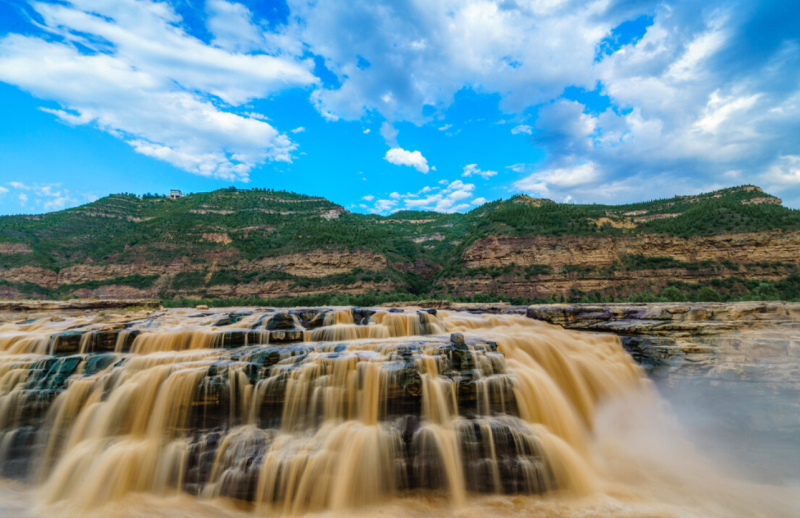
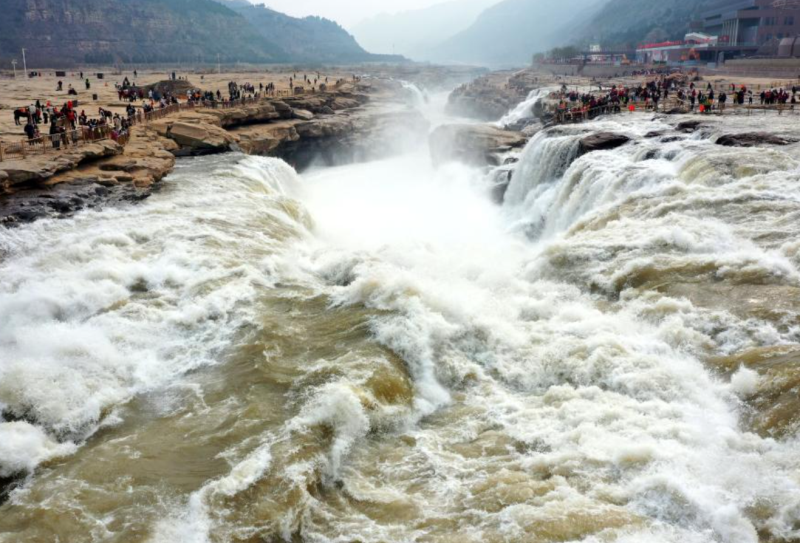
The main Hukou Waterfall is the core landscape of the scenic area, located in the middle section of the canyon on the middle reaches of the Yellow River. Because the riverbed suddenly narrows, the river water plunges from a channel about 300 meters wide into a stone trough only 30-50 meters wide, creating a spectacular scene of "suspended torrents splashing against the walls, like ten thousand horses galloping." The main waterfall has a drop of about 9 meters. The mist produced by the water hitting the rocks can reach dozens of meters, and rainbows often appear under sunlight. The three most famous wonders are "smoke rising from the water," "boats traveling on dry land," and "rainbow reaching the sky." In winter, the waterfall forms an ice waterfall landscape, crystal clear and in sharp contrast to the surging scene in summer. The main waterfall viewing platform is about 50 meters from the waterfall, covers about 800 square meters, and is equipped with safety railings and interpretive signs, making it convenient for tourists to view and learn about the geological formation.
Dragon Cave
Dragon Cave is an excellent spot for viewing Hukou Waterfall. It is located in the rock wall below the waterfall and is a man-made semi-underground passage about 50 meters long, 2 meters wide, and 2.5 meters high, with its bottom level with the Yellow River's water surface. Through Dragon Cave, visitors can reach directly beneath the waterfall, look up at the shocking scene of the river pouring down, and experience the immersive feeling of "sound shaking for miles and mist rushing against the face." At the entrance of Dragon Cave, there are more than 300 steps. The cave is damp year-round and has a low temperature, so visitors should be careful of slippery surfaces. The entire visit takes about 20 minutes.
Mengmen Mountain
Mengmen Mountain is a small island in the Yellow River, located about 1.5 kilometers downstream from Hukou Waterfall. It covers about 1,500 square meters and consists of two huge rocks exposed above the water. Legend says it was a "river-suppressing stone" set up by Yu the Great when he controlled the floods. Mengmen Mountain divides the Yellow River into two streams, with gentle water flow, forming a contrast between movement and stillness with the surging waterfall upstream. On the island stands the "Mengmen Pavilion," with a stone inscription reading "Crouching to Suppress the Wild Current." It is the best spot for viewing the "Mengmen Night Moon" landscape. The wooden walkway connecting Mengmen Mountain to the riverbank is about 800 meters long, and along the way visitors can observe the canyon landforms of the Yellow River.
Yu the Great Temple
Yu the Great Temple is located on the mountainside on the north side of the scenic area. It was first built in the Han Dynasty, and the existing buildings are Ming and Qing reconstructions. It covers about 1,200 square meters and consists of a main hall, side halls, bell and drum towers, and other structures. The main hall enshrines a statue of Yu the Great, and the murals on both sides depict scenes of flood control and are well preserved. In front of the temple stands a thousand-year-old cypress, about 15 meters tall with a trunk diameter of 1.2 meters. It is said to have been planted by Yu the Great himself. Yu the Great Temple is a place where local people offer sacrifices to the hero who controlled the floods. A traditional temple fair is held every year on the twenty-eighth day of the third lunar month (Yu the Great's birthday).
Ancient Yellow River Ferry Crossing
The Ancient Yellow River Ferry Crossing is located about 3 kilometers upstream from Hukou Waterfall. It was an important dock for Yellow River shipping during the Ming and Qing dynasties. Remaining today are the ancient dock site, trackers' plank road, old business firm sites, and other relics, covering about 2,000 square meters. The ancient ferry crossing was once famous for "boats traveling on dry land" (boats dragged along the riverbank to bypass the waterfall). In the site, there remain rope wear marks about 30 centimeters in diameter from the trackers pulling boats. The scenic area has restored ancient ferry boat models here and uses text and images to display the history of Yellow River shipping, allowing visitors to understand the former prosperity of "boats and oars gathering like clouds."
Food
Yellow River Carp
Yellow River carp is a specialty dish around Hukou. It uses wild Yellow River carp (about 50 centimeters long and weighing 1-2 kilograms). After preparation, it is braised with locally produced chili peppers, Sichuan pepper, scallions, ginger, and other seasonings. The meat is tender and fresh, the sauce is rich, and it has a unique river-fresh flavor. In farmhouse restaurants around the scenic area, Yellow River carp is priced by weight at about 120 yuan per kilogram. It is eaten with corn cakes dipped in the sauce and is a famous local dish for entertaining guests, carrying the auspicious meaning of "abundance year after year."
Buckwheat Heluo
Buckwheat Heluo is a traditional noodle dish in northern Shaanxi and southern Shanxi and is commonly found in restaurants in the Hukou scenic area. It is made from buckwheat flour, pressed into strips with a heluo press, boiled, and then served with mutton soup or vegetarian gravy. It has a chewy texture and is nutritious. Buckwheat is a major local coarse grain crop, rich in dietary fiber and suitable for healthy eating. A bowl of buckwheat heluo weighs about 200 grams and costs about 15 yuan. It is often chosen by tourists as a staple food. It can be eaten cold in summer and in hot soup in winter, with different flavors.
Fried Cake
Fried cake is a traditional snack around the scenic area. It is made by fermenting soft yellow millet flour, wrapping it with jujube paste, red bean paste, or vegetable filling, and frying it until golden and crispy. The fried cakes in the Hukou area are characterized by their large size (about 8 centimeters in diameter) and thin outer skin. The filling mostly uses locally produced beach jujubes, with moderate sweetness. At snack stalls at the scenic area entrance, each fried cake costs about 3 yuan. Eaten with millet porridge, it is a daily breakfast for local people and an essential food during festivals, symbolizing "rising step by step."
Tickets:
Tickets are 100 yuan per person.
For the Shanxi entrance, you can search for the official WeChat public account "Shanxi Yellow River Hukou Waterfall Tourism Area" to get the latest updates or buy tickets online.
For the Shaanxi entrance, you can search for the official WeChat public account "Yellow River Hukou Waterfall Tourism Area" to get the latest updates or buy tickets online.
Opening Hours:
Opening hours adjust with the seasons: from April 1 to October 31, it is peak season, with opening hours from 7:00 to 18:00 and last entry at 17:00; from November 1 to March 31 of the following year, it is off-season, with opening hours from 8:00 to 17:00 and last entry at 16:00. In case of extreme weather such as heavy rain or floods, the scenic area may temporarily close.
Tour Routes:
Shaanxi-side tour route: From the scenic area entrance, take the sightseeing bus (about 5 minutes) to the main waterfall viewing platform to enjoy the panoramic view of Hukou Waterfall; then walk to the entrance of Dragon Cave and go down to view the waterfall from below; after leaving Dragon Cave, follow the walkway to Mengmen Mountain and visit the island landscape; finally return to the sightseeing bus stop and go to the Ancient Yellow River Ferry Crossing site. The whole trip takes about 3-4 hours.
Shanxi-side tour route: From the entrance, you directly reach the main waterfall viewing platform (no sightseeing bus needed) to enjoy the frontal view of the waterfall; then walk along the "Yellow River Walkway" to the "Kenanpo" attraction (the site of Yan Xishan's command post during the War of Resistance Against Japan); after returning, you can watch the "Hukou Drum Fighting" performance (one show each day at 11:00 and 15:00). The whole trip takes about 3 hours. Visitors can choose a one-side tour or a cross-province tour according to their interests (note that the entrances of the two provinces are not connected, and tickets must be purchased separately).
Transportation:
Self-driving: From Xi'an, take the Baomao Expressway and Qinglan Expressway to the Yichuan exit, then follow the scenic area special road for about 15 kilometers to reach the Shaanxi-side entrance. The total distance is about 300 kilometers, and the drive takes 4 hours. From Taiyuan, take the Qingyin Expressway and Qinglan Expressway to the Ji County exit, then transfer to the scenic area road for about 10 kilometers to reach the Shanxi-side entrance. The total distance is about 350 kilometers, and the drive takes 4.5 hours. The scenic area parking lot charges 5 yuan per time (small vehicles).
Long-distance bus: Yan'an Bus Station has buses to Yichuan County at 8:00 and 10:00 every day. The trip takes 2 hours and the fare is 35 yuan per person. Then transfer to the Yichuan-to-Hukou bus (one bus every hour, trip time 40 minutes, fare 15 yuan per person). Linfen Yaomiao Bus Station has a direct bus to the Shanxi-side scenic area at 9:00 every day. The trip takes 3 hours and the fare is 50 yuan per person.
Tourist special lines: Travel agencies in Xi'an, Taiyuan, Yan'an, and other cities offer one-day Hukou Waterfall tour routes, including transportation, tickets, and guide services. The price is about 200-300 yuan per person, suitable for tourists with limited time.
Must-Visit Attractions:
Main Hukou Waterfall: 30-50 meters wide, 9-meter drop, wonders such as "smoke rising from the water" and "rainbow reaching the sky," different scenery in all four seasons, and a landmark landscape of the Yellow River.
Dragon Cave: A semi-underground passage below the waterfall, 50 meters long, where you can look up at the pouring waterfall and immersively experience the shocking effects of "sound, light, and mist."
Mengmen Mountain: A natural small island in the Yellow River, 1.5 kilometers from the main waterfall, where you can view the "Mengmen Night Moon" and learn about the history of Yellow River geological evolution.
Ancient Yellow River Ferry Crossing: A Ming and Qing shipping site, with preserved trackers' plank road and ferry boat models, showing the historical appearance of Yellow River shipping.
Travel Suggestions:
The best time to visit is April-May (peach blossom flood) and September-October (autumn flood), when the water volume is large and the waterfall landscape is most spectacular; in winter, you can view the ice waterfall, with fewer people and a quiet scene.
The ultraviolet rays in the scenic area are strong, so sunscreen products are needed in summer; the waterfall mist is heavy, so it is recommended to bring a raincoat (sold in the scenic area for 10 yuan each) to prevent cameras and other equipment from getting damp.
The Shaanxi side offers a more comprehensive viewing angle and is suitable for taking panoramic photos of the waterfall; the Shanxi side has "Yellow River Work Songs" performances and is suitable for experiencing folk culture. You can choose according to your needs.
For dining, farmhouse restaurants around the scenic area are recommended, with an average consumption of about 50 yuan per person. In addition to specialty foods, you can try local dishes such as "Yellow River catfish" and "steamed yellow rice."
If time permits, you can visit nearby attractions in sequence, such as the Yellow Emperor's Mausoleum on the Shaanxi side (about 100 kilometers from the scenic area) and Pingyao Ancient City on the Shanxi side (about 200 kilometers from the scenic area).
Precautions:
When viewing, be sure to stand inside the safety railings and do not approach the edge of the cliff. During flood season (July-August), the water volume is large, and some walkways may be closed. Please follow the guidance of staff.
Dragon Cave is slippery and steep inside. Hold the railings firmly when going up and down the steps. Elderly people and children are advised to be accompanied by family members, and running and crowding should be avoided.
UAV aerial photography is prohibited in the scenic area, and littering is prohibited. Yellow River water resources are strictly protected, and playing in the water or fishing is strictly prohibited.
The entrances of the scenic areas in the two provinces are independent. Self-driving tourists should pay attention to distinguishing the directions of Yichuan, Shaanxi, and Ji County, Shanxi, to avoid taking the wrong route. Cross-province tours require purchasing tickets again and allowing enough travel time.
In winter, the temperature in the scenic area is low (can be below -10°C), so warm clothing is needed; after heavy rain in summer, roads may become muddy, so self-driving requires cautious driving.