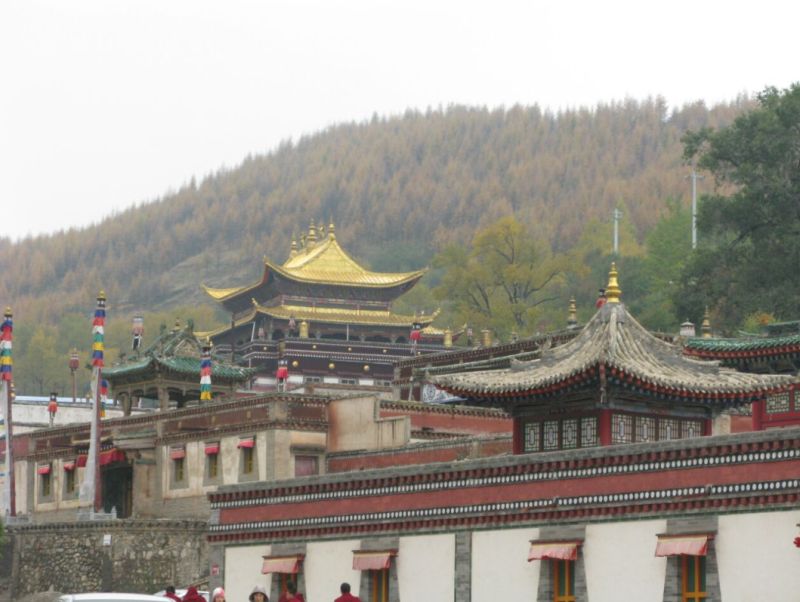
Kumbum Monastery is located in Lushar Town, Huangzhong District, Xining City, Qinghai Province, China, about 25 kilometers from the center of Xining. It is one of the six great monasteries of the Gelug school of Tibetan Buddhism and was rated a National 5A Tourist Attraction in 2012. The scenic area covers about 450,000 square meters and has more than 9,300 buildings and structures of various types. The architectural complex is built along the mountain, distributed across a gully and two slopes of Lotus Mountain, and blends Han and Tibetan architectural styles.
Kumbum Monastery is famous for its "Three Arts"—murals, barbola, and butter sculptures. It also houses a large collection of Buddhist scriptures and academic works in history, philosophy, medicine, and other fields, making it an important treasure house of Tibetan religious culture.
History and Culture
Kumbum Monastery was built because it is the birthplace of Tsongkhapa, the founder of the Gelug school. According to legend, when Tsongkhapa was born, a white sandalwood tree grew from the place where his umbilical cord blood dripped, and the leaves displayed the image of the Lion's Roar Buddha. In the twelfth year of the Hongwu reign of the Ming Dynasty (1379), his mother, Shazha Achai, with the help of believers, built the "Lotus Gathering Stupa" using the sandalwood tree and the Lion's Roar Buddha statue sent by Tsongkhapa as the sacred contents. This was the earliest building of Kumbum Monastery.
In the thirty-ninth year of the Jiajing reign of the Ming Dynasty (1560), the Chan Master Rinchen Zangpo Gyaltsen built a meditation hut beside the stupa to gather monks for meditation. In 1577, the Maitreya Buddha Hall was added. Kumbum Monastery then began to take shape and was named "Gonben Xianba Ling" (meaning "Monastery of the Ten Thousand Buddha Images Maitreya Continent"). After that, it underwent multiple expansions, and in the 17th century its scale expanded significantly under the leadership of the Fourth Panchen Lama, Lobsang Danjin.
In 1949, the Tenth Panchen Erdeni Choekyi Gyaltsen held his enthronement ceremony here. In 1961, Kumbum Monastery was listed by the State Council as one of the first batch of Major Historical and Cultural Sites Protected at the National Level, becoming an important religious and cultural heritage site.
Main Attractions
Great Golden Tile Hall
In Tibetan, "Sedong Qinmo." It is the main hall of Kumbum Monastery, first built in 1379, with a building area of 456 square meters. The hall enshrines a 12.5-meter-high Great Golden Stupa commemorating Master Tsongkhapa. The top of the stupa is covered with gilded copper tiles, and the roof ridge is decorated with auspicious ornaments such as treasure vases and golden deer. The outer walls are inlaid with bianma copper mirrors. The hall also houses precious cultural relics such as thangkas and scriptures, as well as the dharma body statue of the Ninth Panchen Lama and the reliquary stupas of eminent monks.
Great Sutra Hall
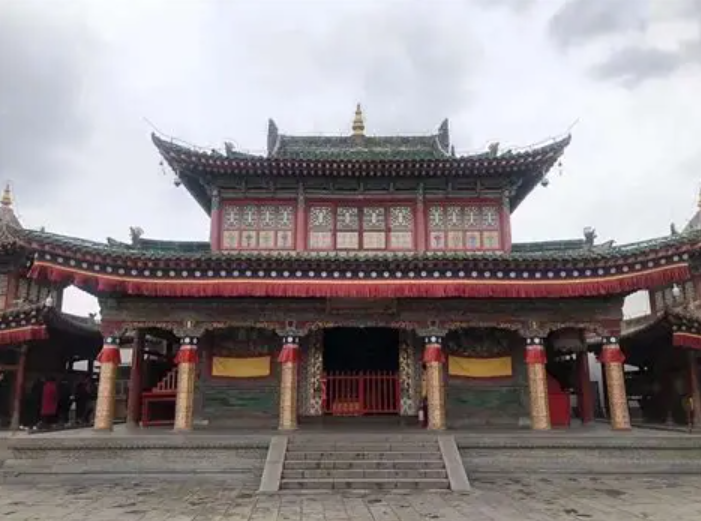
In Tibetan, "Tshogchen Dukhang." It is the largest sutra hall in the whole monastery, first built in 1612, with a building area of 2,750 square meters and capable of accommodating more than 2,000 monks chanting sutras. The hall has 168 Tibetan-style prismatic columns, and the roof is decorated with gilded treasure vases. It enshrines statues of Maitreya, Tsongkhapa, and other Buddhas. The four walls are painted with murals of Buddhist stories. It is the main activity site of the Exoteric College.
Small Golden Tile Hall
In Tibetan, "Tsangkhang Qinmo." It was first built in 1692 and is a two-story building combining Tibetan and Han styles. The outer walls are decorated with copper mirrors and bianma. The hall enshrines statues of five protector deities. The corridor displays specimens of wild animals such as wild oxen, tigers, and leopards. The second floor enshrines a statue of Padmasambhava, and the third floor enshrines statues of Tsongkhapa and his two disciples.
Eight Auspicious Stupas
Located in the square in front of the monastery, it consists of eight white stupas symbolizing the eight great merits of Shakyamuni, built in 1776. The stupas are white and varied in shape, respectively representing the Buddha's birth, enlightenment, first turning of the Dharma wheel, and other deeds. It is one of the landmark sights of Kumbum Monastery.
Butter Sculpture Hall
The hall displays butter sculptures, one of the "Three Arts of Kumbum Monastery." The works are molded from butter mixed with mineral pigments, and their subjects include Buddhas, landscapes, flowers and birds, and more. Production requires several months in a low-temperature environment. The craftsmanship is exquisite and of high artistic value.
Food
Tibetan Yogurt
Made by fermenting yak milk, it is thick in texture and mellow in sourness, often sprinkled with white sugar or honey for seasoning. It is rich in probiotics and highly nutritious. It can be tasted at Tibetan-style restaurants around the scenic area.
Hand-grabbed Mutton
A traditional famous dish of Qinghai. It uses local mutton boiled in clear water to retain its original flavor. The meat is tender and is eaten with garlic paste and pepper salt. It is fatty but not greasy. Authentic flavors can be experienced at halal restaurants near the scenic area.
Niangpi
A cold noodle made from wheat flour or mung bean flour, mixed with chili oil, vinegar, garlic paste, and other seasonings. It has a smooth, refreshing, and chewy texture and is sour, spicy, and appetizing. It is a common local snack available at street stalls and restaurants.
Tianpei
Made by fermenting highland barley or naked oats, it has a clear, sweet wine aroma and a soft, glutinous texture. It helps relieve heat and satisfy hunger. It can be purchased at snack shops around the scenic area.
Tickets:
Tickets are 70 yuan per person.
You can search for the official public account "Kumbum Monastery" on WeChat to get the latest updates. As of July 17, 2025, the official WeChat public account does not provide an online ticket purchasing function.
Opening Hours:
Open all year round, daily 08:00–17:00.
Opening hours may be adjusted with seasonal changes. Please refer to the actual announcements of the scenic area.
Recommended Tour Route:
Recommended route: Entrance → Eight Auspicious Stupas → Small Golden Tile Hall → Great Sutra Hall → Great Golden Tile Hall → Maitreya Buddha Hall → Butter Sculpture Hall → Kalachakra College → Scripture Library
The whole journey takes about 2–3 hours. You can increase or decrease the time spent at attractions according to your interests.
Transportation:
Bus: Take bus routes 909 and 304 from downtown Xining directly to Kumbum Monastery Station.
Shuttle bus: There are daily shuttle buses from Xinning Road Bus Station to Lushar Town, Huangzhong District. After getting off, walk about 10 minutes to arrive.
Self-driving: Exit at Xining South Exit of the Beijing-Tibet Expressway, then drive along the Beijing-Tibet Expressway service road → Beijing-Tibet Expressway → Xidao First-Class Highway. The whole journey takes about 30 minutes.
Taxi: Taking a taxi from downtown Xining to Kumbum Monastery costs about 50–80 yuan (about 30 minutes).
Must-visit Attractions:
Great Golden Tile Hall: The core building of Kumbum Monastery, to see the gilded stupa and precious cultural relics.
Great Sutra Hall: Experience the atmosphere of Tibetan Buddhist sutra chanting and appreciate the murals and column decoration art.
Eight Auspicious Stupas: A landmark sight, to learn about the stories of the Buddha's eight great merits.
Butter Sculpture Hall: Closely appreciate the exquisite craftsmanship of one of the "Three Arts."
Travel Suggestions:
It is recommended to arrange half a day and avoid the tourist group peak before 10 a.m.
Wear comfortable sports shoes, because there are many steps and walking in the scenic area.
You may hire a professional guide (about 100 yuan per time) to gain an in-depth understanding of religious culture.
In summer, prepare sun protection supplies; in winter, pay attention to keeping warm, as the temperature difference between day and night is large.
Precautions:
Photography and video recording are strictly prohibited inside the monastery, and some areas are prohibited to women.
Respect Tibetan customs. Do not touch Buddha statues, scriptures, or monks' ritual objects.
Remove hats when entering halls. Do not wear shorts, short skirts, or revealing clothing.
In high-altitude areas, strenuous exercise is not advisable. Those who feel unwell should prepare medicine in advance.
The roads in the scenic area are relatively steep, so pay attention to safety underfoot.