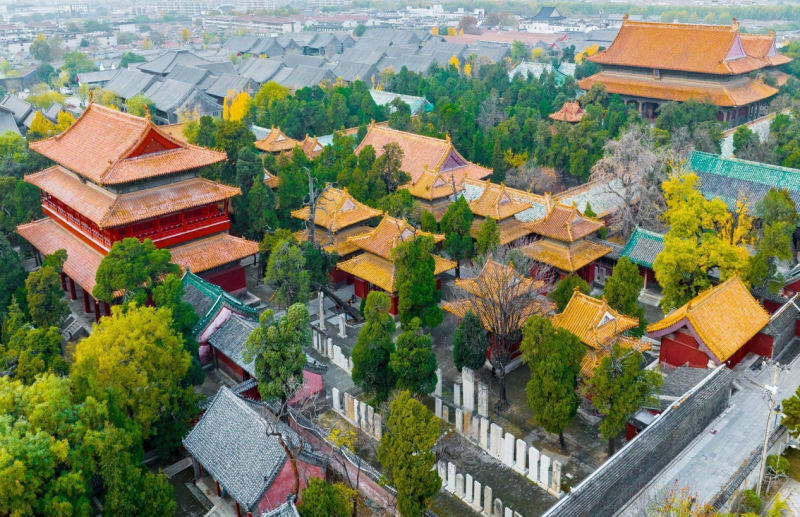
The Three Confucian Sites Scenic Area is located in Qufu City, Jining City, Shandong Province. It is a World Cultural Heritage site and a national 5A-level tourist attraction. It consists of three parts: the Temple of Confucius, the Cemetery of Confucius, and the Kong Family Mansion. It is the core place for commemorating Confucius and inheriting Confucian culture through the ages in China. The scenic area is famous at home and abroad for its profound Confucian cultural heritage, long historical inheritance, grand architectural scale, and rich collection of cultural relics. Among them, the Temple of Confucius covers an area of about 327.5 mu (about 218,000 square meters), with a building area of about 16,000 square meters. It has 466 halls, rooms, altars, pavilions, and other structures, and 54 gateways and archways. The Kong Family Mansion covers an area of about 240 mu (about 160,000 square meters), with a building area of about 12,000 square meters and 463 buildings of various types. The Cemetery of Confucius covers an area of about 3,000 mu (about 2 million square meters) and is the largest and best-preserved family cemetery in China. The three are complete in layout and each has its own characteristics, jointly forming a Confucian cultural holy land integrating sacrifice, residence, and burial.
Historical Culture
The history of the Three Confucian Sites Scenic Area can be traced back to 478 BC, the second year after Confucius' death, when Duke Ai of Lu converted Confucius' former residence into a temple, beginning the history of the construction of the Temple of Confucius. Over the following more than two thousand years, successive dynasties continuously expanded and rebuilt the Temple of Confucius, making it the existing ancient architectural complex in China second only to the Forbidden City in scale. Together with the Beijing Forbidden City and the Chengde Mountain Resort, it is known as one of the "Three Great Ancient Architectural Complexes of China."
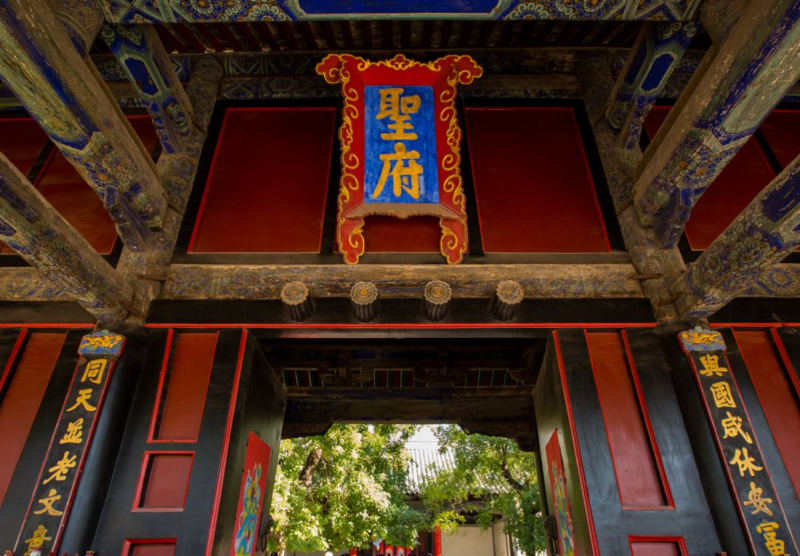
The Kong Family Mansion, as the residence of Confucius' direct eldest descendants, began in the Song Dynasty and was perfected through the Ming and Qing dynasties, forming an architectural layout of "official offices in the front and residence in the rear." It is the largest and best-preserved feudal aristocratic manor existing in China and is honored as "The First Family Under Heaven." Its architectural layout and furnishings fully embody Confucian ethical principles and the patriarchal clan system.
The Cemetery of Confucius is the dedicated cemetery for Confucius and his family. After Confucius was buried here, many of his descendants were also buried here. It has continued for more than 2,500 years, with more than 100,000 tombs and more than 4,000 stone inscriptions. It is the family cemetery with the longest continuous history in the world and is called the "Oriental Pyramid." In 1994, the Three Confucian Sites Scenic Area was inscribed on the UNESCO World Cultural Heritage List, becoming a common cultural treasure of all humanity. The large number of cultural relics, stone inscriptions, and ancient books it preserves provide precious physical materials for the study of ancient Chinese politics, culture, art, and burial systems.
Main Attractions
Temple of Confucius
The Temple of Confucius is the temple for worshipping Confucius and is known for having "the longest construction history and the most complete preservation." Its core building, the Hall of Great Achievements, is 24.8 meters high, 45.69 meters wide, and 24.85 meters deep. It is one of the three great ancient halls of China (along with the Hall of Supreme Harmony in the Forbidden City and the Tiankuang Hall of Dai Temple). Inside the hall is a statue of Confucius, surrounded by statues of the Twelve Philosophers. The ten dragon pillars on the terrace in front of the hall are especially famous. Each is 6 meters high and carved from a single huge stone. The dragon patterns are lifelike and represent the pinnacle of Ming and Qing carving art. The temple also preserves a large number of stone inscriptions from successive dynasties, including clerical script, regular script, running script, and other calligraphic styles from the Han dynasties onward. Among them, the "Han-Wei Stone Inscriptions" and the "Thirteen Classics Stone Inscriptions" (also known as the "Qianlong Stone Classics") are especially precious and constitute a treasure house of Chinese calligraphy art. In addition, the Kuiwen Pavilion (library, 23.35 meters high), the Apricot Altar (said to be the place where Confucius lectured), and other sites are also important landscapes of the Temple of Confucius.
Kong Family Mansion
The Kong Family Mansion, also known as the "Mansion of the Duke Yansheng," is the residence where Confucius' direct eldest descendants lived for generations. Its architectural layout is divided into three routes: east, central, and west. The central route is the main body of the architecture. In the front are official offices, with three halls and six departments for handling official business; in the rear are inner residences, including the Front Upper Room, Front Hall Tower, Rear Hall Tower, and others, which were family living quarters. The west route contains reception courtyards and studies, while the east route contains family temples and workshops. The mansion preserves a large number of Ming and Qing furniture, clothing, documents, and archives. Among them, the "Ten Shang and Zhou Ritual Vessels" (bronze ritual vessels) and "imperially bestowed books" are especially precious. The plaque "The First Family Under Heaven" on the inner residential gate of the Kong Family Mansion was inscribed by the Qianlong Emperor of the Qing Dynasty, highlighting the special status of the Kong Family Mansion. The "Greed-Curbing Painting" mural in the mansion (depicting a legendary monster that can devour gold and silver treasures but is still insatiable) reflects the Confucian idea of "incorruptibility."
Cemetery of Confucius
The Cemetery of Confucius, also known as the "Forest of the Supreme Sage," is the cemetery of Confucius and his family. It is surrounded by walls with a perimeter of 7 kilometers. Confucius' tomb is located in the central part of the Cemetery of Confucius. It is 6.2 meters high and 18 meters in diameter. In front of the tomb is a stone inscription reading "Tomb of the Great Achiever and Supreme Sage, King of Cultural Propagation," erected in the Ming Dynasty. To the east is the tomb of his son Kong Li, and to the south is the tomb of his grandson Kong Ji, forming a layout of "carrying the son and embracing the grandson." The Cemetery of Confucius has ancient trees reaching the sky, with more than 100,000 trees of various types, including several hundred ancient trees over a thousand years old. It is one of the largest artificial gardens in China. In addition to the tombs of Confucius and his descendants, there are also many stone inscriptions in the forest, such as the "Zigong Planted the Kai Tree" stele (commemorating the tree planted by Confucius' disciple Zigong), steles from Ming and Qing emperors worshipping Confucius, and stone figures, stone beasts, and other stone sculpture groups, which have extremely high historical and artistic value.
Food
Confucius Family Banquet
The Confucius Family Banquet is the general name for banquets held by successive Dukes Yansheng. It is a famous official cuisine outside China's four major cuisines and is known for its "complete etiquette, exquisite dishes, and rich cultural connotations." The Confucius Family Banquet is divided into many types, such as birthday banquets, wedding banquets, and family banquets. It stresses that "food is never too refined, and meat is never too finely cut." It preserves the luxury of ancient court cuisine while also incorporating folk flavors. Representative dishes include "Poetry and Rites Ginkgo" (made from the fruit of the thousand-year-old ginkgo tree in the Kong Family Mansion), "Bringing the Son to Court" (symbolizing generations of family officials), and "Eight Immortals Crossing the Sea to Trouble the Arhat" (composed of eight small dishes surrounding one main dish, symbolizing good fortune). The Confucius Family Banquet is not only a culinary feast but also embodies the etiquette norms in Confucian culture. The Kong Family Mansion West Garden Restaurant in the scenic area offers a simplified version of the Confucius Family Banquet.
Surrounding Food
Qufu Smoked Tofu
Qufu Smoked Tofu is a local specialty snack with a history of more than 300 years. It is made from locally produced firm tofu, braised and then smoked with pine needles. It is golden in color and has a unique aroma. It can be served cold, stir-fried, or in soup. Among these, "smoked tofu stir-fried with chili" and "smoked tofu hot pot" are the most common. It can be found everywhere in snack streets in Qufu city (such as Wuma Ci Street). The price is affordable, and it is a must-try food for experiencing local flavors.
Qufu Pancake
Qufu Pancake is different from pancakes in other parts of Shandong. It is made from millet and corn, spread by hand, as thin as paper, and crisp in texture. It can be rolled with scallions and pickles, or filled with eggs, ham, and others. Among these, the "traditional sweet sauce rolled pancake" is the most distinctive. It can be bought from vendors around the Temple of Confucius and the Kong Family Mansion. The unit price is about 5-8 yuan. It is convenient to carry and is a convenient snack favored by tourists.
Tickets:
Combined ticket: 140 yuan/person (including the Temple of Confucius, Kong Family Mansion, and Cemetery of Confucius).
You can search for the official public account "Qufu Three Confucian Sites Scenic Area" on WeChat to get the latest updates or buy tickets online.
Opening Hours:
Opening hours are adjusted according to the seasons: From March 1 to October 31, it is peak season, with opening hours from 8:00 to 17:30 (last entry at 17:00); from November 1 to February 28 (29) of the following year, it is off-season, with opening hours from 8:30 to 17:00 (last entry at 16:30). On New Year's Eve, the Temple of Confucius and the Kong Family Mansion are open until 12:00, and the Cemetery of Confucius is closed; from the first to the third day of the first lunar month, opening hours are 8:30-16:00. Tourists are advised to confirm the latest opening hours through official channels before traveling.
Tour Route:
It is recommended to visit the Three Confucian Sites Scenic Area over two days: On the first morning, visit the Temple of Confucius, entering from the Ten-Thousand-Foot Palace Wall (main gate), and visit core buildings such as the Lingxing Gate, Shishi Gate, Kuiwen Pavilion, and the Hall of Great Achievements in order, focusing on the dragon pillars of the Hall of Great Achievements and stone inscriptions from successive dynasties. This takes about 3 hours. At noon, dine in Qufu city and taste local snacks such as Qufu smoked tofu and pancakes. In the afternoon, go to the Kong Family Mansion, entering from the Queli Gate on the east side of the Temple of Confucius, and visit the official offices, inner residences, garden, and other areas to understand the layout of "official offices in the front and residence in the rear." This takes about 2 hours. On the second morning, visit the Cemetery of Confucius. You can take the scenic area sightseeing bus (one-way 20 yuan/person, round trip 30 yuan/person) to the Confucius tomb area, visit the tombs of Confucius, Kong Li, and Kong Ji, stroll through the ancient forest, and appreciate the stone inscriptions and ancient trees. This takes about 2-3 hours. If time is tight, it can be compressed into one day: morning Temple of Confucius (2.5 hours) Kong Family Mansion (1.5 hours), afternoon Cemetery of Confucius (2 hours), about 6 hours in total.
Transportation:
Bus: Within Qufu city, you can take buses such as No. 1, No. 2, No. 5, and K01 to get off at "Temple of Confucius South Gate" station or "Kong Family Mansion" station and walk to the destination. From Qufu East Station (high-speed railway station), you can take K01 bus (fare 5 yuan) directly to the Temple of Confucius, with a journey of about 40 minutes. From Qufu Bus Station, you can take No. 1 bus (fare 1 yuan) to the Temple of Confucius, with a journey of about 15 minutes.
Self-driving: Starting from the direction of Jinan, take the Beijing-Taipei Expressway (G3) and get off at the Qufu exit. Drive west along Yingbin Avenue for about 3 kilometers to reach the Temple of Confucius parking lot. The parking fee is 5 yuan/hour for small vehicles and 10 yuan/hour for large vehicles.
Taxi/ride-hailing: Taking a taxi from Qufu East Station to the Temple of Confucius costs about 30 yuan, with a journey of 20 minutes. Taking a taxi from Qufu city to the Temple of Confucius has a starting fare of 6 yuan (within 3 kilometers), and 1.5 yuan per kilometer beyond that.
Must-Visit Attractions:
Hall of Great Achievements in the Temple of Confucius: 24.8 meters high, 45.69 meters wide, and 24.85 meters deep, it is one of the three great ancient halls of China. The ten dragon pillars in front of the hall are the pinnacle of Ming and Qing stone carving art. Inside the hall is a statue of Confucius. It is the core building of the Temple of Confucius.
Front Hall Tower of the Kong Family Mansion: The core building of the inner residence of the Kong Family Mansion, a two-story pavilion that was once the residence of the Duke Yansheng and his wife. The building preserves Ming and Qing furniture, clothing, and other cultural relics, reflecting the living scenes of ancient aristocrats. The plaque "The First Family Under Heaven" is hung here.
Tomb of Confucius: Located in the central part of the Cemetery of Confucius, 6.2 meters high and 18 meters in diameter. The stone inscription in front of the tomb reading "Tomb of the Great Achiever and Supreme Sage, King of Cultural Propagation" was erected in the Ming Dynasty. It is surrounded by the tombs of his son Kong Li and grandson Kong Ji, forming the unique layout of "carrying the son and embracing the grandson." It is the core landscape of the Cemetery of Confucius.
Travel Suggestions:
The best seasons for visiting are April-May or September-October. At this time, the climate is mild, there is less precipitation, and it is suitable for outdoor activities. It also avoids summer heat and winter cold.
The buildings in the scenic area are dense and the historical culture is profound. It is recommended to rent an electronic guide device (20 yuan/unit for the Temple of Confucius and Kong Family Mansion, 10 yuan/unit for the Cemetery of Confucius) or hire a guide (100-200 yuan/time) to gain a deeper understanding of the historical stories behind the attractions.
The Cemetery of Confucius is large, and walking the entire route takes about 3 hours. Those with insufficient physical strength can take the scenic area sightseeing bus to save time and energy.
If you want to experience the Confucius Family Banquet, it is recommended to make a reservation 1-2 days in advance at the Kong Family Mansion West Garden Restaurant to avoid no seats on the day. To taste snacks, you can go to Wuma Ci Street and choose time-honored shops (such as "Smoked Tofu Family").
You can combine a visit with other Confucian cultural attractions in Qufu (such as the Temple of Zhou Gong and the Temple of Yan Hui). The Temple of Yan Hui is about 1 kilometer from the Temple of Confucius, with a ticket price of 10 yuan/person, allowing you to further experience the cultural atmosphere of the "Hometown of the Sage."
Precautions:
Smoking, littering, and touching or carving cultural relics and stone inscriptions are prohibited in the scenic area. Photography is prohibited in areas such as the Hall of Great Achievements in the Temple of Confucius and the inner residence of the Kong Family Mansion.
When entering the Temple of Confucius and the Kong Family Mansion, security checks are required. Flammable and explosive items, controlled knives, and other dangerous goods are prohibited. Pets (except guide dogs) are not allowed inside.
The Cemetery of Confucius is a cemetery. Visitors should maintain solemnity when touring, not make noise or frolic, and not trample on tombstones or pick plants at will.
Prices of goods in the scenic area are relatively high. You can buy drinking water, snacks, and other items in Qufu city. Prices on Wuma Ci Street are relatively affordable.
During holidays (such as the Spring Festival, National Day, and during the Confucius Culture Festival), there are many tourists. It is recommended to arrive at the scenic area 1 hour in advance and enter at off-peak times. During the Confucius Culture Festival (September 28, Confucius' birthday), memorial ceremonies for Confucius may be held, so it is necessary to check the activity arrangements in advance.