Mount Tai Scenic Area is located in Tai'an City, Shandong Province. It is a World Cultural and Natural Heritage Site and a national 5A-level tourist attraction, known as the "Chief of the Five Great Mountains" and "The First Mountain Under Heaven." The scenic area covers a total area of about 426 square kilometers, with the main peak, Jade Emperor Peak, at an altitude of 1,532.7 meters. It is famous for its majestic natural scenery and profound historical and cultural heritage. Its distinctive feature lies in the integration of natural and cultural landscapes. It has not only magnificent mountain forms, peculiar rocks, spectacular sunrises, and other natural landscapes, but also numerous ancient buildings, inscriptions, cliff carvings, and other cultural relics. The scenic area currently has 22 ancient building complexes, 97 ancient ruins, 819 historical inscriptions, and 1,018 cliff carvings, mainly distributed along the Central Route and West Route of Mount Tai, forming a rich cultural landscape system.
Historical Culture
The historical culture of Mount Tai can be traced back to ancient times. As early as the Neolithic Age, there were traces of human activity. During the Shang and Zhou dynasties, Mount Tai became a sacred place for emperors of successive dynasties to perform the Feng and Shan sacrifices. According to the Records of the Grand Historian, as early as ancient times, 72 kings had performed the Feng and Shan sacrifices at Mount Tai. Since Qin Shi Huang, 12 emperors personally came to Mount Tai to hold grand Feng and Shan ceremonies or sacrificial rituals, making Mount Tai an important carrier of the symbol of imperial power and the Mandate of Heaven in ancient China.
Mount Tai's religious culture is also profound. Taoism regarded Mount Tai as the "Second Small Grotto-Heaven," and Buddhism also left many relics here, such as Lingyan Temple, forming a cultural characteristic of the integration of Confucianism, Buddhism, and Taoism. Men of letters of past dynasties came in succession, and Confucius, Du Fu, Li Bai, and others all left famous works praising Mount Tai. Du Fu's line "When I reach the summit, all other mountains appear small" is especially an eternal masterpiece. In 1987, Mount Tai was listed by UNESCO as a World Cultural and Natural Heritage Site, becoming the first scenic area in the world to receive this honor. Its characteristic of "dual natural and cultural heritage" embodies the achievements of civilization in the harmonious coexistence of humanity and nature.
Main Attractions
Jade Emperor Peak
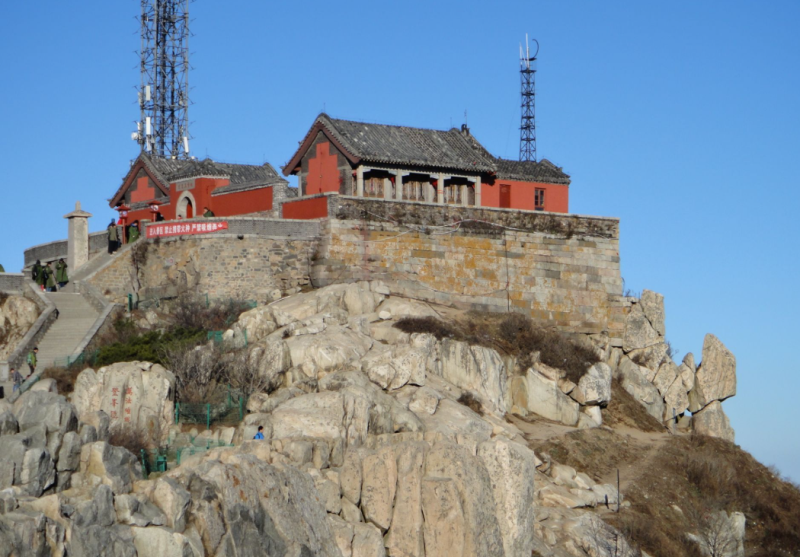
Jade Emperor Peak is the main peak of Mount Tai, with an altitude of 1,532.7 meters. It is named after the Jade Emperor Temple at the summit. The Jade Emperor Temple was first built in the Ming Dynasty and consists of the Mountain Gate, Jade Emperor Hall, Sunrise Viewing Pavilion, River Viewing Pavilion, and other buildings, with a total building area of about 280 square meters. The Jade Emperor Hall enshrines a statue of the Jade Emperor. In front of the hall is the "Extreme Summit Stone," inscribed with the four characters "Mount Tai Extreme Summit," which is the marker of Mount Tai's highest point. Standing at Jade Emperor Peak, one can overlook the surrounding mountains in all directions: to the east, the sunrise over the Yellow Sea; to the west, the golden belt of the Yellow River; to the north, the Nine Smoking Points of Qi; and to the south, the Wen River like a ribbon. The scenery is extremely magnificent, making it an excellent location for viewing Mount Tai's sunrise and sea of clouds.
South Heaven Gate
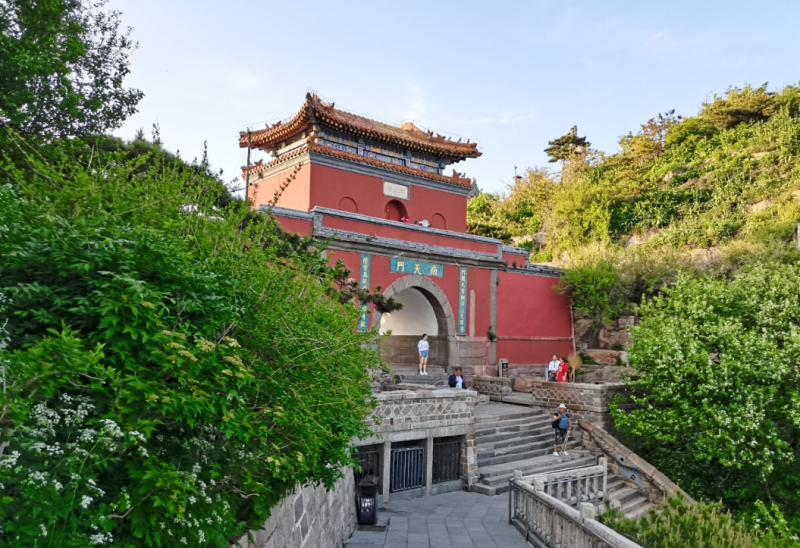
South Heaven Gate is located at the end of the Eighteen Bends of Mount Tai, at an altitude of 1,460 meters. It is the endpoint of the mountain-climbing path and one of the landmark buildings of Mount Tai. It was first built in the Yuan Dynasty, and the existing buildings were rebuilt in the Qing Dynasty. It consists of a gate-tower-style building and side rooms on both sides, with a total building area of about 120 square meters. The three characters "South Heaven Gate" on the gate plaque were written by the Ming Dynasty calligrapher Hu Zanzong. On both sides are stone-carved couplets: "The gate opens to the ninth heaven, looking up as one steps toward the wonders of the three heavens; the steps rise ten thousand levels, looking down upon the marvelous sight of a thousand peaks." These vividly depict the steepness and grandeur of South Heaven Gate. Inside South Heaven Gate is Weiliaoxuan, and on the west side outside the gate is a group of cliff carvings, an important part of Mount Tai's cultural landscape.
Eighteen Bends
The Eighteen Bends are the most precipitous section of Mount Tai's climbing path, located between the northern foot of Duisong Mountain and South Heaven Gate. It is about 0.8 kilometers long, with a vertical height of about 400 meters and a total of 1,827 stone steps. It is famous for its steepness, with slopes mostly above 70 degrees and the steepest part reaching 80 degrees. It is divided into three sections: the "Slow Eighteen Bends," the "Neither Slow Nor Fast Eighteen Bends," and the "Fast Eighteen Bends." On both sides of the Eighteen Bends are steep cliffs covered with inscriptions. Looking upward, the stone steps resemble a heavenly ladder piercing the clouds; looking downward, it feels like standing at the edge of an abyss. It is a test of climbers' physical strength and perseverance and is a typical embodiment of Mount Tai's "majesty."
Dai Temple
Dai Temple is located at the southern foot of Mount Tai. It was the sacred place where emperors of successive dynasties offered sacrifices to the God of Mount Tai, and it is also the largest and most complete ancient building complex at Mount Tai, known as the "Little Forbidden City." Dai Temple covers an area of about 96,000 square meters, with a building area of about 16,000 square meters. It is surrounded by walls about 6 meters high and has four gates. The main buildings in the temple include Tiankuang Hall, Ren'an Gate, Peitian Gate, and the Song Dynasty Tiankuang Hall Stele. Among them, Tiankuang Hall is the core building of Dai Temple, 22.3 meters high, 48.7 meters wide, and 19.7 meters deep. Together with the Hall of Supreme Harmony in the Beijing Forbidden City and the Hall of Great Accomplishment in the Temple of Confucius in Qufu, it is known as one of the "Three Great Halls of China." The mural inside the hall, "The Picture of the God of Mount Tai Setting Out and Returning," is 62 meters long and 3.3 meters high, depicting 697 figures. The scene is grand and it is a treasure of ancient Chinese mural art.
Mid-Heaven Gate
Mid-Heaven Gate is the midpoint of Mount Tai's climbing route, at an altitude of 847 meters. It is the hub connecting the upper and lower parts of Mount Tai. The terrain here is open, with facilities such as the Mid-Heaven Gate Archway, God of Wealth Hall, and cableway station, with a building area of about 500 square meters. From Mid-Heaven Gate, one can go upward to South Heaven Gate, downward to Dai Temple, and northward by cableway to Rear Stone Dock. It is an important stop for tourists to rest and transfer. The scenery around Mid-Heaven Gate is beautiful, with Phoenix Ridge to the west and Mid-Stream Mountain to the east. Climbing here, one can take a short rest and experience the feeling of "having climbed halfway and already experienced mountains and rivers."
Bixia Temple
Bixia Temple is located on Bixia Peak at the summit of Mount Tai, at an altitude of 1,480 meters. It is a sacred place of the Quanzhen school, the mainstream Taoist sect, and enshrines Bixia Yuanjun. The temple was first built during the reign of Emperor Zhenzong of Song, and the existing buildings were built in the Qing Dynasty. It consists of the Mountain Gate, Main Hall, Side Halls, Bell Tower, Drum Tower, and other structures, with a total building area of about 3,900 square meters. The buildings of Bixia Temple are covered with copper tiles and iron tiles, shining brilliantly in the sunlight. It is the highest ancient building complex on Mount Tai. The main hall enshrines a statue of Bixia Yuanjun, and incense is abundant. It is an important place for folk believers to pray for blessings. Its architectural craftsmanship is exquisite and has extremely high historical and artistic value.
Food
Three Beauties of Mount Tai
The Three Beauties of Mount Tai is a specialty dish of Tai'an, mainly made from "cabbage, tofu, and water." It is named for Mount Tai cabbage being tender and sweet, tofu being delicate and smooth, and mountain spring water being clear and refreshing. When making it, the three ingredients are cooked together and a little salt is added for seasoning. The soup is clear and the taste is fresh and delicious, reflecting the characteristic of Mount Tai cuisine of "lightness and original flavor." This dish is available in restaurants in Tai'an city and within the Mount Tai scenic area. It is a must-try for experiencing Mount Tai's food culture, priced at about 30-50 yuan per portion.
Surrounding Food
Tai'an Stir-Fried Chicken
Tai'an Stir-Fried Chicken is a local folk specialty dish. It uses locally free-range native chicken, paired with green peppers, red peppers, potatoes, and other ingredients, and is stir-fried in a traditional iron wok. The meat is firm and chewy, with a rich sauce aroma. On the "Stir-Fried Chicken Street" in Tai'an city (near Longtan Road), there are many time-honored shops, such as "Jinling Stir-Fried Chicken." One portion of stir-fried chicken costs about 80-120 yuan and is suitable for sharing among several people. It is a favorite food of both locals and tourists.
Flaky Baked Wheaten Cake
The flaky baked wheaten cake is a traditional snack of Tai'an with a history of over a hundred years. It is made from flour, sesame, salt, and other ingredients through processes such as kneading, laminating, and baking. The outer skin is crisp, and the inside is soft, salty, and delicious. It can be bought at old streets at the foot of Mount Tai and at snack stalls around Dai Temple, at about 2-3 yuan each. It can serve as a convenient dry food during mountain climbing and tastes even better with tofu pudding.
Tickets:
Ticket: 115 yuan per person (Hongmen hiking route).
You can search for the official public account "Mount Tai Scenic Area" on WeChat to get the latest updates or buy tickets online.
Opening Hours:
Open 24 hours a day, but some attractions and cableways have fixed operating hours. Dai Temple is open from 8:00-17:30 (April-October) and 8:00-17:00 (November-next March). The cableway from Mid-Heaven Gate to South Heaven Gate operates from 7:30-17:30 (April-October) and 8:00-17:00 (November-next March); the cableway from Peach Blossom Valley to South Heaven Gate has the same operating hours as the Mid-Heaven Gate cableway. Tourists are advised to arrange their time reasonably to avoid missing the opening hours of some service facilities when climbing at night.
Tour Routes:
Mount Tai mainly has four climbing routes. The most classic is the Central Route (Hongmen Route): starting from Dai Temple, passing through First Heaven Gate, Confucius' Climbing Site, Mid-Heaven Gate, Eighteen Bends, and South Heaven Gate, and finally reaching Jade Emperor Peak. The entire journey is about 10.5 kilometers, with about 6,290 steps, and takes 5-6 hours on foot. This route has concentrated cultural landscapes and is suitable for first-time climbers with good physical strength.
If physical strength is limited, one can choose to take a tourist bus from Tianwaicun to Mid-Heaven Gate (about 30 minutes, ticket 30 yuan per person), then walk or take the cableway from Mid-Heaven Gate to South Heaven Gate (one-way 100 yuan per person). The whole walking journey takes about 2.5 hours, suitable for tourists with limited time or average physical strength.
The Peach Blossom Valley Route is mainly focused on natural scenery. From Peach Blossom Valley, take the cableway to South Heaven Gate (one-way 100 yuan per person), then walk to Jade Emperor Peak. It is suitable for tourists who prefer natural landscapes, and the whole journey takes about 3 hours.
The Rear Mountain Tianzhufeng Route is relatively steep, with fewer tourists, and is suitable for experienced hiking enthusiasts. The whole journey is about 5.4 kilometers and takes 4-5 hours on foot.
Transportation:
Bus: In Tai'an city, one can take buses such as Route 3, Route 4, Route 19, and K3 to Hongmen Station (the starting point of the Hongmen Route); take Route 15 and K15 to Tianwaicun Station (the starting point of the tourist bus); and take Route 2 to Dai Temple Station. From Tai'an Station (high-speed railway station), one can take bus K37 to Hongmen Station. The journey takes about 1 hour and the fare is 2 yuan.
Self-driving: Starting from the direction of Jinan, take the Beijing-Taipei Expressway (G3) and get off at the Tai'an exit. Drive east along Dongyue Avenue for about 5 kilometers to reach Tianwaicun or the Hongmen parking lot. The parking fee standard is 5 yuan per hour for small vehicles during the day (8:00-18:00) and 10 yuan per time at night (18:00-next 8:00).
Taxi/ride-hailing: Taking a taxi from Tai'an Station to Hongmen costs about 30 yuan and takes 30 minutes; taking a taxi from downtown Tai'an to Hongmen costs about 10 yuan and takes 15 minutes.
Must-Visit Attractions:
Jade Emperor Peak: The main peak of Mount Tai, at an altitude of 1,532.7 meters. It is the best place to view Mount Tai's sunrise and sea of clouds. The Jade Emperor Temple and the "Extreme Summit Stone" at the summit are landmark sights.
Eighteen Bends: 0.8 kilometers long, with 1,827 stone steps and steep slopes. It is the most precipitous section of Mount Tai, reflecting Mount Tai's characteristic of "majesty, wonder, and steepness," and is the core part of the climbing experience.
Dai Temple: The largest ancient building complex at Mount Tai. Tiankuang Hall, together with the Hall of Supreme Harmony in the Forbidden City and the Hall of Great Accomplishment in the Temple of Confucius, is known as one of the "Three Great Halls of China." The mural "The Picture of the God of Mount Tai Setting Out and Returning" in the hall is of great artistic value.
South Heaven Gate: A landmark building of Mount Tai, located at the top of the Eighteen Bends. It is an important node before reaching the summit. There are many cliff carvings inside and outside the gate, and after climbing up, one can overlook the surrounding mountains.
Travel Suggestions:
To watch the sunrise at Mount Tai, check the weather forecast in advance. The best viewing time in summer is 4:30-5:30, and in winter it is 6:30-7:30. It is recommended to arrive at Jade Emperor Peak or Riguan Peak one hour early to wait.
Before climbing, prepare comfortable hiking shoes, sufficient drinking water (prices on the mountain are relatively high, so it is recommended to bring 2-3 liters), and high-calorie snacks (such as chocolate and beef jerky). In summer, take sun protection measures; in winter, pay attention to keeping warm (the temperature at the summit is 8-10°C lower than at the foot of the mountain).
Those with average physical strength can bring a trekking pole (sold at the foot of the mountain for 10-20 yuan each) to reduce the burden on the knees; for night climbing, bring a flashlight or headlamp.
If planning to stay overnight to watch the sunrise, one can choose hotels at the summit such as the Meteorological Observatory Hotel and Jade Emperor Peak Hotel, priced at about 300-800 yuan per night, and advance booking is required; one can also choose to spend the night in a rest room near South Heaven Gate (charged at about 50 yuan per person).
It is recommended to arrange 2 days to visit. On the first day, climb to the summit; the next day, watch the sunrise and then go down the mountain. Along the way, one can carefully savor the scenery and avoid an overly rushed itinerary.
Precautions:
When climbing, follow the principle of "walk without looking at the scenery, look at the scenery without walking," especially on steep sections such as the Eighteen Bends. Pay attention to safety underfoot and avoid passing during crowded periods.
Smoking and littering are prohibited in the scenic area. It is strictly forbidden to carve on rocks or ancient buildings, and the natural and cultural environment should be protected.
Prices on the mountain are relatively high. Drinking water, food, and other items can be purchased in full at the foot of the mountain; some sections have no signal, so it is recommended to travel in groups and keep in contact.
Avoid climbing in thunderstorm weather, as the summit is prone to lightning strikes; in winter, some sections freeze, and ice claws can be purchased at the foot of the mountain (10-20 yuan per pair) for anti-slip protection.
There are medical points in the scenic area (such as at Mid-Heaven Gate and South Heaven Gate). If you feel unwell, seek help promptly.