The Chongsheng Temple and the Three Pagodas Cultural Tourism Area is located in Dali City, Dali Bai Autonomous Prefecture, Yunnan Province, about 1.8 kilometers north of Dali Ancient Town. It is a national 5A-level tourist attraction that integrates Cangshan-Erhai scenery, cultural relics and historic sites, Buddhist culture, and leisure vacations. The scenic area covers 1,000 mu, with a protection and utilization area of 5.68 square kilometers.
History and Culture
The Three Pagodas of Chongsheng Temple were first built during the Kaiyuan period of the Tang Dynasty and flourished in the Song Dynasty. It is famous for its five great treasures: the Three Pagodas, the Jianji Great Bell, the Rain-Copper Guanyin Statue, the "Buddhist Capital" plaque, and the Three Saints Golden Statues. Nine kings of the Dali Kingdom once became monks and practiced at Chongsheng Temple, making it a famous royal temple of the Nanzhao and Dali Kingdoms. During the Xianfeng and Tongzhi periods of the Qing Dynasty, Chongsheng Temple was destroyed by war and natural disasters, leaving only the Three Pagodas. In 1997, the Nanzhao Jianji Great Bell was recast; in 1999, the Rain-Copper Guanyin Statue was recast; and in 2005, the ancient architectural complex of Chongsheng Temple was restored and rebuilt.
Main Attractions
The Three Pagodas of Chongsheng Temple
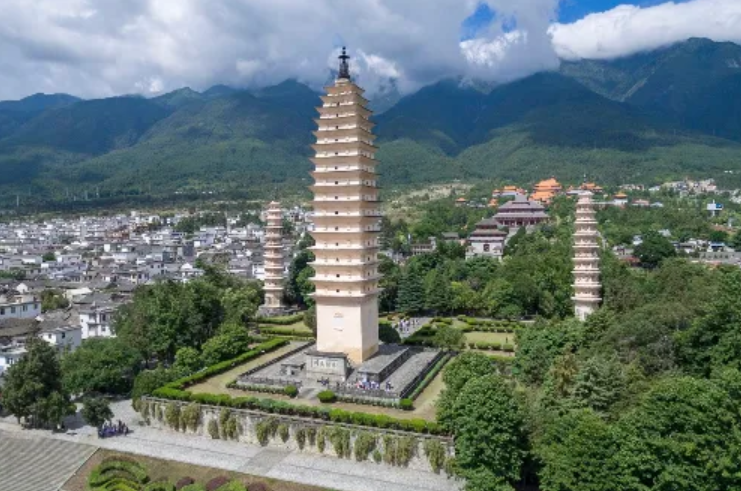
The Three Pagodas consist of one large pagoda and two smaller ones. The large pagoda is called Qianxun Pagoda, with the full name "Fajie Tongling Mingdao Cheng Pagoda." It is 70 meters away from each of the two smaller pagodas in the north and south, and the three pagodas form a tripod arrangement, with a unified layout, harmonious shape, and integrated appearance. Qianxun Pagoda was first built during the reign of Quanfengyou of Nanzhao (823-859 AD). It is a 16-story square multi-eaved hollow brick pagoda, 69.13 meters high, and is a typical Tang Dynasty architectural style. The two smaller pagodas in the north and south are typical Song Dynasty architectural styles. They were built during the reigns of Duan Zhengyan and Duan Zhengxing of the Dali Kingdom (1108-1172 AD). The two smaller pagodas are 97 meters apart and each is 42.19 meters high. They are 10-story octagonal multi-eaved brick pagodas.
Chongsheng Temple
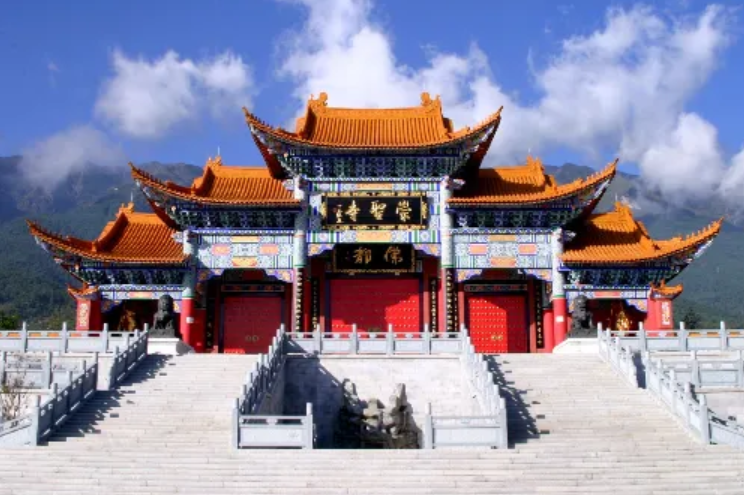
It was restored and rebuilt in 2005. The overall layout consists of three main and secondary axes, eight terraces, nine courtyards, and eleven levels. In terms of architectural style, it combines the essence of architecture from the Tang, Song, Yuan, Ming, and Qing dynasties. Along the main central axis are successively built the Mountain Gate, the Freeing-Life Pond, the Receiving Bridge, the Heavenly Kings Hall, the Maitreya Hall, the Eleven-Faced Guanyin Hall, the Mahavira Hall, the Acarya Guanyin Pavilion, the Mountain and Sea Grand View Stone Archway, and the Sea-Viewing Tower. The 617 Buddha statues and ritual objects in the temple are all cast in bronze, using more than one thousand tons of copper. Among them, 599 Buddha statues and ritual objects are gilded and painted, creating a Chinese record.
Nanzhao Jianji Great Bell
The original bell was destroyed during the wars of the Xianfeng and Tongzhi periods of the Qing Dynasty and was recast in 1997. It is a typical Buddhist bell. The bell body is divided into upper and lower levels. The upper level is decorated with six Paramita patterns. It weighs 16.295 tons, making it the largest bell in Yunnan Province and the fourth-largest bell cast in modern China.
Rain-Copper Guanyin Hall
It was expanded and rebuilt on the original site in 1999. It is 29.99 meters high, covers an area of 8,100 square meters, and has a building area of 4,384 square meters. The hall enshrines the Rain-Copper Guanyin, Acarya Guanyin, Negative-Stone Guanyin, Brahmin Guanyin, and Water-Moon Guanyin statues. The recast Rain-Copper Guanyin statue is 12.6 meters high, cast in copper and gilded, and weighs 11 tons. Its form is the male-body female-appearance style unique to the Dali region.
Three Pagodas Reflection Park
It covers 27 mu, with a water area of more than 10 mu. The park faces south and backs onto the Three Pagodas of Chongsheng Temple. It is named for the clear reflection of the majestic Three Pagodas in the pond within the park. The park contains buildings such as couplet screen walls, stele pavilions, and Yangbo Pavilion, and is planted with various rare and exotic flowers such as camellias, Michelia figo, and azaleas.
Prayer Wheels and Vajra Pestles
The prayer wheels can be turned and are inscribed with the "Sutra of Peace," the "Heart Sutra of Prajnaparamita," the "Diamond Sutra," and the "Lotus Sutra." In ancient India, the vajra pestle was a weapon. After being introduced into Buddhism, it became a ritual instrument for cutting off afflictions and subduing demons. The largest vajra pestle is 6 meters long and 1 meter in diameter, and can be called the king of vajra pestles.
Tour Route:
You can first start touring from the Three Pagodas in the front area and admire the grandeur of the Three Pagodas. Then visit the Nanzhao Jianji Great Bell and the Rain-Copper Guanyin Hall to learn about the related history and culture. After that, go to Chongsheng Temple in the rear area and visit the halls one by one along the main central axis to feel the solemnity of Buddhist culture. Finally, you can go to the Three Pagodas Reflection Park to enjoy the beautiful reflection of the Three Pagodas. The entire tour takes about 3-5 hours and can be adjusted appropriately according to your time and interests.
Tour Suggestions:
It is recommended to go on a day with clear weather, so you can better enjoy the beauty of the Three Pagodas and take photos.
During the tour, you may hire a scenic area guide to gain a deeper understanding of the scenic area's history and culture and the stories behind the attractions.
Keep quiet inside Chongsheng Temple and respect religious beliefs and cultural customs.
You may bring some water and snacks to replenish energy during the tour.
Notes:
Observe the regulations of the scenic area. Do not touch cultural relics at will or damage the scenic environment.
When offering incense in the temple, follow the scenic area's norms, pay attention to safety, and prevent fires.
If you choose to ride there, pay attention to traffic safety and obey traffic rules.
If visiting in summer, take sun protection measures; in winter, keep warm, because the temperature difference between day and night in Dali is relatively large.
Transportation:
Bus: You can take buses such as Route 4 and the Three Pagodas Special Line and get off at the Chongsheng Temple and Three Pagodas Station.
Taxi: Taking a taxi from Dali Ancient Town or the city proper is convenient and quick, with a short travel time.
Cycling: There are many rental points in Dali Ancient Town. You can rent a bicycle or electric bike and ride there, enjoying Dali's natural scenery along the way.
Opening Hours:
Opening hours are 07:30-18:30. Please arrange your visiting time reasonably to avoid missing the entry time.
Tickets:
The reference ticket price is 75 yuan per person.