Heshun Ancient Town is located 4 kilometers southwest of Tengchong City, Baoshan City, Yunnan Province, and is a national 5A-level tourist attraction. The ancient town is surrounded by volcanoes, with a horseshoe-shaped basin in the middle. Its highest elevation within its territory is 2,091 meters, and its lowest is 1,490 meters, covering a land area of 17.4 square kilometers. It has a rich history and culture and is a famous commercial, cultural, and tourist town on the Southern Silk Road. It is also a famous hometown of overseas Chinese, with a unique overseas Chinese culture and caravan culture. The ancient town has more than 100 century-old residences, 8 ancestral halls, 9 temples and monasteries, 9 stone bridges, 6 laundry pavilions, 9 memorial archways, 13 lane gates, 24 moon platforms, and many other ancient buildings.
Historical Culture
Heshun Ancient Town was originally named "Yangwendun." Because a small river flows around the village, it was renamed "Heshun" [river-following], and later, taking the meaning of "scholars harmonious and people obedient," it was elegantly renamed to its current name. It is the hometown of the philosopher Ai Siqi and the hometown of the Jade King. In 2003, the ancient town began a 40-year operation and management period under Yunnan Bolian Heshun Tourism Culture Development Co., Ltd. In 2006, it was selected as the first-place winner of the first China Top Ten Tourism Leaders Brand. In 2007, it was rated as one of the "Third Batch of Chinese Historical and Cultural Towns." In 2013, it was selected for the special stamps "Chinese Ancient Towns (I)." In 2019, it became a "Yunnan Characteristic Town." In 2020, it obtained the qualification to create a national 5A-level tourist attraction.
Main Attractions
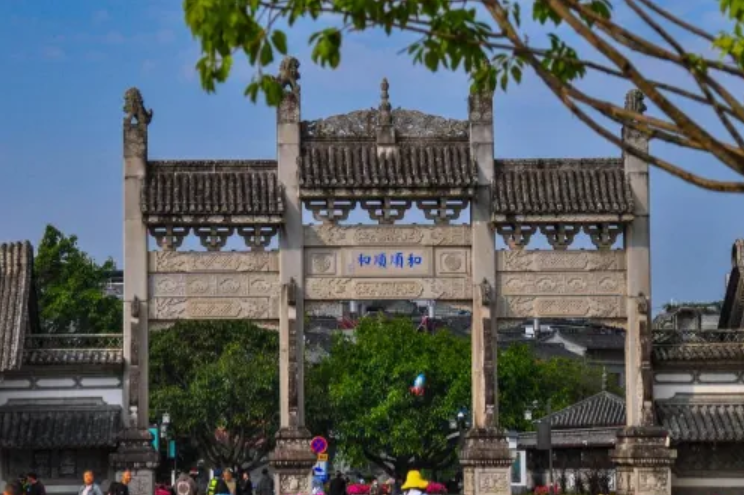
Heshun Shunhe Archway
Built in 2001, it is a landmark building of Heshun. Using a palindrome technique, the two characters "Heshun" are combined into "Heshun Shunhe," expressing beautiful longings and wishes. The two characters "Renli" on the back of the archway were written by Zhao Fan, meaning that Heshun is a hometown of benevolence, righteousness, and morality that values traditional culture.
Yuzhou Pavilion
Built to commemorate Mr. Cun Shusheng, the first principal of Yiqun Middle School. The "Yuzhou Pavilion" stone tablet in the pavilion was inscribed by Chu Tunan. The road by the lotus pond is called Qiunong Road, named after Li Zuhua, the second principal of Yiqun Middle School, reflecting Heshun people's tradition of respecting teachers and valuing education.
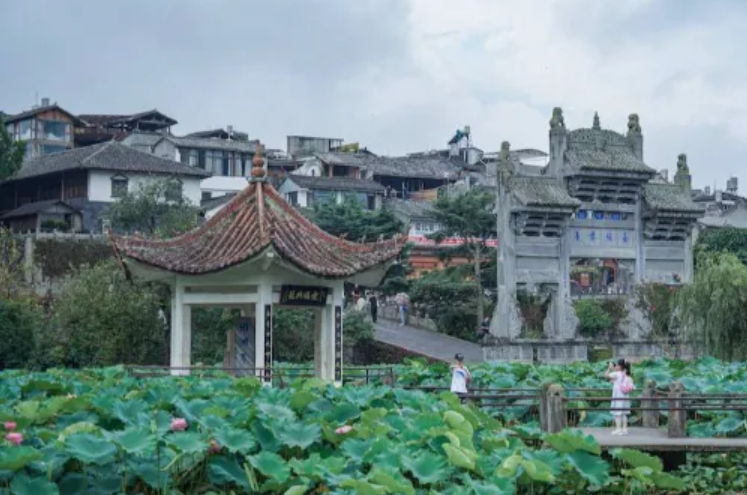
Double Rainbow Bridge
The old bridge was first built in the early Jiajing period of the Ming Dynasty and rebuilt in the tenth year of Guangxu in the Qing Dynasty. The new bridge was built in 1921. The two bridges resemble double rainbows lying across the waves, with exquisite shapes, and green willows shade the bridge area.
Water Impression
Located at Heshun Xianhe, Xianhe is a wetland characterized by biodiversity and is the main source of Heshun Sanhe River. It has a good ecosystem and is home to 187 species of plants, 58 species of birds, 21 species of mammals, 14 species of reptiles, and 9 species of amphibians.
Thousand-Hand Guanyin Ancient Tree Group
Composed of seven towering century-old camphor trees, five of which are arranged in a straight line. Seen up close, they are like green canopies; seen from afar, they resemble a thousand arms spreading out in all directions, much like Thousand-Hand Guanyin.
Yuanlong Pavilion
Originally the Guanyin Hall, the pavilion was built in the 27th year of Qianlong in the Qing Dynasty and named Yuanlong Pavilion. It is a Taoist temple integrating Confucianism, Buddhism, and Taoism. In front is Longtan, and behind are lush ancient trees. It consists of the mountain gate, Dragon King Hall, and other structures.
Zhongtian Temple
Located at the foot of the rear mountain southwest of the main village, it was first built in the eighth year of Chongzhen in the Ming Dynasty, founded with donations from local resident Zhang Chaohai. After later expansion and repairs, the temple consists of the mountain gate, Maitreya Hall, and other structures, built along the main axis according to the mountain terrain. It is the largest temple in Heshun, with a total area of 5,000 square meters, hall area of about 1,140 square meters, and auxiliary area of about 777 square meters.
Kuige Pavilion
Also known as Aofeng Temple, it was first built in the Ming Dynasty. The existing building was rebuilt in the 19th year of Guangxu in the Qing Dynasty. Local people worshipped Kuixing here and set up schools to educate people. It was also a place for summer relaxation and leisure. It consists of the mountain gate, passing hall, and other buildings, and preserves 33 inscriptions and poems from the Ming Dynasty onward.
Wanlouzi Folk Residence Museum
Named because the buildings were built along the curve of the lane, it is a courtyard complex of three courtyards, three rooms, and one screen wall. It is also another name for the famous business firm Yongmaohe and the Li family. The firm lasted through five generations and had more than 100 years of glorious history.
Centenarian Archway
Erected for elderly people of advanced age and high moral prestige. The current Centenarian Archway below the Li Family Ancestral Hall in Shuidui was erected for the wife of Li Degui of Shuidui when she reached 100 years old. The stone archway bears the inscription "Tianmu Peak High" by Tang Jiyao, governor of Yunnan, and is a symbol of longevity among Heshun people.
Preface Hall of the Caravan Museum
Displays content related to the Southern Silk Road. The main mode of transportation was caravan transport by horses. The sculptures in the hall show the scene of the caravan leader leading a large caravan over mountains and ridges.
Dian-Myanmar Anti-Japanese War Museum
Built in 2005 on the former site of the command post of the 20th Army Group of the Chinese Expeditionary Force during the recapture of Tengchong, it was China's first museum built with private funds, privately collected, and themed on the Dian-Myanmar Anti-Japanese War. In 2013, the physical objects in the museum were moved to the Western Yunnan Anti-Japanese War Memorial Hall.
Liu Family Ancestral Hall
Built in the fifth year of Xianfeng in the Qing Dynasty, nearly 150 years ago. Directly in front is a half-moon-shaped lotus pond. On the pond, a two-hole stone bridge leads to the moon platform. On the moon platform, a memorial-style gate is built. After entering the ancestral hall, there are successively a hall, wing rooms, and the main hall. The main hall enshrines the Liu family's first ancestor and includes an ancestral hall culture museum displaying ancestral hall culture.
Tour Route:
Classic one-day tour route: Scenic Area Entrance → Heshun Shunhe Archway → Double Rainbow Bridge → Laundry Pavilion → Yuanlong Pavilion → Ai Siqi Memorial Hall → Thousand-Hand Guanyin Ancient Tree Group → Liu Family Ancestral Hall → Li Family Ancestral Hall → Dian-Myanmar Anti-Japanese War Museum → Wanlouzi Folk Residence Museum → Kuige Pavilion → Zhongtian Temple → Centenarian Archway → Water Impression → Yuzhou Pavilion → Scenic Area Exit.
Travel Suggestions:
It is recommended to visit in the early morning or evening to avoid the strong midday light; the lighting effect in the ancient town is best then.
Wear comfortable walking shoes. There are many stone-paved roads in the ancient town, making them convenient for long tours.
Rent an audio guide (about 20 yuan per device) to gain an in-depth understanding of overseas Chinese culture and caravan history.
Taste local specialties such as Heshun pine flower cake and roast pig trotters. It is recommended to experience traditional tea snacks in an old teahouse in the ancient town.
In summer, take sun protection and mosquito repellent measures. In winter, pay attention to wind protection and warmth. The temperature difference between day and night in Tengchong is relatively large.
Precautions:
There are many ancient buildings in the ancient town. Climbing and carving are prohibited. Please protect cultural relics.
Respect local residents' living customs. Keep quiet when entering ancestral halls and temples.
Xianhe Wetland is an ecological protection area. Please do not feed birds or litter.
When buying specialties such as jade and tea, choose designated shops in the scenic area and ask for formal invoices.
Pay attention to slipping during the rainy season. Some mountain roads are steep, so it is recommended to travel with companions.
Transportation:
Bus: Take Bus No. 6 from Tengchong city to Heshun Ancient Town directly. The fare is 2 yuan. Departure time is 6:30-18:30, about one bus every 15 minutes.
Taxi: Taking a taxi from Tengchong city to Heshun Ancient Town costs about 15 yuan, and the ride takes 15 minutes.
Self-driving: Navigate to "Heshun Ancient Town." The scenic area has a parking lot. The parking fee for a small car is 10 yuan per day.
Opening Hours:
Open all year round, daily 7:30-20:30 (main entrance of the scenic area). The opening hours of individual attractions differ slightly, generally 8:00-18:00.
Tickets:
Adult ticket: 55 yuan per person.