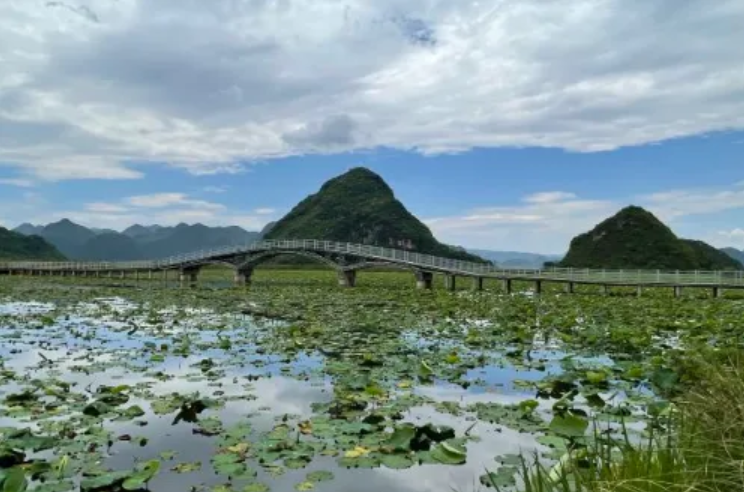
Puzhehei Scenic Area is located in Qiubei County, Wenshan Zhuang and Miao Autonomous Prefecture, Yunnan Province, 13 kilometers from Qiubei County Town. The scenic area covers a total area of 388 square kilometers, with a core scenic area of 15 square kilometers. It is a national 5A-level tourist attraction, a national wetland park, the only pilot area for tourism circular economy in the province, and one of the first batch of provincial-level all-for-one tourism demonstration zones in the province. "Puzhehei" is a word in the Yi language, meaning "a lake filled with fish and shrimp." The scenic area belongs to the karst region of southeastern Yunnan and features a typically developed plateau karst landscape. It is known for its six major landscapes: "waterborne pastoral fields, Yi-style water towns, lotus world, karst wetlands, lake and peak forests, and a paradise for fish and birds." Within the scenic area, there are 312 isolated peaks, 83 karst caves, 54 interconnected lakes, 26.67 square kilometers of wild lotus, and 40 square kilometers of plateau karst wetlands.
History and Culture
Qiubei County, where Puzhehei is located, has a long history. During the Tang Yao, Yu Shun, and Shang dynasties, it belonged to Liangzhou; during the Western Zhou, it belonged to the Baidan people; during the Spring and Autumn and Warring States periods, it belonged to the State of Chu; during the Qin Dynasty, officials were stationed in some areas to govern; during the Western Han, Eastern Han, Shu Han, and Western Jin, it belonged to Tongfeng County of the commandery; during the Eastern Jin, it was under the jurisdiction of Kunzhou of the Nanning Prefecture General Office; during the Tang Dynasty, it was under the jurisdiction of the Qianzhou Dudufu, and during the Taihe period, it was annexed by Meng Guiyi of the Nanzhao Kingdom; during the Song Dynasty, it was called Weimo Bu; during the Yuan Dynasty, it was changed to belong to Guangxi Lu; from 1300 to 1669, it belonged to Weimo Prefecture; during the Kangxi period, it belonged to Shizong Prefecture; in 1731, the Qiubei Sub-prefecture of Shizong Prefecture was established; in 1770, Qiubei Sub-prefecture was reduced to Qiubei County; in 1840, Qiubei was upgraded to a full county under Guangxi; in 1913, it was subordinate to Mengzi, and later directly under Yunnan; in 1949, it belonged to the Wenshan Special Region; in 1958, Qiubei County came under the jurisdiction of the Wenshan Zhuang and Miao Autonomous Prefecture and has continued to be so to this day.
As early as 1.7 million years ago, ancient apes lived in the Puzhehei Scenic Area in Qiubei. The Heiqinglong ancient ape remains and fossils in the Puzhehei Scenic Area, as well as the "bird totem" ancient cliff paintings at Shizishan in Yuezhe, are relics from the Paleolithic and Neolithic periods. Within Qiubei County live seven ethnic groups: Han, Zhuang, Yi, Miao, Hui, Bai, and Yao. In the Puzhehei Scenic Area, the main ethnic groups are the Zhuang, Yi, Sani, Miao, and Yao. The people of all ethnic groups have created colorful ethnic cultures and customs. Among the many traditional festivals of ethnic minorities, the Yi people's "Huamian Festival" and "Torch Festival" are the most grand and lively.
Main Attractions
Swan Lake Scenic Area
Located within the Puzhehei Karst National Wetland Park, it was established on October 1, 2013, and is a karst wetland migratory bird habitat in southwestern China. It covers an area of 3 square kilometers, of which the wetland area is 2.6 square kilometers, including four types: river wetlands, lake wetlands, marsh wetlands, and artificial wetlands. There are nearly ten thousand migratory birds of various kinds, and the wetland animals include fish, amphibians, reptiles, mammals, and birds, totaling more than 200 species.
Xianren Lake
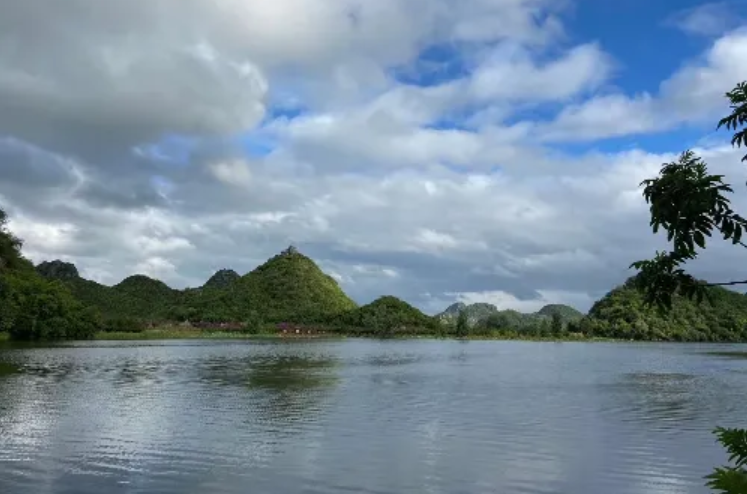
Located north of the Shanhewan area and northwest of Xianrendong Village, it covers an area of 0.7 square kilometers, with a north-south length of about 2 kilometers and a winding shoreline. There are 54 isolated peaks about 10 meters high, as well as several scenic spots such as Xiongshi Wobo, Xiannü Wobo, and Shizi Mountain.
Xianren Cave
Located southeast of Xianren Lake, it has a total length of 244 meters and a height of 3 to 5 meters. Inside the cave are landscapes such as stalactites, stone pillars, soda straws, stone curtains, and rimstone pools. It contains a water cave about 150 meters long, with a water depth of 0.5 to 2 meters, connected to Xianren Lake and navigable by small boat, as well as a water passage inside the cave about 90 meters long, and after landing, a dry cave about 600 meters long.
Puzhehei Lake
Located north of Xianren Lake and west of Puzhehei Village, it is about 2.5 kilometers long, with an area of about 1 square kilometer. The average width of the lake surface is about 300 meters, and the average water depth is about 3 meters. There are more than 50 isolated peaks on the east and west banks, and three more isolated peaks to the north of the lake. Because the lake is rich in carp, grass carp, and crucian carp, it is named "Puzhehei."
Qinglong Mountain
Located west of Puzhehei Lake, its main peak has an altitude of 1,555 meters, about 108 meters above the lake surface. The vegetation consists of evergreen shrubs. At the summit is the Qinglong Mountain viewing platform, where visitors can view the entire panorama of Puzhehei; within the mountain body there are eight karst caves, including Huoba Cave, Yueliang Cave, and Zhangzui Stone Cave.
Tour Routes:
One-day tour: Xianrendong Village - Puzhehei Lake - Qinglong Mountain Viewing Platform - Swan Lake Scenic Area. In the morning, visit Xianrendong Village to experience Yi culture; then take a boat tour of Puzhehei Lake to enjoy the lake and mountain scenery; in the afternoon, climb to the Qinglong Mountain Viewing Platform to overlook the panorama, and finally go to Swan Lake Scenic Area to observe migratory birds and wetland scenery.
Two-day tour: On the first day, Puzhehei Village - Huoba Cave - Yueliang Cave - Xianren Lake. Experience folk life in Puzhehei Village, then visit Huoba Cave and Yueliang Cave to experience the karst cave landscapes, and in the evening enjoy the sunset scenery at Xianren Lake. On the second day, Swan Lake Scenic Area - Bailong Lake - Shede Grassland. In the morning, visit Swan Lake; in the afternoon, go to Bailong Lake, and afterward go to Shede Grassland to experience the grassland scenery.
Travel Suggestions:
Visiting in summer allows you to see large areas of blooming lotus flowers, but attention should be paid to sun protection and mosquito prevention measures.
When touring, choosing a boat ride allows for a better appreciation of the lake and mountain scenery, but attention should be paid to safety and life jackets should be worn properly.
If you want to experience ethnic culture, you can participate in activities such as the Yi people's "Huamian Festival" and "Torch Festival."
Precautions:
There are many lakes in the scenic area. Do not swim in the water at will during the tour to prevent danger.
Respect the customs and habits of local ethnic minorities to avoid conflicts caused by cultural differences.
Protect the environment within the scenic area, do not litter, and keep the scenic area clean.
Transportation:
By plane: You can first arrive at Wenshan Puzhehei Airport, then take an airport shuttle bus or taxi to the scenic area.
By train: Qiubei County has a railway station. After taking a train to Qiubei Station from various places, you can transfer to a bus to the scenic area.
By bus: There are buses from Qiubei County Town to Puzhehei Scenic Area, or you can take a taxi from the county town to the scenic area.
Opening Hours:
Puzhehei Scenic Area is open all day, but the opening hours of specific attractions may vary. For example, Swan Lake Scenic Area is generally open from 08:00 to 18:00, subject to the actual announcement of the scenic area on the day.
Tickets:
Admission is free, but paid items within the scenic area require fees. For example: boat tour 130 yuan, night tour 39 yuan, and so on.