The Alxa League Populus Euphratica Forest Scenic Area is located in Ejina Banner, Alxa League, Inner Mongolia Autonomous Region, and is a national 5A-level tourist attraction. The scenic area covers a total area of about 390,000 mu, with a core area of about 150,000 mu. It is mainly known for its golden Populus euphratica forest landscape in autumn. It is one of only three remaining original Populus euphratica forests in the world and the most concentrated distribution area of Populus euphratica in China. Populus euphratica has the reputation of "living for a thousand years without dying, dying for a thousand years without falling, and falling for a thousand years without decaying." Most of the Populus euphratica trees in the scenic area are over a hundred years old, and some ancient trees are over 800 years old. The scenic area not only has dense Populus euphratica forests but also includes diverse landforms such as deserts, gobi, and lakes. The Ejina River (Heihe River) flows through it, providing the water source for the survival of the Populus euphratica forest and forming a "green miracle in the desert." The scenic area has well-developed sightseeing walkways, viewing platforms, visitor centers, and other facilities. The visitor center has a building area of about 3,000 square meters, and there are more than 20 viewing platforms of various types. It is a tourist attraction integrating ecological sightseeing, science education, and folk custom experiences.
Historical Culture
Ejina Banner has a long history. It was an important node on the northern route of the ancient Silk Road and a place where ethnic groups such as the Xiongnu, Tangut, and Mongols lived and multiplied. As early as the Neolithic Age, there was human activity here. The Lücheng site, Heicheng site, and others discovered within the territory are important witnesses to ancient Western Regions civilization.
The Heicheng site is one of the most representative historical relics around the scenic area. It was first built during the Western Xia period and was an important city on the northern route of the ancient Silk Road. It is famous for the large number of Western Xia documents and Buddhist artworks excavated in the city. During the Yuan Dynasty, Heicheng became an important military and political fortress in the northwest. It was later gradually abandoned due to the diversion of the Ejina River and intensifying desertification. Today, although the Heicheng site has only broken walls left, the city layout of that time can still be seen. It is important physical material for studying Western Xia culture and the process of desertification.
Populus euphratica has a special place in the local ethnic culture. The Mongolian people call Populus euphratica "Taolai" and regard it as a symbol of tenacious vitality. Over the long course of history, local herders have depended on Populus euphratica for survival, forming many legends and customs related to it, such as using Populus euphratica branches for sacrifices and making daily necessities from its wood. These cultural elements have been integrated into the displays of the scenic area, allowing visitors to feel the profound historical heritage while enjoying the natural landscape.
In addition, Ejina Banner is an important part of Alxa League in the Inner Mongolia Autonomous Region. The local Mongolian Torghut tribe has a glorious history. In the Qing Dynasty, they returned to the motherland from the Volga River basin. Their patriotic spirit and unique folk culture are still passed down today. The annual Populus Euphratica Cultural Tourism Festival combines natural landscapes with historical culture through folk performances, photography exhibitions, and other forms, attracting many tourists.
Main Attractions
First Bridge (Taolai Forest)
The First Bridge is located at the entrance of the scenic area and is the starting point of the Populus euphratica forest scenic area. It is named after the first bridge over the Ejina River. "Taolai" in Mongolian refers to Populus euphratica. The Populus euphratica forest here is relatively young, and the trees are relatively sparse, but the water area is large. A branch of the Ejina River flows through here, forming the landscape of "Populus euphratica in the water." In autumn, the golden Populus euphratica trees are reflected in the clear river water, shimmering beautifully. The scenic area has a large parking lot and visitor center here, where tourists can transfer to the scenic shuttle bus. The visiting time is about 1 hour.
Second Bridge (Reflection Forest)
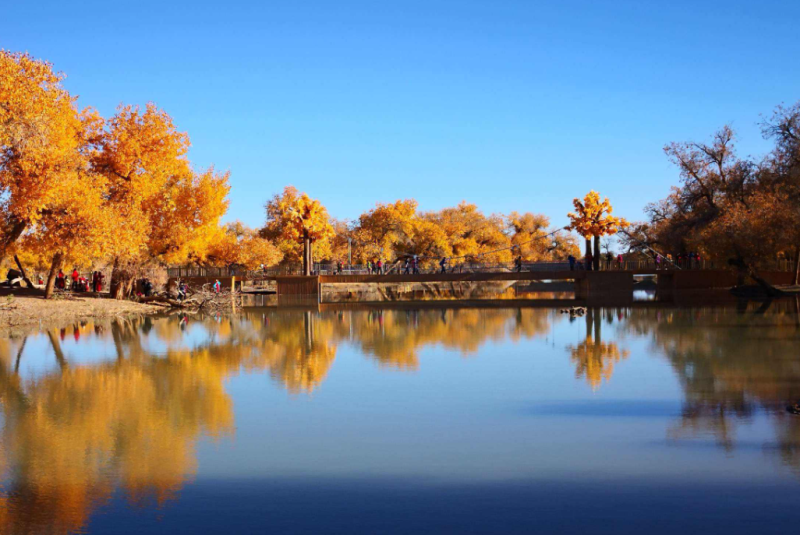
The Second Bridge is one of the most famous attractions in the scenic area, known for the "Reflection Forest," with an area of about 500 mu. The Populus euphratica trees here are tall and dense. The Ejina River forms a wide water surface here, and the branches and leaves of the Populus euphratica form clear reflections in the water. Especially at sunrise or sunset, sunlight falls on the golden leaves and water surface, creating interlaced light and shadow. It is a paradise for photography enthusiasts. The Second Bridge also has a wooden boardwalk with a total length of about 2 kilometers. Tourists can follow the boardwalk deep into the forest to observe the posture of the Populus euphratica up close. The visiting time is about 1.5 hours.
Fourth Bridge (Hero Forest)
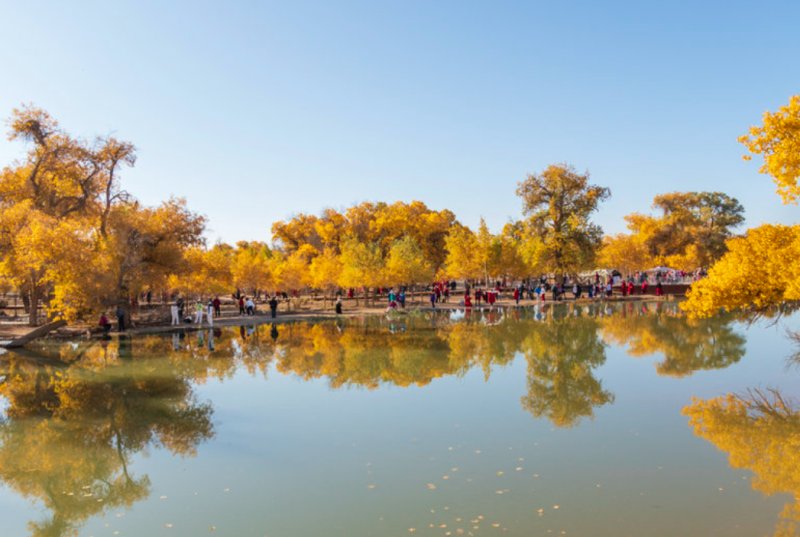
The Fourth Bridge is called the "Hero Forest." It is famous because director Zhang Yimou's film Hero was shot here, with an area of about 800 mu. The trunks of the Populus euphratica here are thick and varied in shape. Many Populus euphratica trees grow on sand dunes, demonstrating tenacious vitality. Some ancient Populus euphratica trees are over 500 years old, and their trunk diameter can reach 1.5 meters. With luxuriant branches and leaves, it is one of the most spectacular areas of Populus euphratica in the scenic area. There is a "Hero Platform" viewing platform in the forest, from which visitors can overlook the entire Populus euphratica forest. The visiting time is about 2 hours.
Seventh Bridge (Dream Forest)
The Seventh Bridge is located deep in the scenic area, with an area of about 600 mu. It is characterized by the "Dream Forest." The Populus euphratica here is mainly young trees, and the trunks are relatively slender. When the leaves turn golden, it looks like a golden ocean. Compared with other areas, the Populus euphratica at the Seventh Bridge appears more delicate, and the tributaries of the Ejina River form many puddles here. The Populus euphratica and their reflections in the puddles set each other off, just like a dream. The Populus euphratica at the Seventh Bridge usually turns yellow about one week earlier than in other areas, making it the earliest place to see golden Populus euphratica in autumn. The visiting time is about 1.5 hours.
Eighth Bridge (Sand Sea Forest)
The Eighth Bridge is the only area in the scenic area connected to the desert, with a total area of about 1,500 mu, combining Populus euphratica and desert landscapes. The desert here belongs to the edge of the Badain Jaran Desert. The sand dunes can reach a height of 50 meters. Tourists can experience sand sliding, camel riding, and other activities in the desert. The Populus euphratica at the edge of the desert grows among sand and gravel, forming a sharp contrast with the golden sand dunes and demonstrating the survival ability of Populus euphratica in extreme environments. The Eighth Bridge has a desert viewing platform and a desert camp. The visiting time is about 2 hours.
Food
Hand-Grabbed Mutton
Hand-grabbed mutton is a traditional food of Alxa League and can be seen everywhere in restaurants in Ejina Banner. Local free-range mutton is selected, cut into large pieces with bones, boiled in clear water, and eaten with salt or garlic paste. Local mutton is famous for its tender meat and lack of gamey smell. Hand-grabbed mutton retains the original flavor of the mutton and is the first choice for herders to entertain guests. In the yurt restaurants around the Populus euphratica forest scenic area, tourists can taste freshly cooked hand-grabbed mutton, paired with local vegetables such as sand onion, with a unique flavor.
Sand Onion Buns
Sand onion is a wild plant growing on the edge of the desert. It is rich in vitamins and minerals and is a local specialty ingredient. Sand onion buns use sand onion as the main filling, paired with minced mutton or minced pork, and appropriate seasonings. The skin is thin and the filling is generous, and the taste is fresh and fragrant. The refreshing taste of sand onion and the rich aroma of meat blend together, creating a unique taste, and it also has certain health benefits. Sand onion buns can be eaten in breakfast shops or restaurants in Ejina Banner. The price is affordable, usually 5 yuan each.
Suoyang Oil Pancakes
Suoyang is a specialty Chinese medicinal material in the Alxa region, with effects such as tonifying the kidney and moistening the intestines. Local residents often use it in cooking. Suoyang oil pancakes are made by grinding suoyang into powder, mixing it with flour, adding yeast for fermentation, and then frying it in oil. They are crispy in texture and have a faint medicinal aroma and sweetness. This food is not only delicious but also has dietary therapeutic effects. It is a local specialty snack and can be purchased at snack stalls around the scenic area. The price is about 3 yuan each.
Camel Milk Wine
Camel milk wine is a traditional drink of the Alxa Mongolians. It is made from camel milk through fermentation. The alcohol content is relatively low, usually between 10 and 15 degrees. The taste is mellow and has a milky aroma. Camel milk wine is rich in protein and amino acids and has certain nutritional value. It is a drink for local herders during festivals or when entertaining guests. In the yurts around the scenic area, tourists can taste freshly brewed camel milk wine and learn about its brewing process. The price is about 50 yuan per bottle (500 ml).
Tickets:
Ticket: 240 yuan per person.
You can search for the official WeChat public account "Ejina Populus Euphratica Forest Scenic Area" to get the latest updates or buy tickets online.
Opening Hours:
The opening hours of the scenic area are adjusted according to the seasons: from April 1 to October 15 each year, the opening hours are 6:00-19:00 (among them, October 1 to October 15 is during the Populus Euphratica Festival, and the opening hours are extended to 6:00-20:00); from October 16 to March 31 of the following year is the off-season, when some areas of the scenic area are open, with opening hours of 8:00-17:00. The best time to view Populus euphratica is from October 5 to 15 each year, when the Populus euphratica leaves are golden and the scenery is at its best. The specific time may fluctuate slightly due to climate.
Tour Route:
On the first day, arrive at the visitor center of the scenic area in the morning and transfer to the shuttle bus to the Second Bridge (Reflection Forest) to view the Populus euphratica and reflection landscape and take photos of the sunrise (if you get up early), which takes about 1.5 hours; then go to the Fourth Bridge (Hero Forest) to visit the filming location of Hero and observe the ancient trees up close, which takes about 2 hours; at noon, dine in the dining area near the Fourth Bridge and taste foods such as hand-grabbed mutton and sand onion buns, which takes about 1 hour.
In the afternoon, go to the Seventh Bridge (Dream Forest) to tour the golden young Populus euphratica forest, which takes about 1.5 hours; then go to the Eighth Bridge (Sand Sea Forest) to experience desert activities (such as camel riding and sand sliding) and view the landscape combining desert and Populus euphratica, which takes about 2 hours; in the evening, return to the Second Bridge to photograph the beautiful sunset over the Populus euphratica, which takes about 1 hour; then return to the entrance of the scenic area to end the day's itinerary.
On the second day, according to interest, you can choose to visit again the attractions you did not fully enjoy, such as the Populus euphratica in the water at the First Bridge and the details of the Hero Forest at the Fourth Bridge, or go to surrounding attractions such as the Heicheng site and the Strange Forest (tickets required separately) to further enrich the itinerary. Visiting the core area of the scenic area takes about 1-2 days in total. If surrounding attractions are included, 3 days can be arranged.
Transportation:
Self-driving: From Alxa Left Banner (BayANHot Town) in Alxa League, drive along S218 Provincial Road and S312 Provincial Road to Dalaihob Town, Ejina Banner. The total distance is about 630 kilometers, and the drive takes about 8 hours; from Jiuquan City, Gansu Province, drive along S214 Provincial Road to Dalaihob Town, Ejina Banner. The total distance is about 390 kilometers, and the drive takes about 5 hours; the scenic area is located about 2 kilometers southeast of Dalaihob Town. Self-driving visitors can directly reach the scenic area parking lot. The parking fee is 10 yuan per day.
Airplane: The nearest airport is Dunhuang Airport in Jiuquan, about 400 kilometers from Ejina Banner. The airport has tourist charter cars to Ejina Banner, costing about 500 yuan per car (can seat 4 people), and the drive takes about 5 hours; alternatively, you can fly to Yinchuan Hedong International Airport and then transfer to a long-distance bus to Ejina Banner. The total distance from Yinchuan to Ejina Banner is about 800 kilometers, and the drive takes about 10 hours. The bus ticket price is 180 yuan per person.
Long-distance bus: Dalaihob Town in Ejina Banner has a long-distance bus station. There are daily buses to and from Jiuquan City (departing at 8:00, 5 hours, ticket price 80 yuan per person) and Alxa Left Banner (departing at 7:00, 8 hours, ticket price 150 yuan per person); from Dalaihob Town to the scenic area, you can walk or take a taxi. The taxi fare is about 10 yuan.
Scenic shuttle bus: The scenic area implements shuttle bus connections, with stations from the First to Eighth Bridges. The through ticket includes the shuttle bus fee and allows unlimited transfers. The first bus is at 6:30, and the last bus is at 19:30. The ride between stations takes about 10-15 minutes.
Must-Visit Attractions:
Second Bridge (Reflection Forest): Characterized by Populus euphratica and water reflections, especially suitable for photography at sunrise and sunset, with an area of about 500 mu, a 2-kilometer wooden boardwalk, and a visiting time of about 1.5 hours.
Fourth Bridge (Hero Forest): The filming location of Hero, with dense ancient Populus euphratica trees, thick trunks, mostly over 500 years old, and the largest trunk diameter reaching 1.5 meters. The visiting time is about 2 hours.
Eighth Bridge (Sand Sea Forest): The only area combining Populus euphratica and desert, with desert dunes 50 meters high. Visitors can experience sand sliding and camel riding (cost about 100 yuan per person per hour). The visiting time is about 2 hours.
Travel Suggestions:
The best season to visit is October 5-15, when the Populus euphratica is golden and the scenery is at its best. It is recommended to book accommodation one month in advance because rooms are in short supply during the peak season.
The stations of the scenic shuttle bus are relatively far apart. It is recommended to wear comfortable sports shoes and carry a light backpack with water, snacks, a camera, and other items.
In autumn, the temperature difference between day and night in Ejina Banner is large. The daytime temperature is about 15-25°C, and at night it can drop below 5°C. It is necessary to bring outerwear, scarves, and other warm clothing.
Dining in the scenic area is relatively expensive (for example, hand-grabbed mutton is about 80 yuan per jin). You can buy dry food and water in Dalaihob Town and bring them into the scenic area. Restaurants in the town offer better value for money.
Photography enthusiasts are advised to bring wide-angle lenses and telephoto lenses. Sunrise (about 6:30-7:00) and sunset (about 18:30-19:00) are the best shooting times.
Precautions:
It is prohibited to pick or break Populus euphratica branches and leaves or carve on tree trunks in the scenic area. Violators will face fines (500-2,000 yuan) to protect the Populus euphratica ecological environment.
In autumn, Ejina Banner has a dry climate and strong winds. It is necessary to bring moisturizing skincare products, lip balm, and windproof sand masks or scarves to avoid dry skin and sand getting into the eyes.
During the peak season (October) in the scenic area, there are many tourists, and there may be queues for the shuttle bus. It is recommended to travel at off-peak times and arrive at the scenic area before 6:30 to avoid the crowds.
Mobile phone signal is good in the scenic area, but signal is weak in some desert areas. It is recommended to keep in contact with companions to avoid getting separated.
Respect local Mongolian customs. Take off shoes before entering a yurt. When accepting milk tea offered by the host, receive it with both hands. Do not photograph herders without permission.
Self-driving visitors should note that in autumn, some roads in Ejina Banner may experience dusty weather with low visibility. Drive slowly and turn on the vehicle lights.