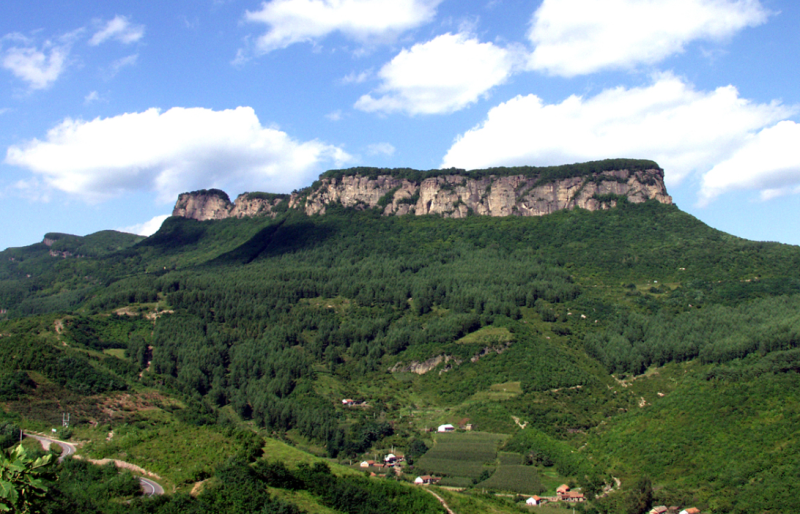
The Wunü Mountain Scenic Area is located 8 kilometers north of Huanren Town, Huanren Manchu Autonomous County, Benxi City, Liaoning Province. It is a national 5A-level tourist attraction and a World Cultural Heritage site. With the early Goguryeo royal city ruins at its core, the scenic area integrates historical culture and natural landscapes, serving functions of archaeological research, historical education, and ecotourism. The mountain body of Wunü Mountain is rectangular in shape, with the main peak at an altitude of 824 meters, stretching 1,500 meters from north to south and 300–500 meters from east to west, covering a total area of approximately 68.6 hectares. On the mountain, remains from the Goguryeo period such as city walls, palaces, and water reservoirs still exist. The remaining city walls are about 1,000 meters long and reach a maximum height of 6 meters, demonstrating the architectural wisdom of the ancient Goguryeo people. The vegetation coverage rate in the scenic area exceeds 90%, and natural landscapes such as mountain forests, gorges, and streams are abundant, with different scenery in each of the four seasons. It is an important destination for understanding Goguryeo history and enjoying the mountain scenery of eastern Liaoning.
Historical Culture
The history of Wunü Mountain can be traced back to 37 BC, when Jumong, the founder of Goguryeo, established the first capital of the Goguryeo regime here, historically known as "Holseunggolseong." As the early political, military, and cultural center of Goguryeo, Wunü Mountain served as a strategically important location that was easy to defend and difficult to attack due to its steep terrain. Its capital ruins witnessed the important stage of the Goguryeo people's evolution from a tribal alliance to a state form.
In 3 AD, the Goguryeo capital was moved to Ji'an, but Wunü Mountain always existed as a military fortress. Thereafter, this mountain city was used during the Liao, Jin, Yuan, and Ming dynasties, leaving historical traces from different periods. Since the 1950s, archaeologists have excavated a large number of artifacts from the Goguryeo period on the mountain, including pottery, ironware, and jade objects, providing precious physical materials for the study of Goguryeo culture. In 2004, the Wunü Mountain City ruins were inscribed as a World Cultural Heritage site due to their unique historical value, becoming an important testimony to Goguryeo civilization.
Main Attractions
Mountain City Ruins
The Mountain City Ruins are the core attraction of Wunü Mountain, with existing remains distributed at the summit and halfway up the mountain. Among them, the city wall from the Goguryeo period is the most representative relic, built with local bluish-gray rocks and winding along the mountain terrain, with some sections still maintaining a height of 6 meters and a width of 3 meters. Within the ruins, palace building foundations can also be seen, covering an area of approximately 1,000 square meters. The remaining column base stones show the scale and layout of the buildings. In addition, the artificially excavated water reservoir (commonly known as the "Heavenly Pool") has a diameter of about 10 meters and a depth of 3 meters. It was built with stone masonry and can still hold water today, reflecting the water conservancy wisdom of the ancient people. Visitors can intuitively understand the structure and functions of the Goguryeo royal city through explanatory signs and restoration models beside the ruins.
Dianjiang Platform
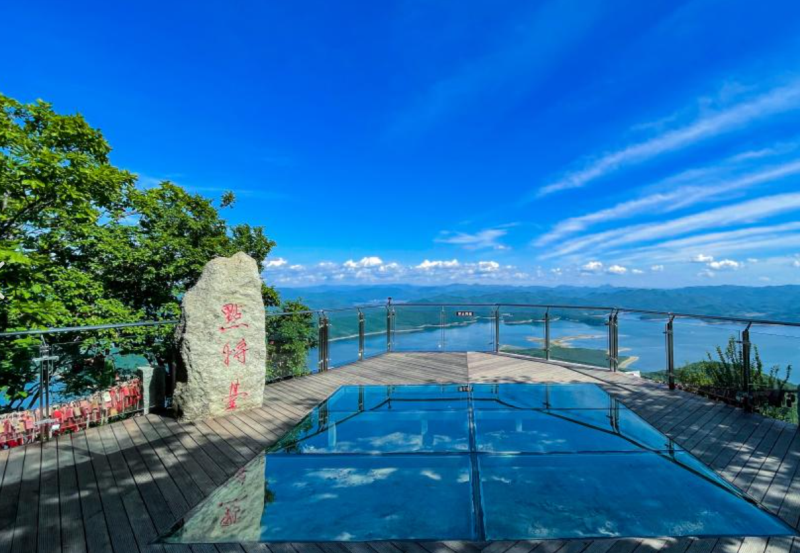
The Dianjiang Platform is located on the western side of the main peak of Wunü Mountain. It is a huge naturally formed rock platform with an area of about 50 square meters and an altitude of 810 meters. It is said to have been the place where the Goguryeo king reviewed troops and issued orders. Standing here, one can overlook the Huanren Reservoir and the surrounding river valley plains below the mountain, with a broad field of vision and a strategically dangerous terrain. Protective railings are installed at the edge of the platform, and visitors can gaze at the landscape from here and feel the momentum of the ancient military fortress. Due to years of wind and rain erosion, the rock surface has formed unique textures, which contrast beautifully with the surrounding green pines, making it a popular spot for photos.
Taiji Pavilion
The Taiji Pavilion is built on a gentle slope halfway up the mountain. It is named because the Huanren Basin, where Huanren County is located, is shaped like a Taiji bagua, and this landform can be clearly viewed from the pavilion. The pavilion is an antique four-cornered pyramidal-roof building with an area of about 20 square meters, equipped with stone tables and stools inside for visitors to rest. At an altitude of about 600 meters, it is a great place to watch the sunrise and sea of clouds. In the early morning, mist curls among the mountains and forms an ink-wash painting with the distant reservoir. The scenery is especially spectacular in spring and autumn. Beside the pavilion stands a stone tablet introducing the geographical features of Huanren, helping visitors understand the unique local natural environment.
One-Line Sky
One-Line Sky is a natural wonder of Wunü Mountain, located in the middle section of the climbing trail. It is a narrow passage formed by two huge rocks facing each other, about 30 meters long, with the narrowest part allowing only one person to pass sideways. The stone walls on both sides are 10–15 meters high, and looking up, only a single line of sky is visible. The stone steps in the passage are steep, and some sections require holding onto the rock walls to move forward, making it highly challenging. Walking through it, one can feel the steepness of the mountain and the uncanny workmanship of nature. On the stone walls, grooves carved by ancient climbers still remain, presumed to be the passage used by defending soldiers going up and down the mountain in those days, combining natural landscape and cultural-historical value.
Food
Huanren Icewine
Huanren Icewine is the most distinctive beverage around the scenic area. Although it is not "food" in the traditional sense, it has become a must-try due to its status as a geographical indication product. Huanren County, where Wunü Mountain is located, is a famous icewine production area in China. It is made from mountain grapes naturally frozen below -8°C. The wine is golden yellow in color, mellow and sweet in taste, with honey and fruit aromas. It is sold in specialty shops within the scenic area and in the county town, with prices ranging from several dozen yuan to several hundred yuan depending on quality. Some wineries also offer tasting experiences. Visitors can purchase it after sightseeing and experience the distinctive wine culture of eastern Liaoning.
Manchu Eight Bowls
The Manchu Eight Bowls is a classic dish of Manchu restaurants around Wunü Mountain and belongs to the local traditional banquet form. This dish consists of eight different bowls of food, including crispy white meat, chicken stewed with mushrooms, Amar Zun meat (stewed pork), mixed stew, and more, with a balance of meat and vegetables. It mainly uses stewing, steaming, and braising, reflecting the rough and practical characteristics of Manchu cuisine. At the "Manchu Eight Bowls Restaurant" in Huanren County, a set of Eight Bowls for 8 people costs about 200–300 yuan. The ingredients are mostly taken from local mountain forests and farmland, with authentic flavor, suitable for sharing among multiple people.
Mountain Vegetable Banquet
Wunü Mountain and the surrounding mountainous areas are rich in various wild mountain vegetables, such as Aralia elata sprouts, dandelion, bracken, and wild celery. Local restaurants prepare these wild vegetables into different dishes such as cold salads, stir-fries, and fillings, forming a distinctive mountain vegetable banquet. Among them, scrambled eggs with Aralia elata sprouts are tender and fresh, and stir-fried bracken with meat is fragrant and delicious. Both retain the natural flavor of the wild vegetables and are rich in vitamins and dietary fiber. A mountain vegetable platter costs about 30–50 yuan and can be tasted at farmhouses at the foot of the scenic area, making it an excellent choice for experiencing the dietary characteristics of the mountainous areas of eastern Liaoning.
Tickets:
Tickets are 105 yuan per person.
You can search for the official public account "Wunü Mountain Scenic Area" on WeChat to get the latest updates or buy tickets online.
Opening Hours:
Opening hours are adjusted according to the seasons: from April 1 to October 31, it is peak season, with opening hours from 8:00 to 17:00 (last entry at 16:00); from November 1 to March 31 of the following year, it is off-season, with opening hours from 9:00 to 16:00 (last entry at 15:00). Affected by weather, some climbing trails may be closed in winter.
Suggested Tour Route:
A recommended tour route covering the core attractions: from the scenic area entrance, take the sightseeing bus (15 yuan per person one way) to the mountainside parking lot (about 5 minutes), then walk up the mountain. First pass through One-Line Sky (about 20 minutes) to experience the steep natural landscape; then go to Taiji Pavilion (about 15 minutes on foot) to overlook the Huanren Taiji landform (about 30 minutes); continue upward to the Mountain City Ruins (about 25 minutes on foot) to visit the city walls, palace foundations, and water reservoir and other relics (about 1.5 hours); finally climb to the Dianjiang Platform (about 10 minutes on foot) to overlook the panorama and take photos (about 30 minutes). For descending, you can choose to return by the original route, or go down to the parking lot via the trail on the other side (about 1 hour on foot). The total tour time is about 4–5 hours. If time permits, you can stay for 1 hour at the Goguryeo Cultural Relics Exhibition Hall at the foot of the mountain (free admission) to gain a deeper understanding of the historical background.
Transportation:
Public transportation: From the Huanren County passenger transport station, take the special minibus to Wunü Mountain. It runs every hour from 8:00 to 16:00, takes about 20 minutes, and costs 5 yuan per person. After getting off, walk 5 minutes to the scenic area entrance.
Self-driving: From Huanren County, drive north along Wunü Mountain Road for 8 kilometers. The entire route is asphalt road and takes about 15 minutes. The scenic area parking lot charges 10 yuan per time for small vehicles and 20 yuan per time for large vehicles.
Tourist special lines: Travel agencies in Benxi city and Shenyang city all offer one-day tour special lines to Wunü Mountain, including round-trip transportation and tickets, priced at about 200–250 yuan per person. For details, consult local travel agencies.
Must-Visit Attractions:
Mountain City Ruins: The core area of the early Goguryeo royal city, with existing 1,000 meters of remaining walls, palace foundations, and a water reservoir, showing the architectural technology and capital layout of Goguryeo in 37 BC. It is a core component of the World Cultural Heritage.
One-Line Sky: A natural gorge 30 meters long and narrow enough at its narrowest point for only one person to pass through, with stone walls up to 15 meters high on both sides. It combines steep scenery and the function of a historical passage, and is a landmark experience on the climbing route.
Dianjiang Platform: A viewing platform at an altitude of 810 meters, overlooking the Huanren Reservoir and plains. It is said to be the place where the Goguryeo king reviewed troops. With a broad field of vision, it is the best location to feel the strategic position of the mountain city.
Travel Tips:
The suggested touring time is 1 day. It is best to visit from April to May or from September to October, when the climate is cool and the vegetation is lush or the forests are dyed in layers, offering the best scenery.
The climbing trail is about 3 kilometers long, with a cumulative ascent of about 400 meters. Some sections are steep. It is recommended to wear slip-resistant sports shoes and carry trekking poles for assistance.
There are few dining options within the scenic area. It is recommended to bring simple meals and drinking water from Huanren County, or eat at farmhouses at the foot of the mountain, with an average consumption of about 30–50 yuan per person.
When visiting the Mountain City Ruins, it is recommended to rent an electronic guide (30 yuan per unit) or hire a guide to gain a deeper understanding of the Goguryeo historical background. A 200 yuan deposit is required at the visitor center for the guide device.
In summer, take sun protection measures and carry mosquito repellent; in winter, pay attention to slip prevention when climbing, as some sections may have snow. Check the weather forecast in advance.
Precautions:
Smoking and open fires are strictly prohibited in the scenic area. As the mountain vegetation is dense, forest fire prevention regulations must be strictly observed. Violators will face fines.
During climbing, do not leave the designated trails without authorization. Some undeveloped areas are dangerous and may damage cultural relics.
Protect cultural relics and historic sites. Do not touch or carve on the city walls and remains. Surveillance is installed in the scenic area, and violators will be held accountable.
During thunderstorms, climbing should be suspended and shelter should be taken in indoor places nearby (such as Taiji Pavilion). Avoid staying at the summit or in open areas.
Mobile phone signal in the scenic area is weak. It is recommended to travel with companions and keep in contact.