Qianshan Scenic Area is located in Tiedong District, Anshan City, Liaoning Province. It is a national 5A-level tourist attraction, known as the "Pearl of Northeast China" and "the First Mountain of Liaodong." It is named after the legend that there are 999 peaks. The scenic area is famous for its beautiful peaks, steep rocks, secluded valleys, ancient temples, tall Buddha statues, strange pine trees, and abundant flowers. It combines natural landscapes with cultural landscapes and covers a total area of 125 square kilometers, with the core scenic area covering about 44 square kilometers. The highest peak in the area is Xianren Terrace, with an elevation of 708.3 meters, making it the second-highest peak on the Liaodong Peninsula. Qianshan belongs to the Changbai Mountain range. Its geological structure is mainly granite, and after hundreds of millions of years of weathering and erosion, it has formed many peculiar landforms, such as Yixiantian, Jiabianshi, and Wugenshi. There are currently 38 temples in the scenic area. Among them, Zuyue Temple built in the Tang Dynasty, Da'an Temple built in the Liao Dynasty, Xiangyan Temple built in the Jin Dynasty, and Wuliang Temple built in the Ming Dynasty are known as the "Five Great Zen Temples of Qianshan." They are among the important birthplaces of Buddhist and Taoist culture in Northeast China and attract a large number of tourists and believers every year for sightseeing and pilgrimage.
Historical Culture
The development history of Qianshan can be traced back to the Neolithic Age, when ancestors were already active here. During the Shang and Zhou dynasties, the Qianshan area belonged to Youzhou and was an important region of ancient Liaodong culture.
The spread of Buddhist culture in Qianshan began in the Eastern Jin Dynasty and had begun to take shape by the Tang Dynasty. Zuyue Temple is a representative building from this period. The surviving Tang Dynasty Buddhist statue fragments and steles bear witness to the religious prosperity of that time. During the Liao and Jin dynasties, Qianshan became a Buddhist holy site. Temples such as Xiangyan Temple and Da'an Temple were successively built, with monks gathering and incense burning prosperously. In the Ming Dynasty, Taoism was introduced to Qianshan. The construction of Wuliang Temple marked the formation of the coexistence and mutual prosperity of Buddhism and Taoism in Qianshan. Over the following hundreds of years, the cultures of the two religions merged with each other, leaving behind a large number of cultural relics such as inscriptions and cliff carvings, including the "Straight Up to the Blue Sky" stone inscription at Wuliang Temple and the "Tufu Yingsheng" plaque at Longquan Temple.
In the Qing Dynasty, Qianshan received royal attention. Emperors such as Kangxi and Qianlong visited Qianshan and left many poems and inscriptions. In modern times, Qianshan, as an important religious cultural and scenic area in Northeast China, has received continuous protection and development. It was listed as a national scenic area in 1982 and promoted to a national AAAAA-level tourist attraction in 2017. Today, Qianshan is not only a combination of nature and culture, but its rich religious architecture and inscription culture also provide valuable physical materials for the study of Northeast local history and religious history.
Main Attractions
Xianren Terrace
Xianren Terrace is the main peak of Qianshan, with an elevation of 708.3 meters. It is named because there is a huge rock at the top shaped like an immortal sitting or lying down. From the summit, visitors can overlook the entire Qianshan area, and on clear days can see the Bohai Bay in the distance. At the top stands an ancient Liao Dynasty pagoda, 7 meters high. It is a hexagonal solid brick pagoda with Buddhist scriptures carved on its body and is a provincial-level cultural relic protection unit. The hiking trail from Wuliang Temple to Xianren Terrace is about 5 kilometers long. Along the way are steep landscapes such as "Tianshangtian" and "Yibu Dengtian." Among them, "Yixiantian" is formed by two huge rocks pressing against each other, with a gap only wide enough for one person to pass sideways, and the narrowest part is about 0.5 meters wide.
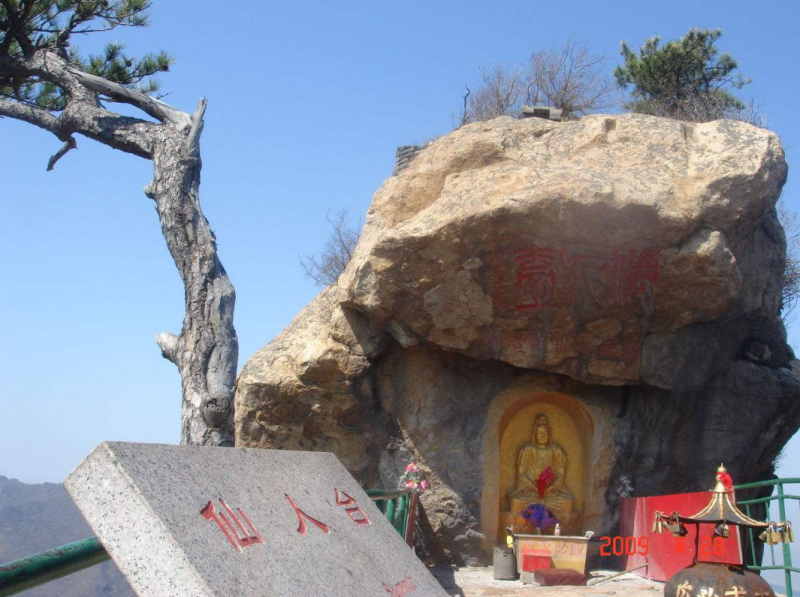
Wuliang Temple
Wuliang Temple is the core Taoist site in Qianshan. It was first built in the sixth year of Chongzhen in the Ming Dynasty (1633) by Taoist Liu Tailin of the Quanzhen School of Taoism and covers an area of about 20,000 square meters. The main buildings in the temple include the Sanguan Hall, Laojun Hall, and Yuhuang Pavilion, all built according to the mountain terrain and arranged in an orderly manner. Among them, Yuhuang Pavilion is located at the highest point in the temple, with a building area of about 80 square meters. From the pavilion, visitors can overlook the entire temple. Wuliang Temple preserves a large number of inscriptions from the Ming and Qing dynasties, such as Taoist talisman carvings on "Taiji Stone" and poems inscribed on "Muyu Stone," which have important historical and cultural value. The "Jiabianshi" landscape outside the temple is particularly peculiar. Two huge rocks tilt in a V shape, and visitors must turn sideways and hold in their stomachs to pass through. The three characters "Jiabianshi" are carved on the rock and were inscribed in the Qing Dynasty.
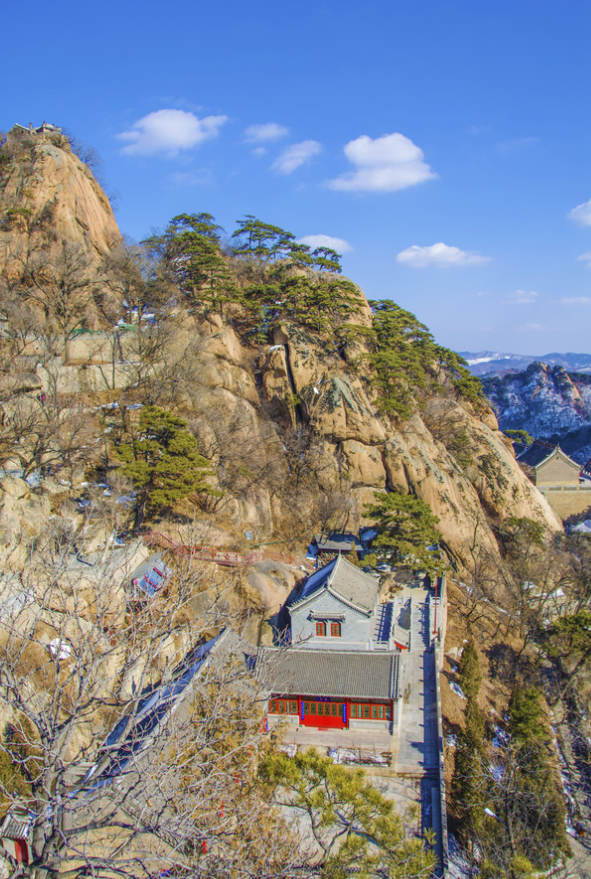
Longquan Temple
Longquan Temple is the first of the "Five Great Zen Temples of Qianshan." It was first built in the Tang Dynasty, and the existing buildings were rebuilt during the Ming and Qing dynasties. It covers an area of about 15,000 square meters. The temple is named after a clear spring nearby (Longquan). The spring water does not dry up all year round, and its temperature remains constant at about 10°C. The main buildings in the temple include the Mahavira Hall, Dharma King Hall, and Sutra Library. Among them, the Sakyamuni Buddha statue enshrined in the Mahavira Hall is 5 meters high and was made with Ming Dynasty copper gilding craftsmanship. There are many ancient pines around Longquan Temple. Among them, the "Panlong Pine" is more than 800 years old, with a trunk twisting like a dragon and a crown spread of 20 square meters. The temple preserves more than 20 inscriptions from the Jin Dynasty to the Qing Dynasty, recording the history of the temple's rise and decline.
Da'an Temple
Da'an Temple is located in the southern part of Qianshan. It was first built in the Liao Dynasty and rebuilt in the Ming Dynasty. It covers an area of about 12,000 square meters. Because it is located deep in the mountains and has a quiet environment, it is known as the "Pure Land of Qianshan." The main buildings in the temple include the Weituo Hall, Guanyin Hall, and Ksitigarbha Hall, all of which are flush gable style buildings. The natural landscape of Da'an Temple is unique. The "Tongming Mountain" next to the temple is named because there is a see-through stone cave at the top. The cave is about 3 meters high and 2 meters wide. Standing inside the cave, one can see the opposite peak. The "Stone Shed" in the temple is a naturally formed huge stone platform with an area of about 50 square meters. It is said to have been a place where monks meditated.
Xiangyan Temple
Xiangyan Temple was first built in the Jin Dynasty and is located in the central part of Qianshan. It is named because the ancient pines and rocks in the temple give off fragrance (actually the odor produced by the combination of pine resin and rock minerals). It covers an area of about 10,000 square meters. The buildings in the temple center on the Great Compassion Hall. The Thousand-Hand Guanyin statue enshrined in the hall is 6 meters high and is a Qing Dynasty wood carving. Around Xiangyan Temple there are many strange rocks and stones, such as "Golden Turtle Gazing at the Moon" and "Giant Elephant Drinking Water," which are remarkably lifelike. The "Immortal Cave" behind the temple is about 30 meters deep, and inscriptions by Jin Dynasty monks are carved on the stone walls inside.
Food
Qianshan Old Tofu
Qianshan Old Tofu is a local specialty food. It is made from soybeans soaked in Qianshan mountain spring water, ground with a stone mill, and coagulated with bittern. It has a delicate texture and rich bean aroma. When eaten, it is paired with special sauce (made by simmering shiitake mushrooms, wood ear mushrooms, dried small shrimp, etc.) and condiments such as chive flowers and chili oil. It has a smooth and tender texture and is salty and delicious. Farmhouse restaurants in the scenic area sell each portion for about 15 yuan. It is recommended to eat it with corn pancakes for a more rustic flavor.
Anshan Meat Dates
Anshan Meat Dates are a traditional Liaoning flavor snack, named because they are shaped like red dates. They are commonly seen in restaurants around the Qianshan Scenic Area. Lean pork is used as the main ingredient, cut into thin strips, marinated with soy sauce, sugar, cooking wine, and other seasonings, then air-dried and smoked. They are bright red in color, firm in texture, and moderately salty and sweet. Vacuum-packed meat dates are sold in specialty stores in the scenic area, priced at about 40 yuan per 500 grams, suitable as souvenirs.
Qianshan Stewed Chicken
Qianshan Stewed Chicken uses locally free-range native chicken, paired with Qianshan specialty hazel mushrooms and vermicelli, and is slowly stewed in a clay pot for more than 2 hours. The chicken is tender and the soup is rich. "Mountain Flavor Restaurant" in the scenic area sells each portion for 88 yuan. The native chicken used weighs about 1.5 kilograms and is enough for 3-4 people. It is the first choice for tourists to experience farmhouse dishes.
Surrounding Food
About 5 kilometers from Qianshan Scenic Area, there are many specialty restaurants on "Food Street" in Tiedong District, Anshan City. "Old Anshan Restaurant" is recommended, featuring Northeast home-style dishes. Its signature dishes include sweet and sour pork (38 yuan per portion) and Di San Xian (28 yuan per portion), with authentic flavors. "Seafood Stall" offers fresh Bohai Bay seafood, such as garlic vermicelli steamed scallops (6 yuan each) and spicy stir-fried clams (25 yuan per portion), with an average consumption of about 60 yuan per person.
Tickets:
Tickets are 76 yuan per person.
You can search for the official public account "Qianshan Scenic Area" on WeChat to get the latest updates or buy tickets online.
Opening Hours:
Opening hours are adjusted according to the season: peak season (April 1-October 31) is 7:00-17:30 (last entry at 16:30); off-season (November 1-March 31 of the following year) is 8:00-16:30 (last entry at 15:30). The opening hours of each temple are the same as the scenic area. The cable car operating hours are 8:00-17:00 (shortened to 16:00 in the off-season).
Tour Route:
Recommended one-day tour route: enter the main gate of the scenic area at 7:30 a.m., take the sightseeing bus to Wuliang Temple (about 15 minutes), and visit Wuliang Temple and surrounding landscapes such as "Jiabianshi" and "Taiji Stone" (about 2 hours); at 9:30, follow the trail to the Tianshangtian Scenic Area and experience steep landscapes such as "Yixiantian" and "Yibu Dengtian" (about 1.5 hours); at 11:00, take the Tianshangtian cable car to Wufo Summit (about 10 minutes), and climb to the top of Wufo Summit to overlook the mountains (about 1 hour); at 12:00, dine in the rest area near Wufo Summit (you can bring dry food or buy simple meals); at 13:30, walk to Longquan Temple and visit the ancient temple and the "Panlong Pine" (about 1.5 hours); at 15:00, head toward Xianren Terrace and tour the natural landscapes along the way (about 1.5 hours); at 16:30, return to the main gate of the scenic area, and you can buy souvenirs at specialty stores on the way. The whole journey is about 10 kilometers on foot. Those with insufficient physical strength can appropriately reduce the number of attractions.
Transportation:
Bus: In Anshan city, take buses 8, 17, or 25 to the "Qianshan Scenic Area" station, then walk about 10 minutes to the main gate. The ride takes about 40 minutes, and the fare is 2 yuan.
Self-driving: From the center of Anshan, drive east along Qianshan East Road for about 12 kilometers, taking about 25 minutes. The scenic area parking lot charges 10 yuan per time for small vehicles and 20 yuan per time for large vehicles. Parking spaces are tight in peak season, so it is recommended to arrive early.
Tourist line: There is a one-day tour line from Shenyang to Qianshan, including round-trip transportation and tickets, priced at about 150-180 yuan per person. You can sign up at travel agencies near Shenyang Station and Shenyang North Station.
High-speed rail: After taking the high-speed rail to Anshan Station, transfer to bus 8 to reach the scenic area. The high-speed rail ride from Shenyang takes about 30 minutes, and the ticket price is 30 yuan.
Must-Visit Attractions:
Xianren Terrace: The main peak of Qianshan, with an elevation of 708.3 meters. From the summit, visitors can overlook the panorama. The Liao Dynasty ancient pagoda is a landmark landscape.
Wuliang Temple: The core Taoist site of Qianshan. Landscapes such as "Jiabianshi" and "Muyu Stone" complement Taoist buildings, with profound cultural heritage.
Longquan Temple: The first of the "Five Great Zen Temples." The Tang Dynasty ancient temple, thousand-year-old ancient pines, and Longquan form a quiet artistic conception, suitable for calm visiting.
Tianshangtian Scenic Area: Featured by steep landforms such as "Yixiantian" and "Yibu Dengtian," it is a popular area for mountain climbing and exploration.
Travel Suggestions:
It is recommended to spend 1 day. The best visiting season is May-October, when vegetation is lush and the climate is suitable; in winter, visitors can enjoy snow scenery, but some sections are slippery, so safety must be noted.
Before climbing, prepare comfortable sports shoes and sun protection supplies. In summer, it is recommended to bring a sun hat and water bottle (there are many drinking water points in the scenic area). In winter, wear non-slip shoes and bring warm clothing.
Dining in the scenic area is relatively expensive. You can bring dry food such as bread and fruit and eat in rest areas; if you want to taste local specialties, it is recommended to eat at farmhouse restaurants outside the scenic area.
Those with weaker physical strength can reasonably use sightseeing buses and cable cars to reduce walking distance; there are multiple rest pavilions in the scenic area where you can stop and rest at any time.
It is recommended to download the scenic area electronic map in advance and mark must-visit attractions to avoid backtracking; there are many tourists on weekends and holidays, so it is recommended to travel off-peak (such as on weekdays or arriving early).
Precautions:
When climbing, follow "walk without looking at the scenery, look at the scenery without walking," especially on steep sections such as "Yixiantian" and "Jiabianshi." Pass through in order and do not crowd.
Smoking, littering, picking flowers and trees, and carving rocks are prohibited in the scenic area. Violators will face fines.
When entering temples, observe religious etiquette, do not make noise, do not touch Buddha statues, and turn off the flash when taking photos.
During the rainy season (July-August), geological disasters such as landslides may occur. Pay attention to weather forecasts and avoid climbing in severe weather; there are emergency shelters in the scenic area where you can take refuge in case of emergencies.
The scenic area medical point is located near Wuliang Temple and provides simple medical services.