Qingcheng Back Mountain is located in Qingchengshan Town, Dujiangyan City, Chengdu, Sichuan Province. It is an important part of the world cultural heritage site Qingcheng Mountain-Dujiangyan and a national 5A-level tourist attraction. The scenic area covers about 100 square kilometers, with the highest peak, Laojun Pavilion, at an altitude of 1,260 meters. Qingcheng Back Mountain is famous for its tranquil and beautiful natural scenery and profound Taoist culture, and is known as "Qingcheng, the most secluded under heaven." The vegetation coverage rate in the scenic area is as high as over 95%, and it is evergreen all year round, with green mountains and clear waters, crisscrossing streams, and flying waterfalls and springs everywhere. It mainly consists of tourist areas such as Feiquan Valley, Wulong Valley, Baiyun Ten Thousand Buddha Cave, and Tongtian Cave.
Historical Culture
Qingcheng Mountain is one of the important birthplaces of Chinese Taoism, and Taoist culture has been passed down here for more than two thousand years. During the Eastern Han Dynasty, Zhang Daoling, the founder of Taoism, once built a thatched hut here to preach, leaving behind many Taoist relics and legends. The Taoist buildings of Qingcheng Back Mountain were first built in the Jin Dynasty and underwent repairs and expansions through the Tang, Song, Yuan, Ming, and Qing dynasties, forming today's Taoist architectural complex represented by Jianfu Palace, Shangqing Palace, Tianshi Cave, and Zushi Hall.
The Taoist culture of Qingcheng Mountain is rich in connotation, integrating Taoist philosophy, health preservation concepts, and martial arts culture. Taoist martial arts schools such as Qingcheng Tai Chi and Qingcheng Sword are renowned at home and abroad, attracting many martial arts enthusiasts to come and study and exchange. In addition, Qingcheng Mountain also preserves a large number of Taoist cultural relics and classics, such as the stele of Emperor Xuanzong of Tang's handwritten edict and Yue Fei's handwritten Former and Later Memorials to the Throne by Zhuge Liang, which have extremely high historical and cultural value.
Main Attractions
Tai'an Ancient Town
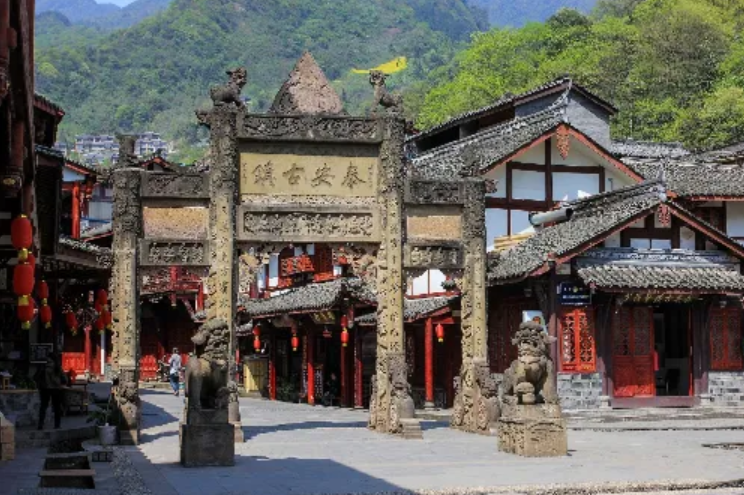
Tai'an Ancient Town is the gateway to Qingcheng Back Mountain. It was first built in the Tang Dynasty and has a history of more than 1,000 years. The ancient town is surrounded by mountains and water, antique and picturesque, and preserves a large number of ancient buildings and street styles from the Ming and Qing dynasties. In the town, there are historical sites such as Tai'an Temple and Guanyin Pavilion, as well as many specialty snacks and handicraft shops, making it a good place for tourists to rest and shop.
Wulong Valley
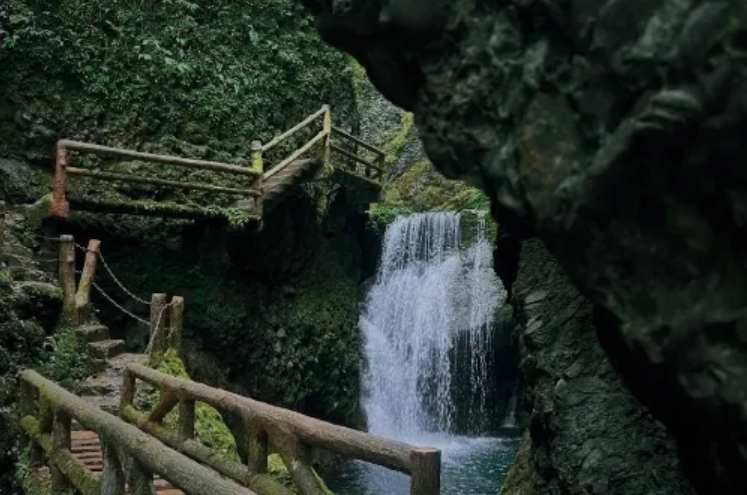
Wulong Valley is one of the main tourist areas of Qingcheng Back Mountain. It is named because five streams converge in the valley. The valley has green mountains and clear waters and crisscrossing streams, with attractions such as Jinwawa Pool, Longyin Gorge Plank Road, and White Dragon Spouting Water. Jinwawa Pool is the core attraction of Wulong Valley. The pool water is crystal clear, surrounded by green trees, and it is a good place to escape the summer heat.
Longyin Gorge Plank Road
It is about 600 meters long in total, clinging to steep cliffs. At the sheer precipice, planks are laid in midair for passage. In ancient times, wooden stakes were driven through the rock and planks were laid; now it has been rebuilt in reinforced concrete imitating wood, like a long dragon hidden in the gorge.
Feiquan Valley
Feiquan Valley is famous for its flying springs and waterfalls. There are many waterfalls in the valley in various forms, among which "Hundred-Zhang Long Bridge" and "Heavenly Bridge Wonder" are the most famous. Hundred-Zhang Long Bridge is a stone arch bridge spanning Feiquan Valley, about 100 meters long and about 3 meters wide, and is one of the landmark buildings of Qingcheng Back Mountain. Heavenly Bridge Wonder is a naturally formed stone arch bridge, about 30 meters high and with a span of about 20 meters. Its surface is flat, just like a bridge in the sky.
Baiyun Ten Thousand Buddha Cave
Located on the half-rock of the watershed between Wulong Valley and Feiquan Valley, it stretches about 2.5 kilometers from north to south, with more than a hundred large and small natural caves scattered around it, anciently known as Baiyun Cave. The cave group includes attractions such as Jiuseng Cave, Dizang Cave, Tongtian Cave, Great Compassion Hall, and Baiyun Temple, with 2,000 Buddha statues, hence the name Baiyun Ten Thousand Buddha Cave.
Baiyun Temple
As early as the Tang Dynasty, Zen Master Baiyun lived in seclusion here and cultivated to Buddhahood. Since then, this place has become a place for Buddhism to spread scriptures and practice. Baiyun Temple was rebuilt in 1992 on the site of Baiyun Nunnery, and in 1996 it was registered as a legal religious site and opened to the public.
Tour Route:
Recommended one-day tour route: Tai'an Ancient Town → Wulong Valley → Jinwawa Pool → Longyin Gorge Plank Road → Youyi Village → Baiyun Cableway → Baiyun Ten Thousand Buddha Cave → Heavenly Bridge Wonder → Feiquan Valley → Hundred-Zhang Long Bridge → Tai'an Ancient Town. This route covers the main attractions of Qingcheng Back Mountain and takes about 6-8 hours in total.
Travel Suggestions:
Wear comfortable shoes. The scenic area is mostly mountain roads, and walking is relatively strenuous.
Carry rain gear with you. The weather in mountainous areas is changeable and it rains easily.
It is recommended to set off early in the morning to avoid peak tourist crowds in the scenic area.
You can taste local food and buy specialty souvenirs in Tai'an Ancient Town.
Those with poor physical strength can choose to take sightseeing buses and cableways to save energy.
Precautions:
Smoking is prohibited in the scenic area. Pay attention to fire safety.
Protect the environment and do not litter.
Observe the regulations of the scenic area and do not enter unopened areas without authorization.
Pay attention to weather changes. In case of severe weather such as heavy rain or strong winds, return to a safe area promptly.
There are many monkeys in the scenic area. Do not feed them randomly to avoid being scratched by monkeys.
Transportation:
Bus: Take Metro Line 2 from Chengdu Xipu Station to Xipu Station, transfer to the Chengdu-Dujiangyan Intercity Railway to Qingchengshan Station, then transfer to Bus 101 or 102 to Qingcheng Back Mountain Station.
Self-driving: Depart from Chengdu, take the Chengdu-Dujiangyan Expressway and the Dujiangyan-Wenchuan Expressway to the Qingcheng Mountain exit, and drive along the Qingcheng Back Mountain Tourist Road to arrive.
Chartered car: You can charter a car from downtown Chengdu or near the Qingcheng Mountain scenic area to go to Qingcheng Back Mountain. The cost is about 200-300 yuan per day.
Opening Hours:
Opening hours are 08:00-17:00 (summer) and 08:30-17:00 (winter). Ticket sales hours in the scenic area are 08:00-16:30 (summer) and 08:30-16:00 (winter). Subject to the actual opening hours of the scenic area.
Tickets:
The ticket price is 20 yuan per person.