Qingcheng Mountain is located southwest of Dujiangyan City, Chengdu, Sichuan Province. It is one of the birthplaces of Chinese Taoism and a national 5A-level scenic area. The scenic area covers a total area of about 200 square kilometers, with the main peak, Laojun Pavilion, at an altitude of 1,260 meters. It is famous for its natural scenery, which is "the most secluded under heaven," and its profound Taoist culture. It is known, along with the steepness of Jianmen, the elegance of Emei, and the grandeur of Kuimen, as one of the "Four Excellences of Shu." The vegetation coverage rate on the mountain is over 98%, and the negative oxygen ion concentration reaches as high as 25,000 per cubic centimeter, making it a natural oxygen bar. There are currently more than 10 Taoist temples and palaces in the scenic area, among which Tianshi Cave and Shangqing Palace are national key cultural relics protection units. The buildings mostly adopt the Qing Dynasty western Sichuan folk dwelling style, built according to the terrain, simple and elegant.
Historical Culture
The Taoist culture of Qingcheng Mountain began in the Eastern Han Dynasty, with a history of more than 1,800 years. In 143 AD, Zhang Daoling built a thatched hut here to preach, founded the Way of the Five Pecks of Rice, and Qingcheng Mountain became the "Fifth Grotto-Heaven" of Taoism. During the Tang and Song dynasties, Taoism flourished, with more than 70 temples and palaces. Most of the existing buildings were rebuilt during the Ming and Qing dynasties. Emperor Xuanzong of Tang once granted it the name "Zhangren Temple," Emperor Qinzong of Song granted the plaque "Huiqing Jianfu Palace," and Zhang Sanfeng practiced here during the Ming Dynasty, leaving behind the "Sanfeng Relics."
In addition to Taoist culture, Qingcheng Mountain was also an important place for ancient Chinese education. During the Tang Dynasty, a disciple of the eminent monk Jianzhen built Yuanming Palace here, and the great Confucian scholar Zhang Shi lectured here during the Song Dynasty. In addition, Qingcheng martial arts is also an important school of Chinese martial arts. It was formed during the Tang and Song dynasties and flourished during the Ming and Qing dynasties. It is known for being "light, nimble, round, and alive, rising and falling quickly," and is known, along with Shaolin and Wudang, as one of the three major martial arts systems.
Main Attractions
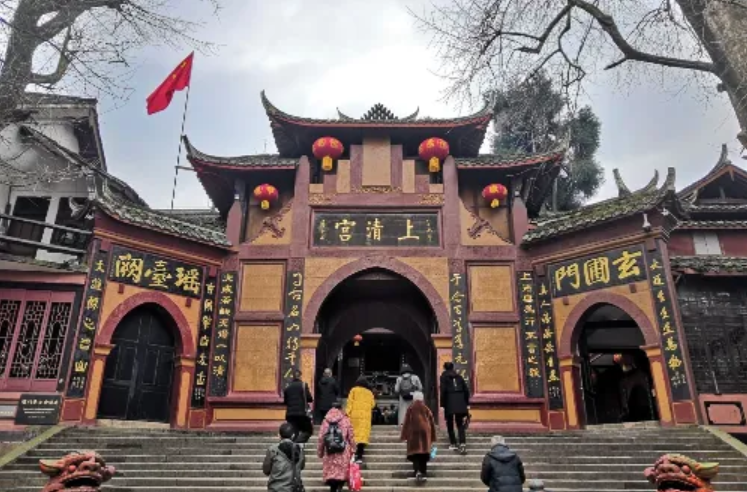
Shangqing Palace
Shangqing Palace was first built during the Jin Dynasty. The existing buildings were rebuilt during the Qing Dynasty and are located at the summit of Qingcheng Mountain, at an altitude of 1,600 meters. In front of the palace are stone steles reading "The Fifth Famous Mountain Under Heaven" and "The First Peak of Qingcheng." The palace enshrines statues of the Supreme Lord Laozi, the Jade Emperor, and other deities. The Tang Dynasty stone statues of the Three Sovereigns in the Sanqing Hall are precious cultural relics. Behind the palace are the Shengdeng Pavilion and Huxing Pavilion, from the top of which one can overlook the Chengdu Plain.
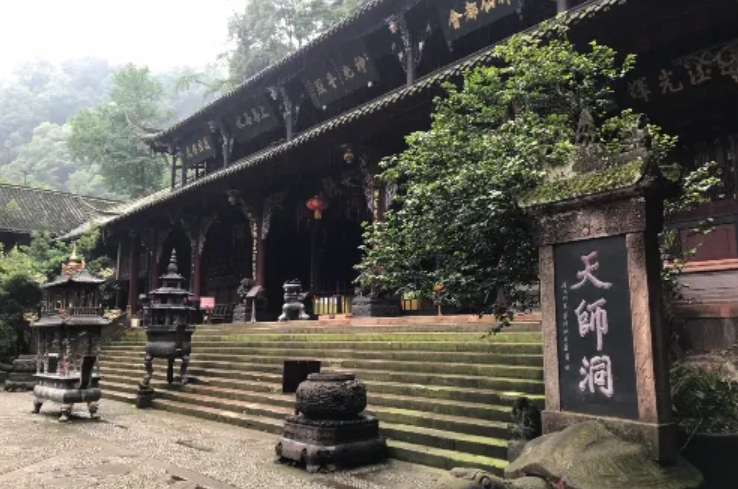
Tianshi Cave (Taoist Temple)
Tianshi Cave is the core attraction of Qingcheng Mountain. It was first built during the Sui Dynasty and got its name because Zhang Daoling once practiced here. The temple enshrines a statue of Zhang Daoling. Outside the temple are landscapes such as Sandao Stone, Xixin Pool, and the ancient ginkgo tree. The ancient ginkgo tree is about 50 meters tall and over 1,800 years old. It was planted by Zhang Daoling himself and is one of the oldest ginkgo trees in China. The Tianshi Cave building complex covers an area of 7,000 square meters. The existing halls were rebuilt during the Qing Dynasty and are built according to the mountain, magnificent in scale.
Jianfu Palace
Jianfu Palace was first built during the Tang Dynasty. The existing buildings were rebuilt during the Qing Dynasty. It is located at the entrance of Qingcheng Mountain and is the first palace after entering the mountain. Its name comes from the plaque "Huiqing Jianfu Palace" granted by Emperor Huizong of Song. The palace enshrines statues of the Five Sacred Emperors, the Queen Mother of the West, and other deities. In front of the palace is Jianfu Palace Square. The stone stele in the square inscribed with "Qingcheng Is the Most Secluded Under Heaven" was written by Zhang Daqian and is a popular spot for tourists to take photos.
Yuecheng Lake
Yuecheng Lake is an artificial lake in Qingcheng Mountain, located at the foot of Zhangren Peak, at an altitude of 800 meters. The lake surface area is about 15,000 square meters, and the water depth is about 10 meters. The lake and mountain scenery complement each other. Tourists can take a boat across the lake (ticket 5 yuan) to reach the cable car station. By the lake is the Yuecheng Lake Restaurant, which serves specialty foods of Qingcheng Mountain.
Laojun Pavilion
Located at the top of Laoxiao Peak, the first peak of Qingcheng, at an altitude of about 1,260 meters, it is one of the landmark buildings of Qingcheng Mountain's Taoist culture and an excellent place to overlook the entire mountain scenery.
Chaoyang Cave
Located on the southern mountainside of Laoxiao Peak, the main peak of Qingcheng Mountain, it is named because the cave entrance faces east and is the first to receive sunlight at dawn each day. It is a highly representative natural karst cave and Taoist cultural site in Qingcheng Mountain.
Yuqing Palace
One of the important representatives of Taoist temples and palaces in Qingcheng Mountain, it is located at the foot of Zhangren Peak at an altitude of about 1,000 meters in the front mountain of Qingcheng, backed by verdant peaks and facing a deep valley in front. It is named because the palace once enshrined the statue of the Taoist Yuqing Zhenwang. Its history can be traced back to the Tang Dynasty, and after repairs during the Ming and Qing dynasties, most of the existing buildings were rebuilt in modern times according to traditional forms, fully displaying the characteristics of the integration of Qingcheng Mountain's "seclusion" and "Tao."
Tour Routes:
One-day tour route: Jianfu Palace (30 minutes) → Yuecheng Lake (10 minutes by boat) → Front Mountain Cable Car (15 minutes up) → Shangqing Palace (1 hour) → Laojun Pavilion (40 minutes) → Tianshi Cave (1.5 hours) → Chaoyang Cave (30 minutes) → Front Mountain Cable Car (15 minutes down) → Yuecheng Lake (10 minutes by boat) → Jianfu Palace (return). This route covers the core attractions and requires taking the cable car and boat. It is suitable for tourists with limited time.
Two-day tour route: D1 Jianfu Palace → Tianran Tuhua → Tianshi Cave → Zushi Hall → Shangqing Palace, stay overnight at Shangqing Palace; D2 Shangqing Palace → Laojun Pavilion → Yuanming Palace → Yuqing Palace → Yuecheng Lake → Jianfu Palace. This route offers an in-depth experience of Taoist culture, with about 6 hours of hiking, suitable for tourists with good physical strength.
Travel Suggestions:
It is recommended to carry a light backpack and wear non-slip shoes. The steps in the front mountain are relatively steep, and some sections require using both hands and feet. Trekking poles can be rented (10 yuan/piece).
The vegetarian restaurant at Shangqing Palace serves Taoist vegetarian meals at 25 yuan/person. Dishes include vegetarian version of ginkgo stewed chicken, Qingcheng pickles, and others. Meal time is 11:30-13:30.
In summer, the temperature in the mountain is 5-8°C lower than in the city, so a thin jacket is needed. In winter, some sections have ice and snow, so waterproof shoes are recommended. Ice claws can be purchased at the scenic area entrance (15 yuan/pair).
The front mountain cable car takes 15 minutes one way. During peak seasons (weekends and holidays), the queue time is relatively long. It is recommended to arrive at the scenic area before 9 a.m. to avoid crowds.
Qingcheng Mountain is known for its "seclusion." It is recommended to arrange more than half a day to visit and quietly experience the integration of Taoist culture and natural scenery.
Notes:
Smoking is prohibited in the scenic area. Violators will be fined 50-200 yuan. Photography is prohibited in each temple and palace, and Taoist etiquette must be observed.
There are many insects and ants in the mountains. It is recommended to wear long pants, avoid brightly colored clothing, and not feed wild animals at will.
On the hiking route, there are no supply points from Tianshi Cave to Zushi Hall. Drinking water and dry food should be prepared in advance (energy bars and chocolate are recommended).
The last cable car of the front mountain is at 17:00. Downhill time should be arranged reasonably to avoid walking at night. Tourists in the back mountain need to take the cable car down before 16:30.
When purchasing specialties, it is recommended to go to designated shops in the scenic area and avoid buying from roadside stalls to prevent counterfeit and inferior products.
Transportation:
High-speed rail: Take the intercity high-speed rail from Chengdu Xipu Station to Qingcheng Mountain Station. There are more than 20 trains per day, the journey takes 30 minutes, and the fare is 10 yuan. Qingcheng Mountain Station is about 1.5 kilometers from the scenic area entrance. You can walk or take a sightseeing bus (5 yuan).
Bus: There are direct buses to Qingcheng Mountain from Chengdu Chadianzi Bus Station and Xinnanmen Bus Station. There are more than 10 buses per day, the journey takes 1.5 hours, and the fare is 25-30 yuan. From Dujiangyan city area, take Bus 101 to Qingcheng Mountain Scenic Area. It runs every 15 minutes, the journey takes 40 minutes, and the fare is 2 yuan.
Scenic area sightseeing bus: The sightseeing bus from Qingcheng Mountain Station to the scenic area entrance is 5 yuan/person. The sightseeing bus within the scenic area (front mountain-back mountain) is 20 yuan/person, and can be ridden multiple times with the ticket.
Self-driving: Chengdu → Rongchang Expressway → Dujiangyan West Exit → Qingcheng Mountain Avenue. The drive takes about 1.5 hours. The scenic area parking lot charges 20 yuan/day. During peak seasons (weekends and holidays), it is recommended to arrive before 9 a.m.
Opening Hours:
Qingcheng Mountain Scenic Area is open all year round. The daily opening time is 8:00-17:30, and entry stops at 17:00. The front mountain cable car operates from 8:30 to 17:00, and the back mountain cable car operates from 9:00 to 16:30. The opening hours of major temples and palaces such as Jianfu Palace and Shangqing Palace are 8:00-18:00, and in winter they close early at 17:30.
Tickets:
Peak season (March 1-November 30) 80 yuan/person, off-season (December 1-February 28 of the following year) 70 yuan/person.