Kaiyuan Temple is located at No. 176 West Street, Licheng District, Quanzhou City, Fujian Province. It is a national 4A-level tourist attraction, the largest Buddhist temple in Fujian Province, and a key national cultural relic protection unit. The temple covers a core area of approximately 78,000 square meters, faces south, and has a well-ordered layout. Its iconic landmarks are the Twin Pagodas, and the complex integrates southern Fujian traditional architecture, Buddhist culture, and the history of overseas transportation. It is an important cultural heritage site of Quanzhou as a world maritime trade center during the Song and Yuan dynasties, and a core center for the spread of Buddhist culture in southern Fujian. The temple now contains nearly 30 major halls and structures. The East and West Pagodas are the tallest pair of stone pagodas in China and are the most representative buildings of the site. The overall architecture combines Tang-dynasty layout, Song-dynasty style, and southern Fujian craftsmanship, giving it immense cultural and architectural value.
History and Culture
Kaiyuan Temple was first built in the second year of the Chuigong era of the Tang dynasty (686 AD), originally named Lotus Monastery, established when Huang Shougong donated his residence for the temple. It is one of the earliest Buddhist temples in Quanzhou. In the 26th year of the Kaiyuan era (738 AD), it was renamed Kaiyuan Temple. Over the following dynasties—Tang, Five Dynasties, Song, Yuan, Ming, and Qing—it was repeatedly renovated and expanded, and it remained a Buddhist center in southern Fujian.
During the Song and Yuan dynasties, Kaiyuan Temple reached its peak of prosperity thanks to Quanzhou's flourishing overseas trade. The temple complex continued to grow and became an important venue for Buddhist exchanges at home and abroad. At the same time, it became deeply intertwined with the history of Quanzhou Port's overseas transportation, bearing witness to the diverse cultural integration in Quanzhou. The East and West Pagodas were first built in the Five Dynasties and Song periods respectively, and were eventually constructed as stone pagodas, representing the pinnacle of ancient stone architecture.
During the Ming and Qing dynasties, Kaiyuan Temple underwent multiple restorations that preserved its core layout and cultural relics. In modern times, the temple has received systematic protection and restoration. In 1982, it was listed as a key national cultural relic protection unit, and in 2021, it was inscribed as part of the UNESCO World Heritage Site "Quanzhou: Emporium of the World in Song-Yuan China," becoming a core cultural tourism landmark of Quanzhou.
Major Attractions
East and West Pagodas (Twin Pagodas)
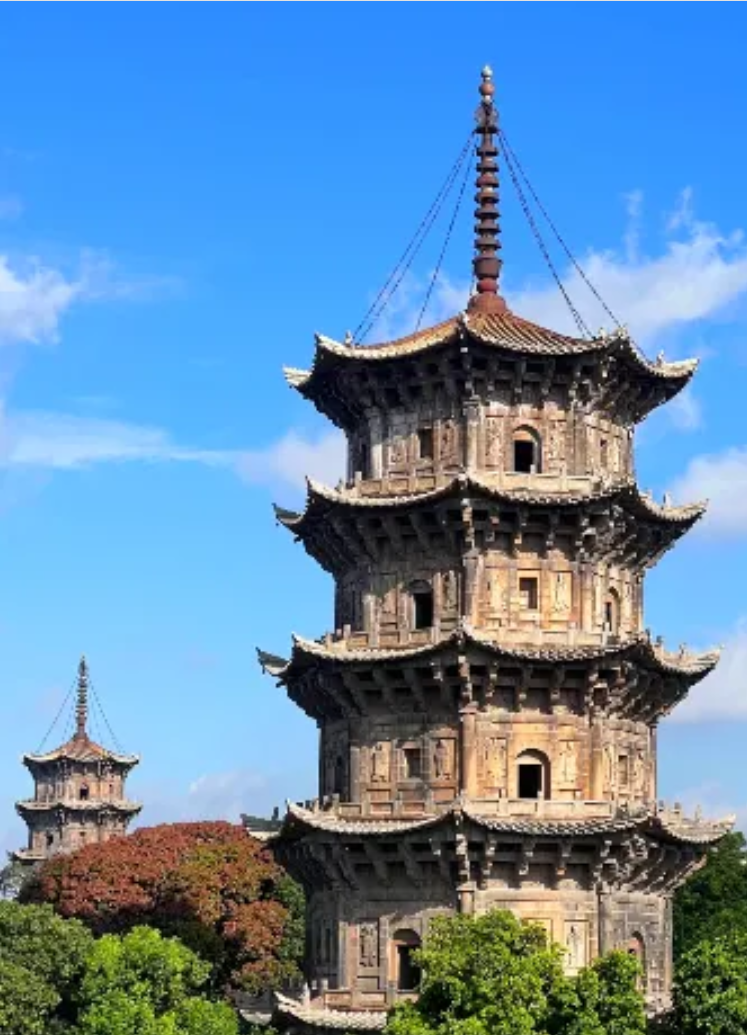
The East and West Pagodas are the iconic landmarks of Kaiyuan Temple and are key national cultural relics. The East Pagoda is named Zhenguo Pagoda, and the West Pagoda is named Renshou Pagoda. Zhenguo Pagoda was first built in the sixth year of the Xiantong era of the Tang dynasty (865 AD), initially as a wooden pagoda and later reconstructed in stone. It stands 48.27 meters tall, with five octagonal stories, and features exquisite Buddhist carvings and reliefs on its body. Renshou Pagoda was first built in the second year of the Zhenming era of the Later Liang during the Five Dynasties (916 AD), standing 44.06 meters tall, also a five-story octagonal stone pagoda with superb carving. Both pagodas are entirely made of stone without a single piece of wood, and they are the tallest and oldest existing multi-story stone pagodas in China.
Mahavira Hall
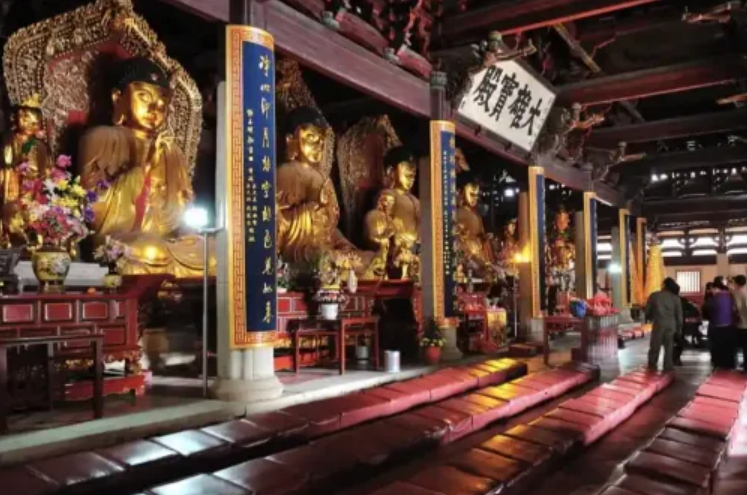
The Mahavira Hall is the main hall of Kaiyuan Temple. It was first built in the Tang dynasty; the existing structure dates from a Ming-dynasty reconstruction. It is 20 meters high, nine bays wide and six bays deep, covering about 1,387 square meters. Inside are enshrined the Three Buddhas, and the ceiling features 24 flying celestial musician wood carvings that blend southern Fujian woodcarving with Buddhist art, making it the essence of the temple's architecture.
Sweet Dew Precept Altar (Ganlu Jietan)
The Sweet Dew Precept Altar is one of the three major precept altars still extant in China. It was first built in the second year of the Tiansheng era of the Northern Song dynasty (1024 AD); the existing structure dates from a Qing-dynasty reconstruction. The altar has five tiers and enshrines Buddha statues and guardian precept deities. It is an important site for Buddhist ordination ceremonies, with rigorous architectural planning and both religious and architectural value.
Mulberry-Lotus Historic Site (Sanglian Guji)
The Mulberry-Lotus Historic Site is a core landscape related to the temple's origin. It features an ancient mulberry tree over 1,300 years old, which is a historical witness to the temple's founding. According to legend, this was the mulberry tree from Huang Shougong's donated residence, and the temple was built because the tree produced white lotus flowers. It is the oldest natural and cultural relic within the temple grounds.
Master Hongyi Memorial Hall
The Master Hongyi Memorial Hall is located inside Kaiyuan Temple and was built in memory of the modern eminent monk Master Hongyi. The hall houses manuscripts, personal belongings, paintings, calligraphy, and other cultural relics, displaying Master Hongyi's practice and cultural contributions in southern Fujian. It is an important site for cultural and commemorative visits.
Suggested Tour Route:
Main Gate → Heavenly King Hall → Worshipping Courtyard → Mahavira Hall → Mulberry-Lotus Historic Site → Sweet Dew Precept Altar → Zhenguo Pagoda (East Pagoda) → Renshou Pagoda (West Pagoda) → Master Hongyi Memorial Hall → Sutra Library
Tour Tips:
Recommended visiting time: 1.5 to 2 hours to fully explore the core attractions and immerse yourself in the temple culture.
Priority should be given to the Twin Pagodas; climbing them offers a panoramic view of Quanzhou's ancient city. Climbing requires a separate ticket.
Combine your visit with Quanzhou's West Street and Zhongshan Road for a comprehensive ancient-city cultural tour.
It is best to enter before 9:00 AM or after 3:00 PM to avoid crowds and enjoy a better experience.
You may hire an on-site guide for in-depth knowledge of the temple's history and architecture.
Important Notes:
As a religious site, visitors should remain quiet and refrain from loud talking, running, or horseplay.
Photography and video recording are prohibited inside the halls. Do not touch cultural relics, climb buildings, or climb the stone pagodas.
Flammable and explosive items and pets are not allowed inside the scenic area.
Please observe religious etiquette: do not kneel casually or step on the stone slabs of the worshipping courtyard.
Access to the Twin Pagodas is limited by the number of visitors; please queue in an orderly manner.
Smoking is prohibited inside the scenic area. Do not litter; take care of cultural relics and the environment.
Transportation:
Bus: Take Quanzhou bus routes 2, K502, or K612 and get off at Kaiyuan Temple Station.
Ancient City Tourist Shuttle: Take the Quanzhou Ancient City tourist shuttle and get off at the Kaiyuan Temple stop.
Self-driving: Navigate to the Kaiyuan Temple parking lot; designated public parking is available near the site.
Walking: Enter from West Street in Quanzhou and walk directly to the temple's main gate.
Opening Hours:
Regular opening hours: 8:00 AM to 5:30 PM daily; last entry at 5:00 PM.
On Buddhist festival days such as the 1st and 15th of the lunar month, opening time is advanced to 7:30 AM, while closing time remains unchanged.
Opening hours remain unchanged during major statutory holidays; any special adjustments will be announced in advance.
Tickets:
Admission is free. Guided tours are available for a fee.