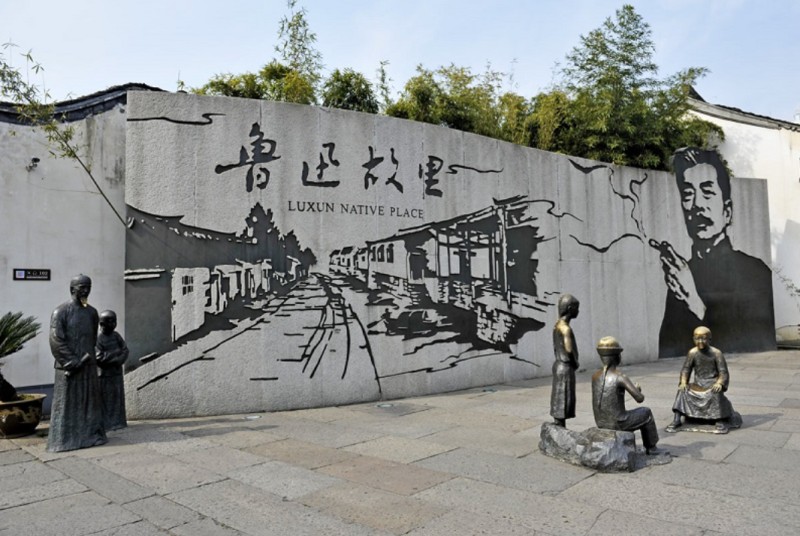
Lu Xun's Hometown · Shen Garden Scenic Area is located in Yuecheng District, Shaoxing City, Zhejiang Province. It is a National 5A Tourist Attraction composed of two core areas, Lu Xun's Hometown and Shen Garden, with a total area of about 5.7 hectares. Among them, Lu Xun's Hometown covers an area of about 4.1 hectares, and Shen Garden covers an area of about 1.6 hectares. It is a comprehensive scenic area integrating a famous person's hometown, a historic garden, and cultural experiences.
The scenic area features Lu Xun culture and Southern Song Dynasty love culture as its core characteristics. It preserves a large number of architectural styles from the Ming and Qing dynasties, with a total building area of about 18,000 square meters, including historical relics such as Lu Xun's Ancestral Residence, Lu Xun's Former Residence, Baicao Garden, and Sanwei Study, as well as Shen Garden, a private garden from the Southern Song Dynasty. As an important carrier of Shaoxing's history and culture, the scenic area receives more than 3 million visitors annually and is a landmark scenic area showcasing Shaoxing's folk customs and literary heritage.
Historical Culture
The history of Lu Xun's Hometown is closely connected with the Lu Xun family. Lu Xun (1881-1936) was a famous modern Chinese writer and thinker. His former residence and surrounding environment were the places where he lived in childhood and adolescence, and they are also the prototype locations for literary works such as "From Baicao Garden to Sanwei Study" and "Hometown." Lu Xun's Ancestral Residence was built during the Qianlong period of the Qing Dynasty, and Lu Xun's Former Residence is a late Qing building. These buildings witnessed Lu Xun's growth and also reflect the life of Shaoxing gentry families in the late Qing Dynasty and early Republic of China.
The history of Shen Garden can be traced back to the Southern Song Dynasty (1127-1279). It was originally the private garden of the Shen family, a literary family in the Southern Song Dynasty, and has a history of more than 800 years. It is famous for the love story of the Southern Song patriotic poet Lu You and Tang Wan. The two met here and wrote poems titled "Phoenix Hairpin," which became a classic love tragedy in Chinese literary history. Shen Garden therefore became a symbol of love culture. Most of its existing buildings were rebuilt during the Ming and Qing dynasties and retain the typical style of Jiangnan gardens.
The ancient city of Shaoxing where the scenic area is located was the ancient capital of the State of Yue and has a long history. The area where Lu Xun's Hometown and Shen Garden are located retains Shaoxing's traditional layout of "small bridges, flowing water, and households," as well as folk cultural elements such as black-awning boats, yellow rice wine, and village opera. It is a concentrated expression of Shaoxing's water town culture and folk customs.
Main Attractions
Lu Xun's Former Residence
Lu Xun's Former Residence is located in the central part of Lu Xun's Hometown Scenic Area. It is the place where Lu Xun lived during his youth, covering an area of about 500 square meters, and is a late Qing brick-and-wood residential building. The former residence is divided into parts such as the gatehouse, main hall, side rooms, and upper floors. Lu Xun's bedroom is on the second floor, simply furnished, retaining original objects such as a desk and bed. The former residence displays scenes of Lu Xun's family life and documentary materials related to Lu Xun's creative work. It is an important place for understanding Lu Xun's life.
Sanwei Study
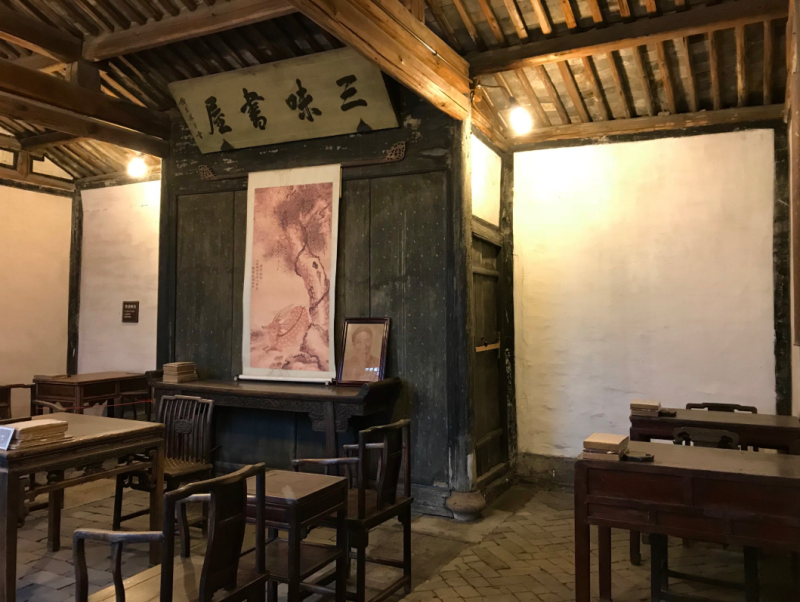
Sanwei Study is located to the east of Lu Xun's Former Residence. It was the private school where Lu Xun studied as a teenager (ages 12-17), covering an area of about 200 square meters, and is a Qing Dynasty building. The study was run by Mr. Shou Jingwu, and Lu Xun studied classics such as the "Four Books" and "Five Classics" here. A plaque reading "Sanwei Study" hangs in the main hall, and the couplet "To have no sound is the greatest joy, only filial piety and fraternal duty; to have flavor in the great broth, it is poetry and books" is carved on the pillars on both sides. Lu Xun's seat is in the northeast corner of the study, and the desk still bears the character "Early" that he carved there, becoming a symbol of diligent study.
Baicao Garden
Baicao Garden is the vegetable garden behind Lu Xun's Former Residence, covering an area of about 1,400 square meters. It was originally the private vegetable garden of Lu Xun's family. The garden contains plants such as Chinese honeylocust trees, mulberries, and raspberries, as well as facilities such as a stone well curb and mud wall base, basically consistent with the scenes described by Lu Xun in "From Baicao Garden to Sanwei Study." Visitors can experience here the childhood joy of Lu Xun's words: "Needless to say the green vegetable plots, the smooth stone well curb, the tall Chinese honeylocust tree, and the purple-red mulberries."
Shen Garden
Shen Garden is located about 500 meters south of Lu Xun's Hometown. It is a famous Jiangnan garden from the Southern Song Dynasty, with a total area of about 1.6 hectares, composed of three parts: East Garden, South Garden, and North Garden. The garden contains buildings such as the Lone Crane Pavilion, Half-Wall Pavilion, and Double Osmanthus Hall, as well as the "Phoenix Hairpin Stele" on which Lu You and Tang Wan wrote poems. The garden centers on water scenery, with rockeries, pavilions, and flowers and trees arranged in an orderly yet irregular manner, embodying the Jiangnan garden characteristic of "changing scenery with each step." The nighttime live performance "Shen Garden Night" reproduces the love story of Lu You and Tang Wan through lighting and drama.
Lu Xun's Ancestral Residence
Lu Xun's Ancestral Residence, also known as "Zhou Family Old Taimen," is located to the west of Lu Xun's Former Residence. It is the place where Lu Xun's ancestors lived, built during the Qianlong period of the Qing Dynasty, covering an area of about 1,000 square meters, and is a typical Shaoxing taimen building. The ancestral residence consists of a gate hall, main hall, incense hall, and seat building. It is grand in scale and exquisitely decorated, displaying the etiquette and life scenes of Shaoxing gentry families in the Qing Dynasty. The plaque "Deshou Hall" in the main hall was made in the Qing Dynasty, reflecting the family's moral aspirations.
Lu Xun Memorial Hall
Lu Xun Memorial Hall is located at the entrance of Lu Xun's Hometown Scenic Area, with a building area of about 6,000 square meters. It is a modern exhibition hall. With the theme "Lu Xun's Life and Creation," the hall systematically displays Lu Xun's life through objects, pictures, sculptures, multimedia, and other forms, including his life in Shaoxing, his experience studying in Japan, and his literary creation process. The hall also has a Lu Xun works reading room and an interactive experience area. It is an important place for studying and commemorating Lu Xun.
Food
Shaoxing Yellow Rice Wine Popsicle
Shaoxing Yellow Rice Wine Popsicle is a specialty snack around Lu Xun's Hometown. It is made with Shaoxing yellow rice wine as an ingredient, added with milk, cream, and other ingredients. It has a dense texture and a light aroma of yellow rice wine, with extremely low alcohol content (about 0.5%). It is sold in shops within Lu Xun's Hometown Scenic Area at about 5 yuan each. It is a cooling dessert loved by tourists and also an innovative expression of Shaoxing yellow rice wine culture.
Fennel Beans
Fennel beans are a traditional Shaoxing snack, famous because Lu Xun mentioned in "Kong Yiji": "Warm a bowl of wine, and ask for a dish of fennel beans." Fennel beans are made from broad beans, cooked with cinnamon, fennel, salt, and other seasonings. They are greenish-yellow in color, soft and glutinous in texture, and salty and savory in taste. They can be tasted at the "Xianheng Hotel" in Lu Xun's Hometown. A small dish costs about 8 yuan, and they taste even better with Shaoxing yellow rice wine.
Black-Awning Boat Banquet
The black-awning boat banquet is a characteristic Shaoxing dining form. Tourists can take a black-awning boat (from Lu Xun's Hometown to Shen Garden) and taste Shaoxing specialty dishes on board, such as drunken shrimp, drunken crab, and Shaoxing braised pork. The boat banquet package costs about 150-200 yuan per person, includes 4-6 dishes, and is paired with Shaoxing yellow rice wine. At the same time, visitors can enjoy the water town scenery along the way and experience the artistic conception of "the boat traveling in the water, the person sitting in a painting."
Surrounding Food
The "Xianheng Hotel" near Lu Xun's Hometown is a century-old restaurant. In addition to fennel beans, its drunken chicken, drunken meat, and other drunken foods are also very distinctive. A portion of drunken chicken costs about 38 yuan. The "Shaoxing Restaurant" around Shen Garden serves Shaoxing stinky tofu, crispy outside and tender inside, at 10 yuan per portion. In addition, new-style snacks such as Shaoxing yellow rice wine milk tea (about 12 yuan per cup) and cream xiaopan (a traditional pastry, about 3 yuan each) are also popular among tourists and can be bought at shops around the scenic area.
Tickets:
Lu Xun's Hometown Scenic Area is free and open to the public, but advance reservation is required. The ticket for Shen Garden Scenic Area is 40 yuan per person.
You can search for the official WeChat public account "Shaoxing Lu Xun's Hometown Shen Garden Scenic Area" to get the latest updates or make online reservations and purchase tickets.
Opening Hours:
The opening hours of Lu Xun's Hometown Scenic Area are 8:30-17:00 (April 1-October 31) and 8:30-16:30 (November 1-next March 31), with entry stopping at 16:30. Shen Garden's daytime opening hours are the same as Lu Xun's Hometown. Shen Garden's nighttime opening hours are 18:30-21:00 (October 1-next April 30) and 19:00-21:30 (May 1-September 30).
Tour Route:
Recommended one-day tour route: Arrive at the entrance of Lu Xun's Hometown Scenic Area at 9:00 a.m., swipe your ID card to enter, and visit Lu Xun Memorial Hall (1 hour); 10:00 visit Lu Xun's Ancestral Residence (40 minutes) and Lu Xun's Former Residence (40 minutes); 11:20 go to Sanwei Study (30 minutes), and after visiting, go to Baicao Garden (30 minutes); 12:20 dine at Xianheng Hotel and taste fennel beans and Shaoxing yellow rice wine (1 hour); at 13:30 p.m., walk to Shen Garden (about 10 minutes) and visit the Shen Garden Historic Area and Lu You Memorial Hall (1.5 hours); 15:10 experience the black-awning boat (from Shen Garden Pier to Lu Xun's Hometown Pier, 20 minutes by boat, cost 60 yuan per person); 16:00 buy specialties such as yellow rice wine popsicles and fennel beans in Lu Xun's Hometown, and end the trip.
Transportation:
Bus: Multiple buses in Shaoxing can reach Lu Xun's Hometown. Among them, routes 1, 7, 10, 24, 30, and others directly reach the "Lu Xun's Hometown" stop, with a fare of 1 yuan; BRT Express Bus Line 1 gets off at the "Lu Xun's Hometown" stop, with a fare of 2 yuan.
High-speed rail: From Shaoxing North Station (high-speed rail station), take BRT Line 1 to the "Lu Xun's Hometown" stop. The ride takes about 40 minutes and costs 3 yuan; taking a taxi costs about 50 yuan and takes 25 minutes.
Self-driving: Starting from downtown Hangzhou, take the Shanghai-Kunming Expressway and exit at Shaoxing, then drive south along Zhongxing Middle Road for about 3 kilometers. The drive takes about 1.5 hours. There are Lu Xun's Hometown Parking Lot and Shen Garden Parking Lot around the scenic area, with about 300 parking spaces and a parking fee of 8 yuan per hour.
Taxi: Taking a taxi from Shaoxing Station (old railway station) to Lu Xun's Hometown costs about 10 yuan and takes 10 minutes; taking a taxi from Shaoxing East Station to the scenic area costs about 30 yuan and takes 20 minutes.
Must-Visit Attractions:
Sanwei Study: A 200-square-meter Qing Dynasty private school where Lu Xun studied as a youth. It preserves original objects such as the desk with the character "Early" and is the prototype location of "From Baicao Garden to Sanwei Study," full of literary memories.
Baicao Garden: A 1,400-square-meter vegetable garden, a place where Lu Xun played in childhood. It is highly consistent with the description in the text, allowing visitors to feel the childhood joy in Lu Xun's writing. It is a must-visit place for literature lovers.
Shen Garden: A 1.6-hectare Southern Song garden, famous for the "Phoenix Hairpin" love story of Lu You and Tang Wan. The "Phoenix Hairpin" stele in the garden is the core attraction, and the nighttime live performance is worth watching.
Lu Xun's Former Residence: A 500-square-meter late Qing residence, Lu Xun's residence in his youth. It preserves original furnishings and displays scenes of Lu Xun's family life. It is an important window for understanding Lu Xun's life.
Tour Suggestions:
It is recommended to avoid peak holidays (such as May Day and National Day), when tourists are dense and attractions such as Sanwei Study and Shen Garden require queuing. The best visiting time is 9:00-11:00 a.m. on weekdays.
When visiting Lu Xun Memorial Hall, you can rent an audio guide (20 yuan per device), or join the scenic area's free scheduled guided tours (10:00 a.m. and 14:00 p.m.) to gain an in-depth understanding of Lu Xun's literary achievements.
The "Phoenix Hairpin" live performance during Shen Garden night tours (18:30-21:00) combines lighting and drama and offers a strong experience. It is recommended to reserve one day in advance on the official public account. The ticket price is 80 yuan per person.
To taste fennel beans, the "Xianheng Hotel" main branch is recommended. This century-old restaurant has a simple and ancient environment, and visitors can also take photos with the Kong Yiji statue.
In summer, pay attention to heat protection, as there is little shade in the scenic area; winter is relatively damp and cold, so it is recommended to wear waterproof shoes and carry rain gear (Shaoxing has frequent light rain).
Notes:
Lu Xun's Former Residence, Sanwei Study, and other sites are cultural relic protection units. Touching exhibits and climbing buildings are prohibited, and flash photography is not allowed.
When taking a black-awning boat, wear a life jacket, do not lean your body out of the boat, and keep mobile phones, cameras, and other items safe to prevent them from falling into the water.
There are many shops in the scenic area. When buying specialties such as yellow rice wine, pay attention to the production date. Prices in supermarkets outside the scenic area may be more affordable.
Shaoxing water towns have many stone-paved roads, which are slippery on rainy days. It is recommended to wear non-slip shoes; some sections are narrow, so pay attention to avoiding pedestrians, especially in peak season.
The area around the "Phoenix Hairpin" stele in Shen Garden is crowded with tourists. When taking photos, pay attention to queuing and avoid crowding; for nighttime visits, follow the guidance and watch your step.
Pets and drones are prohibited in the scenic area. Smoking must be done in designated areas. Violators will be fined (50-200 yuan).