The Root Palace Buddhist Country Cultural Tourism Area is located in the southern suburbs of Kaihua County, Quzhou City, Zhejiang Province. The scenic area covers 3.03 square kilometers. Its overall architectural style combines the characteristics of Tang Dynasty architecture and Huizhou-style architecture, and the internal landscapes are built according to the terrain. Here, the mountains and waters are elegant, the cultural heritage is rich, and the landscapes are unique. It is the world's only root culture-themed tourism area. Guided by roots, the scenic area ingeniously integrates root carving art, bonsai art, ornamental stone culture, and ancient garden architecture, and is known as the world capital of root carving art. The park gathers more than 160 kinds of plants and precious tree species, and 36 species of birds, including the long-tailed blue magpie, red-billed leiothrix, Chinese bulbul, and thrush, reside here year-round. In 2013, the Root Palace Buddhist Country Scenic Area became Quzhou City's first China National 5A-level Tourist Attraction. It is also a China National Cultural Industry Demonstration Base, a China National Ecological Civilization Education Base, the Root Carving Creation Practice Base of the China Sculpture Institute, and the Guinness World Record "Largest Root Carving Museum."
Historical Culture
In 1991, after local root art prodigy Xu Guqing returned from completing his studies, he and seven other workers founded a root carving factory covering 200 square meters in a farmhouse building. This was the predecessor of the Root Palace Buddhist Country. Xu Guqing registered the "Zui Gen" trademark and established Quzhou Zui Gen Artworks Co., Ltd. in 2000. In 2002, he began preparations for the construction of the Root Palace Buddhist Country Cultural Tourism Area.
In 2006, the "China Root Art Fine Arts Exposition Garden" began construction. This was an ecological civilization tourism scenic area featuring bonsai, ornamental stones, root art, and ancient garden architecture, which later became the Root Palace Buddhist Country Cultural Tourism Area. In 2007, the first-phase landscape of the "China Root Art Fine Arts Exposition Garden" opened to the public.
In 2013, construction of the Huaxia Root Culture Scenic Area project began. On December 15, 2018, the Huaxia Root Culture Scenic Area of the Root Palace Buddhist Country opened for trial operation. At the same time, the 7th China (Kaihua) Root Carving Art Culture Festival and the 2nd "Belt and Road" International Root Art Cultural Exchange Week were held in the Huaxia Root Culture Scenic Area.
In 2015, China's only root carving culture-themed hotel was completed, known as a "museum you can live in." Subsequently, with the goal of creating an immersive travel experience for visitors, the Root Palace Buddhist Country Cultural Tourism Area continued to optimize its garden landscapes, and supporting facilities such as experience halls were successively improved.
In 2017, civil construction began on the Red Culture Root Carving Art Museum. In 2019, the main structure was topped out, with a building area of more than 7,000 square meters. On May 18, 2020, the Buddhist Culture Root Carving Art Museum of the Kaihua Root Palace Buddhist Country Cultural Tourism Area officially opened, becoming a new starting point for the transformation of the Root Palace Buddhist Country Cultural Tourism Area.
Main Attractions
Root Carving Buddhist Country
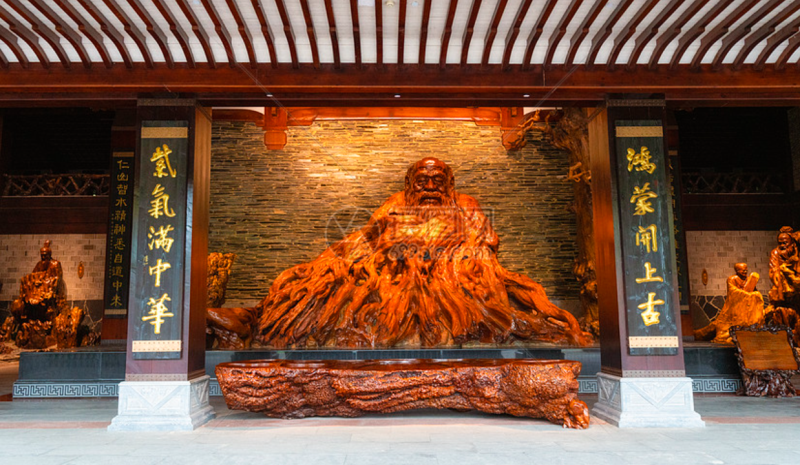
The Root Carving Buddhist Country has a building area of 12,000 square meters and contains three main halls arranged in depth. It is the main part of the scenic area and is roughly laid out according to the main buildings of a Buddhist Zen temple. From front to back, they are the Future Buddha Hall, the Mahavira Hall, and the Five Hundred Arhats Hall. The first building is a two-story structure, while the second and third buildings are single-story structures. In addition, the Arhat Culture Corridor is built along the mountain and winds around them. Here are displayed more than 1,000 giant root carving works in the Buddhist culture series, including Sakyamuni, the Future Buddha, the Four Great Bodhisattvas, the Four Great Vajras, and the Five Hundred Arhats. Among them, the largest root carving of the main Buddha Sakyamuni is massive in form and weighs more than 40 tons. The root material traveled a long detour from the remote China-Myanmar border and, after being "enlightened" by Zui Gen, finally stood majestically as a Buddha.
Zui Gen Tian Gong Museum
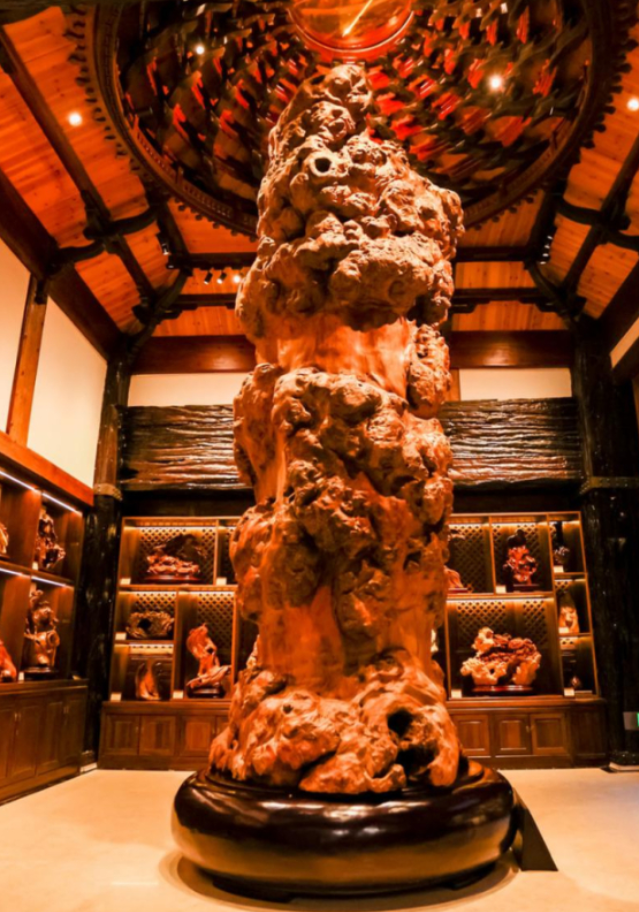
Relying on the advantageous geographical location of the North Gate and its profound cultural heritage, the Zui Gen Tian Gong Museum is the first root carving museum in China. The museum brings together landscapes, fine works, famous works, famous shops, and famous exhibitions in one hall, and is equipped with exquisite business formats such as various foods and handicraft exhibition and trade, making it a vibrant cultural venue. It is divided by function into four areas: the first floor is the International Handicraft Exchange Center, the second floor is the Zui Gen Tian Gong Grand Hotel, the third floor is the Zui Gen Tian Gong Museum, and the fourth floor is the Zui Gen Artworks Trading Center. The museum displays works from various periods by Master Xu Guqing and members of his master studio. These works have unique styles, original material selection, and exquisite creation, with a wide range of themes and profound conceptions. They are permeated with strong vitality and possess a natural, innocent beauty and a strong sense of mission for traditional culture.
Green Plum Garden
The Green Plum Garden is built along the mountain. Its name is taken from the "Qing" character in Xu Guqing's name and the "Mei" character from his hometown Meilin. The garden is themed around plum blossom bonsai and has more than 3,000 bonsai of various types, mainly thousand-year-old plum old stumps and landscape bonsai. Precious tree species include yew, Chinese mosquito mother, and ginkgo, with more than 500 varieties. Most of the bonsai created by Xu Guqing are relatively large in scale, using old trees and ancient stumps as materials, and emphasizing harmonious combination with surrounding ancient architecture, landscape, and environment, creating a personified nature.
Hundred Trees in Spring
Hundred Trees in Spring is one of Zhejiang Province's first ecological environment education demonstration bases. It covers 600 square meters and displays more than 200 pieces of thousand-year-old dead famous trees and ebony wood. These tree roots come from various parts of China and have a long history, witnessing the cycle between humanity and nature. Through artistic creation, they have been preserved, and some original materials collected have been made into display boards, serving to warn people to protect the ecological environment.
Stele Corridor
The Stele Corridor is located next to the Root Carving Buddhist Country. It is a building imitating a Hakka round house, used to engrave and preserve the ink writings and calligraphy and paintings of celebrities who have come to the Root Expo Garden. Its circular architectural shape is located between the Zui Gen Tian Gong Museum and the Root Carving Buddhist Country.
Five Hundred Arhats
This set of giant root art Five Hundred Arhats was created by Master Xu Guqing after more than ten years of preparation and the expenditure of huge funds to collect thousand-year-old longan wood, lychee tree roots, and other root stumps from various parts of China. It is more than 680 meters long. The Five Hundred Arhats formation has a unique style, and its arrangement simulates the scene of gathering together to discuss a Buddhist dharma assembly. The overall layout follows important dharma assemblies such as the Buddha converting the five ascetics and promoting Buddhism in the Kingdom of Magadha as the main line. All the Arhats surround the Mahavira Hall, totaling 500 statues, forming a "hui" shape, symbolizing the cycle of reincarnation spoken of in Buddhism. This work integrates modern artistic concepts into traditional Chinese carving techniques, perfectly combining root carving art and Chinese Buddhist culture. It is the world's largest set of root-carved Five Hundred Arhat statues.
Zui Jing Garden
Zui Jing Garden is located at the foot of the mountain and covers an area of more than 20,000 square meters. It was created by root carving master Xu Guqing using the earth and stone excavated during the construction of the Root Palace Buddha Pagoda landscape project to fill valleys and create a garden, divert water to make a lake, and arrange scenery according to the mountain terrain. This is a landscape garden mainly featuring bonsai, with more than 2,000 bonsai of pine, cypress, and miscellaneous trees, among which precious species such as galar, Japanese white pine, Buddhist pine, and black pine are the main ones. The circular corridor in the center of the forest is called the "Reflection Corridor." Its shape resembles a Chinese Hakka tulou. Around it are Kaihua bluestone slabs used for calligraphy master steles, and in the central circular courtyard, ancient trees reach the sky.
Zui Gen Tan
Zui Gen Tan is a Tang-style building and is the creation site of Master Xu Guqing. The first floor is the Zui Gen Fine Works Hall, and the second floor is office space and an exhibition room, with corridors and pavilions facing the Green Plum Garden across the lake. Here are displayed more than 60 rare treasures collected by Master Xu Guqing since his artistic career. It is a place for him to engage in root art creation and research, as well as to receive friends and discuss art.
Root Palace Buddha Pagoda
The Root Palace Buddha Pagoda is located to the northwest of the Root Carving Buddhist Country. It is a square pagoda and also a landmark building in western Zhejiang. Construction of the pagoda began on June 26, 2012. It covers 1,500 square meters, has 13 stories, is 79.99 meters high, and has a total building area of 5,700 square meters, with an additional underground palace floor. The interior walls of the Root Palace Buddha Pagoda are mainly Buddhist yellow. Around the pagoda are planted cypresses and ginkgoes. It is framed with reinforced concrete and decorated mainly with brick-and-wood structure. A large number of wooden dougong brackets are layered internally. The Root Palace Buddha Pagoda uses "seeing the Buddha when flowers bloom" as a metaphor, highlighting the collected contents and complementing more than 1,000 giant Buddhist-themed root carving artworks. The root carving works displayed in the pagoda are mainly Guanyin statues. There are more than 200 Guanyin Bodhisattva root carving statues inside, so it is also called Guanyin Pagoda. The pagoda displays more than 1,000 fine root art works, including rosewood root carving Guanyin hundred images, thirty-three manifestations, Thousand-Hand Guanyin, Dripping Water Guanyin, Wish-Fulfilling Guanyin, Reclining Guanyin, and Four-Faced Guanyin. Floors 1-2 display four Guanyin statues, namely Thousand-Hand Guanyin, Dripping Water Guanyin, Wish-Fulfilling Guanyin, and Reclining Guanyin, as well as Guanyin's Thirty-Three Manifestations. Floors 3-4 display ebony root carving fine works of the Eight Hundred Arhats. Floors 5-10 contain the Hundred Guanyin Images. Floors 11-12 feature Guanyin murals. The top floor enshrines a wooden Four-Faced Guanyin, implying compassion, wisdom, peace, and blessed destiny. In the middle is placed a huge inscribed bronze bell, the Eight-Faced Zen Bell, weighing 13 tons and cast in bronze. The underground palace is used to display Guanyin statues from past dynasties. On November 11, 2014, the completion ceremony of the Root Palace Buddha Pagoda opened.
Food
Kaihua Qi Gao
One of the must-eat snacks when coming to Kaihua, known as "Quzhou's little pizza." It has a soft rice cake texture, and its taste is similar to fa gao. It is covered with many side ingredients such as shredded pork, shredded bamboo shoots, shredded tofu, and chopped scallions. Freshly out of the pot, Kaihua Qi Gao is fragrant and very delicious. However, some people may find the small shrimp skins and wood ear mushrooms on top a little fishy, but those who like it will definitely love it.
Longtan Shaobing
Longtan Shaobing is crispy and crunchy. When freshly baked, it is absolutely superb, with a burnt aroma outside and full of juice in one bite. There are many flavor choices, among which the preserved mustard greens and fresh meat filling is especially popular. When eating, adding a little sugar makes the taste even better.
Wang A Gai Food
This is a restaurant highly recommended by locals. The QQ noodles are complete in color, aroma, and taste, and the fried rice cakes are also fragrant and very delicious.
Na Ni Xiaolongbao
Very famous locally, it operates until early morning. Its xiaolongbao are rich in soup and full of meat filling. Paired with a bowl of authentic Majin rice soup, the taste is intoxicating.
Tickets:
Tickets are 118 yuan per person.
You can search for the official WeChat public account "根宫佛国文化旅游区" to get the latest updates or buy tickets online.
Opening Hours:
The scenic area is open from 08:30 to 17:00 (open all year round). However, on some special holidays or due to scenic area maintenance and other reasons, the opening hours may be adjusted. Visitors are requested to pay attention to the official notices of the scenic area in advance.
Recommended Tour Route:
A recommended one-day tour route: arrive at the scenic area at 9:00 a.m. and start touring from the Fumen Xiangguang attraction to feel the unique charm of the sculpture group composed of gate sculptures, ornamental stones, the Bagua diagram, as well as root culture sculptures and tea culture sculptures. Then go to Jiqu Zhai to appreciate representative root art works by Xu Guqing from various periods and award-winning works by his disciples. At about 10:30, come to the Root Carving Buddhist Country and visit the Future Buddha Hall, Mahavira Hall, Arhat Hall, etc., to experience the shock of Buddhist culture series giant root carving works such as the 40-plus-ton main Buddha Sakyamuni and the 680-meter-long Five Hundred Arhats formation. At 12:30, dine in a restaurant within the scenic area and taste local specialty food. At 13:30, go to the Zui Gen Tian Gong Museum to view works from various periods by Master Xu Guqing and studio members. At 15:00, go to Zui Jing Garden to enjoy more than 1,500 bonsai art works mainly consisting of pines and cypresses. At 16:00, go to the Green Plum Garden to enjoy various plum blossom bonsai and precious tree species. Finally, at around 16:40, go to the Root Palace Buddha Pagoda and climb the pagoda to overlook the panoramic view of the scenic area (climbing the pagoda requires an additional fee), ending the day's itinerary.
Transportation:
Bus: There are multiple bus stations in Kaihua County. Visitors can take special buses to the scenic area. The ticket price is about 5 yuan, and the journey takes about 20 minutes.
High-speed rail: You can first arrive at Kaihua Station, then take a bus to the scenic area at the high-speed rail station. The fare is 3 yuan, and the journey takes about 30 minutes. You can also choose to take a taxi, which costs about 30 yuan and takes 20 minutes.
Self-driving: Departing from surrounding cities such as Hangzhou, you can drive along the Shanghai-Kunming Expressway, exit at Kaihua, and then follow navigation to the scenic area. The journey takes about 3 hours. There are parking lots around the scenic area, and the parking fee is about 10 yuan per day.
Must-Visit Attractions:
Root Carving Buddhist Country: The world's largest root carving museum, certified by Guinness. The main Buddha Sakyamuni statue is 9.9 meters high and weighs 40 tons. It is carved from thousand-year-old longan wood, and the details are stunning. The 680-meter-long Five Hundred Arhats formation features Arhats with different expressions, perfectly integrating the natural forms of tree roots with Buddha statues.
Zui Gen Tian Gong Museum: China's first professional root carving museum, housing representative works by Master Xu Guqing, such as "Century Gate" and "Four Great Bodhisattvas." The top-floor lecture hall offers root carving art lectures (reservation required).
Zui Gen Bao Pagoda: A landmark of western Zhejiang, a 13-story pagoda 79 meters high. Climbing to the top offers a panoramic view (additional fee required). The underground palace contains a thousand small Buddha statues, with a mysterious lighting effect.
Children's Fun Park: A must-go place for families! There are 12 zodiac root carvings and an animal paradise, very suitable for photos and check-ins.
Travel Suggestions:
It is recommended to avoid peak holiday periods such as May Day and National Day, when there are many tourists. At popular attractions such as the Root Carving Buddhist Country and Zui Gen Bao Pagoda, you may need to wait in line for a long time. The experience is better on weekdays from 9:00 to 11:00 in the morning.
When visiting attractions such as the Root Carving Buddhist Country, you can rent the scenic area's explanation equipment (rental fee 20 yuan per use), or participate in the free guided tours regularly provided by the scenic area (10:00 a.m. and 14:00 p.m.) to gain a deeper understanding of the cultural connotations behind root carving art.
If you are interested in root carving art, you can go to the top-floor lecture hall of the Zui Gen Tian Gong Museum and make a reservation in advance to participate in a root carving art lecture, experiencing the charm of root carving art up close.
During the tour, you can go to specialty restaurants in the scenic area and taste local food such as Kaihua Qi Gao and Longtan Shaobing, experiencing the local unique food culture.
In summer, take sun protection and mosquito repellent measures. There are many trees in the scenic area, and there are relatively many mosquitoes. In winter, keep warm. Some areas in the scenic area are relatively open and windy.
Precautions:
Most of the root carving works in the scenic area are precious artworks. Touching and climbing are strictly prohibited. Please do not use flash when taking photos to avoid damaging the root carvings.
When visiting high places such as the Root Palace Buddha Pagoda, be sure to follow the scenic area regulations, do not go beyond the safety protection facilities, and ensure your own safety.
There are dining and shopping areas in the scenic area, but prices may be relatively high. Visitors can choose whether to purchase according to their own needs. If you need to buy specialties, it is recommended to carefully identify quality and price.
The roads in the scenic area are complex, and some sections are relatively narrow. Please pay attention to your footing when touring and avoid crowding and pushing. Especially during the peak tourist season, take good care of elderly people and children traveling with you.
The Root Palace Buddhist Country Cultural Tourism Area is a scenic area with a strong cultural atmosphere. Please keep the scenic area clean and do not litter.
Pets are prohibited from entering the scenic area, and drones are strictly prohibited in the scenic area. The scenic area has designated smoking areas. Smoking is prohibited in non-smoking areas, and violators will face fines of 50-200 yuan.