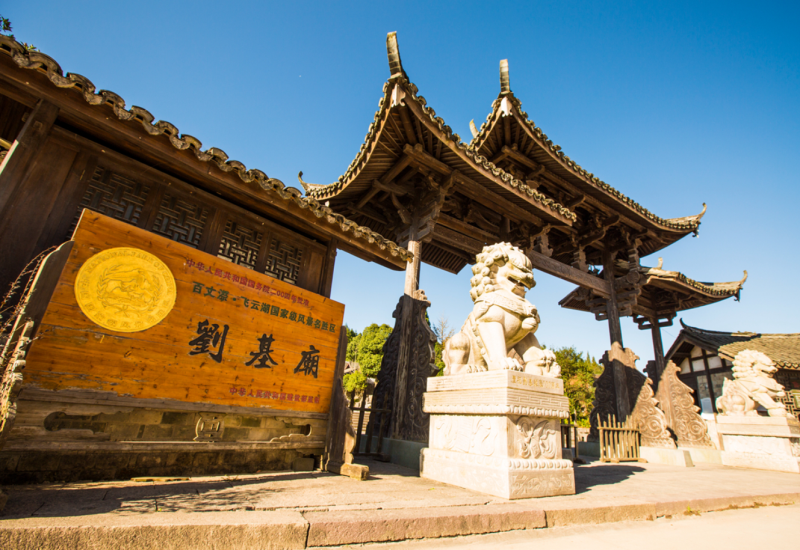
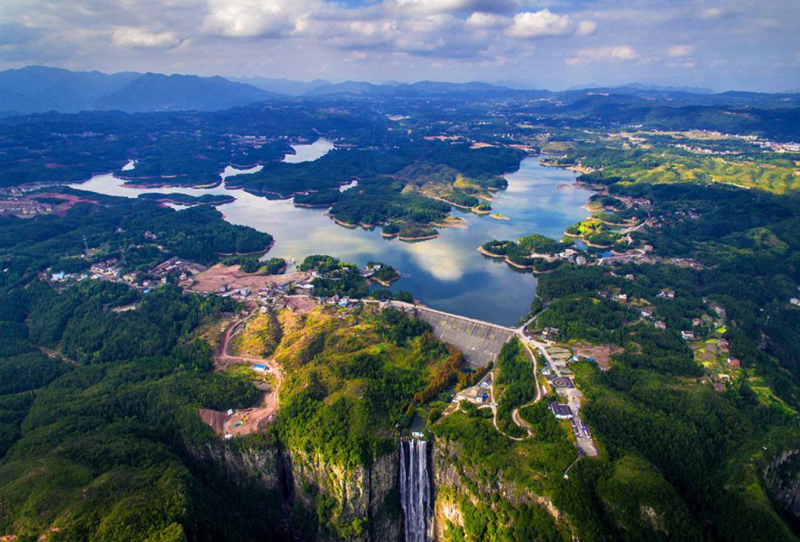
Liu Bowen's Hometown Scenic Area is located in Baizhangji Town, Wencheng County, Wenzhou City, Zhejiang Province. It is a national 5A-level tourist attraction with a total area of approximately 4.81 square kilometers. The scenic area consists of two core parts: Liu Ji Temple and Baizhangji, integrating cultural landscapes with natural scenery. With "Liu Ji Culture" as its soul and "Baizhang Flying Waterfall" as its feature, it combines Ming and Qing architectural art, folk culture, and eco-tourism resources. Among them, Liu Ji Temple covers an area of 0.3 hectares with a building area of 3,023 square meters, and is the largest and best-preserved Ming Dynasty wooden architectural complex in southern Zhejiang. The Baizhangji Scenic Area covers approximately 4.51 square kilometers, with the 207-meter-high "China's First Highest Waterfall" Baizhangji as its core, forming a cascading waterfall group landscape characterized by "the first cascade being majestic, the second cascade being wondrous, and the third cascade being serene."
History and Culture
Liu Bowen (1311–1375), whose given name was Ji and courtesy name was Bowen, was a politician and literary figure of the late Yuan and early Ming dynasties, a founding meritorious official of the Ming Dynasty, granted the title of Chengyi Bo, and posthumously honored with the title "Wencheng." Wencheng County was named after him. Liu Ji Temple within the scenic area was first built in the second year of the Tianshun era of Emperor Yingzong of Ming (1458) to commemorate Liu Ji and his descendants, and was renovated multiple times during the twelfth year of the Kangxi era of the Qing Dynasty (1673) and the Republican period. The temple currently houses the plaque "Chengyi Bo Temple" bestowed by Emperor Wuzong of Ming (Zhu Houzhao), couplets and stone inscriptions written by literati of successive dynasties, and exhibitions on Liu Ji's life and deeds. It is an important physical carrier for studying Ming Dynasty architectural art and Liu Ji culture.
The "Legend of Liu Bowen" associated with the scenic area has been included in the National Intangible Cultural Heritage List. Its content covers Liu Ji's wisdom stories, folk anecdotes, and more, and it is still widely circulated in southern Zhejiang. In addition, Wencheng County, where the scenic area is located, also preserves traditional folk activities such as the "Taigong Sacrifice," held regularly every year to commemorate Liu Ji and his family, reflecting the local commitment to inheriting and respecting traditional culture.
Main Attractions
Liu Ji Temple
Liu Ji Temple is a three-courtyard, single-eave, two-courtyard-style wooden architectural complex, consisting of a spirit wall, head gate, ceremonial gate, main hall, Zhuiyuan Ancestral Hall, and side rooms. The main hall enshrines statues of Liu Ji and his sons Liu Lian and Liu Jing. Above the shrine are plaques reading "Imperial Teacher" and "Royal Assistant," and on both sides the pillars bear the couplet: "In divining affairs and examining details, with clear evidence, first among founding civil officials; in planning and strategizing, always hitting the mark, unmatched among advisors who crossed the river," summarizing Liu Ji's achievements. The temple also preserves precious cultural relics such as the "Stele of Liu Ji Temple Bestowed by Emperor Wuzong of Ming" and the "Edict Conferred upon Liu Ji as Grand Tutor Wencheng," which possess extremely high historical and calligraphic artistic value.
Baizhangji
Baizhangji is the waterfall group with the largest drop in East China. The core waterfall, "First Cascade," is 207 meters high and more than 30 meters wide. Water pours down from the mountain top with a sound like thunder and magnificent momentum, and it is known as the "Number One Waterfall Under Heaven." The surrounding vegetation is dense and the negative oxygen ion content is extremely high, forming a unique "forest oxygen bar" environment. Walking down along the canyon trail, visitors can successively view the "Second Cascade" (85 meters high, shaped like a flying rainbow) and the "Third Cascade" (about 1.5 kilometers long, with gentle water flow and connected pools and waterfalls). The entire route is about 3 kilometers, and the tour takes 2–3 hours.
Anfu Temple
Anfu Temple is located near the scenic area and was first built in the third year of the Yuanhe era of Emperor Xianzong of Tang (808). It is the place where Liu Ji studied in his youth. The existing buildings of the temple are in Ming and Qing style, and within the temple are landscapes such as a thousand-year-old camphor tree, a life-release pond, and the Great Hero Hall. The temple also houses a "Tang Camphor" with a history of more than 1,200 years, as well as a stone inscription of "Loyalty, Filial Piety, Integrity, and Cleanliness" handwritten by Liu Ji. It is an important place to experience Buddhist culture and Liu Ji's legacy.
Food
Wencheng Glutinous Yam
A specialty of Wencheng County and a National Geographical Indication Product. Glutinous yam has a rough skin and delicate flesh. After cooking, it is glutinous, soft, and sweet. It can be steamed, used in soups, or made into desserts. Restaurants around the scenic area often present it as yam stewed with pork ribs or candied yam, making it a characteristic health-preserving delicacy on local dining tables.
Bowen Shaobing
Made mainly from flour, preserved mustard greens, and pork, and baked over charcoal fire. The shaobing is crispy on the outside and soft on the inside, salty and savory. According to legend, it was created by Liu Bowen. It is one of the most representative snacks around the scenic area and is often purchased as a souvenir.
Wencheng Lamian
A local traditional noodle dish. The noodles are chewy and smooth, and the soup base is mostly made by simmering pork bones or beef bones, paired with ingredients such as beef, green vegetables, and chili. Noodle shops near the scenic area mostly offer freshly pulled and freshly cooked lamian, suitable as a staple food for a quick meal.
Wuyang Chunyu Tea
Produced in Wuyang Village, Wencheng County (Liu Ji's birthplace), and a National Geographical Indication Product. The tea leaves are tightly rolled and slightly curved in appearance, emerald green and glossy in color. After brewing, the aroma is high and clear, and the taste is fresh and sweet with a lingering aftertaste. Tea houses are available within the scenic area, where visitors can experience tea picking and tea making and taste freshly brewed spring tea.
Tickets:
Baizhangji Scenic Area: 65 yuan/person
Liu Ji Temple: Free
You can search for the official WeChat public account "Liu Bowen's Hometown 5A Scenic Area" to obtain the latest updates or purchase tickets online.
Opening Hours:
Liu Ji Temple: Open all year, 8:00–17:00 (extended to 17:30 in summer);
Baizhangji: Open all year, 7:30–16:30 (7:00–17:00 in summer, 8:00–16:00 in winter).
Note: In case of severe weather such as heavy rain or strong winds, Baizhangji Scenic Area may be temporarily closed. It is recommended to check the official announcement before traveling.
Tour Route:
Recommended one-day tour route:
Arrive at Liu Ji Temple at 8:30 a.m., visit the main hall, Zhuiyuan Ancestral Hall, and other buildings, and learn about Liu Ji's life and deeds (about 1.5 hours);
At noon, taste local dishes such as Bowen Shaobing and glutinous yam at farmhouses around the scenic area;
At 13:00 p.m., head to Baizhangji Scenic Area and, from the entrance, follow the trail to visit the First Cascade, Second Cascade, and Third Cascade in sequence. The entire walk is about 3 kilometers (about 3 hours). At the end, you can take a sightseeing bus back to the entrance (10 yuan/person);
The itinerary ends at around 16:30, then return.
Transportation:
Self-driving:
From Wenzhou: Take the Wenzhou Ring Expressway to the Zhuyong Expressway, exit at Wencheng, and follow Provincial Highway 56 and National Highway 322 to the scenic area. The total journey is about 1.5 hours;
From Hangzhou: Via the Changshen Expressway and Zhuyong Expressway, exit at Wencheng. The total journey is about 4 hours;
The scenic area has a large parking lot. Parking fee: 10 yuan/day.
Public transportation:
Take a bus from Wenzhou Passenger Transport Center or Wenzhou South Railway Station to Wencheng County (about one bus every 30 minutes, journey about 1.5 hours). After arriving at Wencheng Bus Station, transfer to the scenic area shuttle bus (daily from 8:00 to 16:00, one bus per hour, fare 15 yuan);
High-speed rail: You can take the train to Wenzhou South Railway Station, then transfer to a bus to Wencheng County.
Must-Visit Attractions:
Liu Ji Temple: A model of Ming Dynasty wooden architecture and the core place to experience Liu Ji culture. Visit the plaques, couplets, and cultural relic exhibitions.
Baizhangji First Cascade: China's First Highest Waterfall. View up close the shocking scene of the waterfall pouring down, and it is the best spot for photos and check-ins.
Baizhangji Second Cascade Viewing Platform: Overlook the flying rainbow landscape of the Second Cascade and experience a "Water Curtain Cave"-like soaking sensation (bring a raincoat during the rainy season).
Travel Tips:
Wear non-slip sports shoes. The trails in Baizhangji Scenic Area have many stone steps, and some sections are slippery, especially near the Second Cascade.
In summer, bring sun protection items and a raincoat. There is heavy water mist near the First Cascade, so cameras should be protected against water; in winter, keep warm as the mountain top temperature is lower.
It is recommended to visit Liu Ji Temple in the morning to avoid peak crowds; go to Baizhangji in the afternoon, when the light is soft and suitable for photography.
Those with weaker physical strength can choose the one-way sightseeing bus at Baizhangji (from the endpoint to the entrance) to save time and energy on the return trip.
Notes:
No loud noise is allowed in Liu Ji Temple, and touching cultural relic exhibits is prohibited.
Swimming and fishing are prohibited in Baizhangji Scenic Area. Please do not deviate from the designated trails to ensure safety.
Restaurants around the scenic area are small in scale, and during holidays you may need to queue in advance for meals.
When purchasing specialties such as Bowen Shaobing, it is recommended to choose regular shops in the scenic area and avoid roadside mobile vendors.