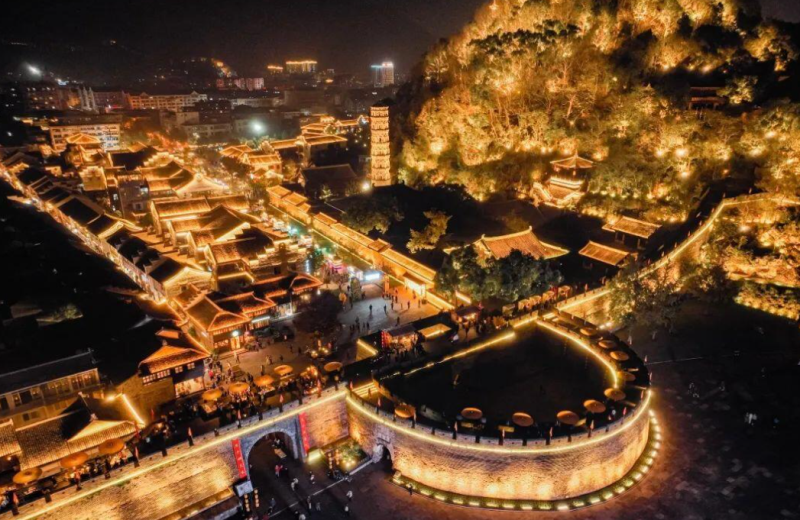
The Taizhou Prefectural City Cultural Tourism Area is located in Linhai City, Taizhou City, Zhejiang Province, and is a national 5A-level tourist attraction. With the ancient city wall of Linhai as its core, the scenic area integrates ancient city culture, military culture, religious culture, folk culture, and other elements, showcasing the unique historical style and cultural heritage of the coastal region of eastern Zhejiang. The scenic area preserves a large number of ancient buildings from the Ming and Qing dynasties, including city walls, city gates, temples, and streets and alleys. Among them, the Linhai Ancient City Wall is one of the four best-preserved ancient city walls in China and is praised as the "Jiangnan Great Wall." The total area of the scenic area is about 3.12 square kilometers. Its core areas include the Taizhou Prefectural City Wall (Jiangnan Great Wall), Ziyang Ancient Street, East Lake, and Jinshan, forming a unique landscape pattern in which "city, mountain, water, and street" are mutually integrated.
Historical Culture
Taizhou Prefectural City has a long history. Its city-building history can be traced back to the Eastern Jin Dynasty, more than 1,600 years ago. Since the Tang Dynasty, it has been the political, economic, and cultural center of the Taizhou region. Through successive dynasties, it was repaired and expanded, forming today's grand and rationally laid-out ancient city pattern.
The Linhai Ancient City Wall is the core carrier of the scenic area's historical culture. It was first built in the Eastern Jin Dynasty and underwent repairs through the Tang, Song, Yuan, Ming, and Qing dynasties. The existing city wall has a total length of more than 6,000 meters, a height of 7-8 meters, and a width of 4-6 meters. It consists of barbicans, enemy platforms, bastions, crenellations, and other parts, serving both military defense and flood control and flood resistance. This architectural feature of "integrating city defense and water conservancy" is relatively rare among ancient city walls nationwide.
Ziyang Ancient Street is an important part of the historical culture of Taizhou Prefectural City. It is named in memory of Zhang Boduan (courtesy name Ziyang), the founder of the Southern School of Taoism in the Southern Song Dynasty. The street is 1,080 meters long and 4-5 meters wide, retaining the street layout and architectural style of the Ming and Qing dynasties. Along the street are distributed a large number of time-honored shops, residences, temples, and more. It is one of the best-preserved ancient commercial streets in the eastern Zhejiang region.
Main Attractions
Taizhou Prefectural City Wall (Jiangnan Great Wall)
The Taizhou Prefectural City Wall, also known as the Jiangnan Great Wall, is the core attraction of the scenic area. It was first built in the Eastern Jin Dynasty, and the existing wall was built in the Ming Dynasty. It has a total length of more than 6,000 meters, with about 5,000 meters still standing. The city wall was built along the Ling River, following the terrain and winding ups and downs. It has 7 city gates, including Jingyue Gate, Xingshan Gate, Zhenning Gate, Wangjiang Gate, and Kuocang Gate. Among them, Jingyue Gate, Xingshan Gate, and Zhenning Gate have barbicans. On the city wall are also distributed 13 enemy platforms, 14 bastions, and numerous crenellations, with complete military defense facilities. The highest point of the city wall is Wanghai Tower on Beigu Mountain, at an altitude of about 100 meters. Climbing the tower offers a panoramic view of the entire Linhai ancient city and the scenery of the Ling River.

Ziyang Ancient Street
Ziyang Ancient Street is located in the core area of Taizhou Prefectural City. It is 1,080 meters long and 4-5 meters wide and is a well-preserved ancient street from the Ming and Qing dynasties. The street is paved with bluestone slabs, and both sides are two-story wooden buildings, mostly in the layout of front shop and rear residence or shop below and residence above. It preserves a large number of time-honored shops, such as the "Feng Cun Ren Tang" pharmacy founded during the Daoguang period of the Qing Dynasty and the "Xie Cheng Chang" cloth store from the Republic of China period. The ancient street also contains historical relics such as Ziyang Palace, Sanfuji, and Jiusi Lane, as well as numerous traditional handicraft workshops, displaying rich local folk customs.
East Lake
East Lake is located on the east side of Taizhou Prefectural City. It is an artificial lake first excavated during the Qingli period of the Northern Song Dynasty under the supervision of Qian Xuan, then county magistrate of Linhai. It was originally named "Fangsheng Pond" and after multiple repairs and expansions formed its current scale. The lake covers an area of about 28,000 square meters and is divided into three parts: Front Lake, Rear Lake, and Xiaojian Lake. In the lake are landscapes such as islets, islands, bridges, and pavilions. The main attractions include Huxin Pavilion, Bangou Pavilion, and Luo Linhai Memorial Temple. East Lake is connected to the Taizhou Prefectural City Wall. The lake and mountain scenery and the ancient city wall enhance each other, forming a beautiful Jiangnan water town scroll.
Jinshan
Jinshan is located on the southeast side of Taizhou Prefectural City. It is named because its shape resembles the headscarf used by ancient men to tie their hair. It has an altitude of about 157 meters and is one of Linhai's landmark peaks. There are many historical sites on the mountain, mainly including Longxing Temple first built in the Tang Dynasty, the Thousand Buddha Pagoda from the Song Dynasty, and the Jinshan Pagoda Group from the Ming Dynasty. Longxing Temple is an important temple in the history of Buddhism in Taizhou and was once one of the ancestral temples of the Japanese Tendai school. The temple preserves a large number of Buddhist cultural relics and historical remains. The Thousand Buddha Pagoda, also known as Duobao Pagoda, was built during the Dazhong Xiangfu period of the Northern Song Dynasty. It is about 30 meters high, and its body is carved with more than 1,000 Buddha statues. It is exquisitely shaped and is a key cultural relic protection unit in Zhejiang Province.
Jiangnan Badaling
Jiangnan Badaling is a section of the Taizhou Prefectural City Wall, located in the Beigu Mountain section. Because the terrain is strategically important and the wall is steep, it closely resembles the Badaling Great Wall in Beijing and is therefore named Jiangnan Badaling. This section of the city wall is about 1,400 meters long, with an elevation difference of about 70 meters. It has 10 enemy platforms and multiple crenellations and is the part of the entire city wall with the most prominent military defense function. Climbing Jiangnan Badaling allows visitors to experience the majesty and steepness of the Great Wall while also enjoying the beautiful scenery of the Ling River and Linhai urban area.
Food
Linhai Maixia
Linhai Maixia is a traditional specialty snack of Taizhou Prefectural City with a history of several hundred years. Its preparation method is to mix flour with water into a paste, use chopsticks to pick it into boiling water, forming strip-shaped noodles resembling shrimp, then add shrimp, clams, shredded pork, bamboo shoots, green vegetables, and other ingredients and cook. The soup is delicious, and the maixia is chewy and smooth. It can be tasted in many restaurants including those on Ziyang Ancient Street, generally priced at 15-25 yuan per bowl.
Ziyang Street Seaweed Cake
Ziyang Street Seaweed Cake is a specialty pastry of Linhai, made mainly with seaweed as filling and paired with flour, white sugar, and other ingredients. Its outer skin is crisp, and the filling is fresh and fragrant, with the unique flavor of seaweed. The "Wang Tianshun" seaweed cake on Ziyang Ancient Street is a century-old time-honored brand, supplied in limited quantities every day, priced at 1.5-2 yuan each, and deeply loved by tourists.
Egg White Sheep Tail
Egg White Sheep Tail is a traditional sweet food of Taizhou Prefectural City. It originated in the Qing Dynasty and is named because its shape resembles a sheep's tail. Its preparation method is to beat egg whites until fluffy, wrap them around red bean paste filling, deep-fry until golden brown, remove, and sprinkle with white sugar. It has a crisp outside and soft inside, sweet and delicious. It can be tasted in major restaurants in Linhai, generally priced at 20-30 yuan per portion.
Linhai Cao Geng
Linhai Cao Geng is a traditional snack of Taizhou Prefectural City. It is divided into sweet geng and savory geng and is usually eaten during the Lantern Festival. Savory geng uses rice flour as the main ingredient and is cooked with mushrooms, tofu, winter bamboo shoots, dried shrimp, pork, and other ingredients. Sweet geng uses glutinous rice flour as the main ingredient and is cooked with red dates, longan, lotus seeds, peanuts, and other ingredients. It is delicious and nutritious and can be tasted in local restaurants and households, generally priced at 8-15 yuan per bowl.
Nearby Food: Sanmen Green Crab
Sanmen Green Crab is a specialty of the Taizhou region, famous for its delicious meat and rich nutrition. In restaurants around Taizhou Prefectural City, visitors can taste various preparations such as steamed green crab and ginger-scallion stir-fried green crab. The price depends on the size of the crab, generally 100-200 yuan per jin.
Tickets:
Combined ticket 70 yuan per person.
You can search for the official WeChat public account "Taizhou Prefectural City Cultural Tourism Area" on WeChat to obtain the latest updates or buy tickets online. As of July 29, 2025, the online ticket purchase entry of this official WeChat public account is the "Prefectural City Official Website" option.
Opening Hours:
Opening hours vary for different attractions: the opening hours of the Taizhou Prefectural City Wall (Jiangnan Great Wall) are 8:00-17:00 (summer) and 8:00-16:30 (winter); the opening hours of East Lake are 8:00-17:00 (summer) and 8:00-16:30 (winter); Ziyang Ancient Street is open all day (the business hours of shops along the street are generally 8:00-22:00); the opening hours of Jinshan are 8:00-17:00. Visitors are advised to arrange their time reasonably and learn the specific opening hours of each attraction in advance.
Tour Route:
Recommended one-day tour route: enter the Taizhou Prefectural City Wall from Jingyue Gate at 9:00 a.m., tour along the city wall to Jiangnan Badaling, climb Wanghai Tower to overlook the panorama, about 2 hours in total; leave the city wall from Zhenning Gate at about 11:00, go to Ziyang Ancient Street, taste specialty snacks such as seaweed cakes and maixia, and visit the ancient street and surrounding historical relics, about 1.5 hours; go to East Lake at 13:30 p.m., enjoy the lake and mountain scenery, and visit attractions such as Huxin Pavilion and Luo Linhai Memorial Temple, about 1 hour; go to Jinshan at 15:00, visit Longxing Temple, the Thousand Buddha Pagoda, and other attractions, about 1.5 hours; end the itinerary at 16:30. The total walking distance is about 8 kilometers and can be adjusted appropriately according to individual physical strength.
Transportation:
Public transportation: from Taizhou urban area, take a bus to Linhai Passenger Transport Center, then transfer to Linhai city buses 202, 203, 205, etc., and get off at "East Lake Park" station or "Ziyang Street" station to reach the vicinity of the scenic area; from Linhai Railway Station, take bus 211 to "Passenger Transport Center" station, then transfer to the above buses to go to the scenic area.
Self-driving: from Hangzhou, take the Hangzhou-Ningbo Expressway and Changtai Expressway, exit at Linhai, and drive along Jingjiang Middle Road, Huipu Road, etc., to reach the scenic area. The whole journey takes about 2.5 hours. There are multiple parking lots around the scenic area, such as East Lake Parking Lot and Ziyang Street Parking Lot. Parking fees are generally 5-10 yuan per hour.
Taxi: the starting fare of taxis in Linhai is 6 yuan (within 3 kilometers), and 2 yuan per kilometer beyond 3 kilometers. It is about 5 kilometers from Linhai Passenger Transport Center to the scenic area, costing about 15 yuan.
Tourist routes: some travel agencies in Taizhou have opened tourist routes to the Taizhou Prefectural City Cultural Tourism Area. Visitors can consult and register in advance.
Must-Visit Attractions:
Taizhou Prefectural City Wall (Jiangnan Great Wall): about 5,000 meters long, one of the best-preserved ancient city walls in China, combining military and flood control functions. Climbing the wall offers views of the ancient city and the Ling River scenery. Suggested visiting time: 2 hours.
Ziyang Ancient Street: 1,080 meters long, preserving a large number of buildings and time-honored shops from the Ming and Qing dynasties. It is a good place to experience Linhai folk culture and taste specialty snacks. Suggested visiting time: 1.5 hours.
East Lake: about 28,000 square meters, with landscapes such as islets, islands, bridges, and pavilions in the lake, contrasting beautifully with the ancient city wall. Suggested visiting time: 1 hour.
Jinshan: about 157 meters above sea level, with many historical sites on the mountain such as Longxing Temple and the Thousand Buddha Pagoda. It is a good place to climb high and look far and experience Buddhist culture. Suggested visiting time: 1.5 hours.
Travel Suggestions:
Best season to visit: spring (March-May) and autumn (September-November), with suitable weather and beautiful scenery, avoiding the high heat of summer and the cold of winter.
Length of visit: 1-2 days are recommended. One day can cover the main attractions, while two days allow a deeper experience of the ancient city culture and surrounding scenery.
Clothing suggestions: the scenic area involves a lot of walking, so comfortable sports shoes are recommended; in summer, pay attention to sun protection and bring a sun hat, sunglasses, etc.; in winter, pay attention to keeping warm.
Dining suggestions: Ziyang Ancient Street is the main place to taste local food, where visitors can try specialty snacks such as maixia, seaweed cakes, and egg white sheep tail; restaurants around the scenic area can also be chosen, with relatively affordable prices.
Accommodation suggestions: there are various types of accommodation around the scenic area, such as high-end hotels like Linhai International Hotel and Taizhou Garden Villa, priced at about 300-600 yuan per night; there are also homestays around Ziyang Ancient Street, priced at about 150-300 yuan per night, which can be chosen according to individual needs.
Notes:
Some sections of the scenic area have many steps. Please pay attention to safety when walking, especially the elderly and children should be accompanied.
Areas such as Ziyang Ancient Street are crowded. Please take good care of personal belongings to prevent loss.
Protect the scenic area environment. Do not spit, litter, or damage cultural relics and historical sites.
Observe scenic area regulations. Do not smoke in non-smoking areas and do not climb or play in dangerous areas such as the city wall.
During holidays, there are many tourists in the scenic area. It is recommended to buy tickets in advance and travel at off-peak times to avoid congestion.
Some attractions in the scenic area require walking long distances. Depending on individual physical strength, visitors may choose to take sightseeing buses in the scenic area (if available). Specific fees can be inquired with scenic area staff.
Before visiting, visitors may consult relevant materials to understand the historical and cultural background of the scenic area so as to better appreciate the attractions.