The Tiantai Mountain Scenic Area in Taizhou is located north of Tiantai County, Zhejiang Province, in a subtropical monsoon climate zone. The scenic area covers a total area of 187 square kilometers. It is a national key scenic and historic area, one of China's top ten famous mountains, a national eco-tourism demonstration zone, one of Zhejiang Province's top ten tourist destinations, and a national 5A-level tourist attraction. It is the destination of the Tang Poetry Road in eastern Zhejiang and the birthplace of Hehe culture. Tiantai Mountain has an average elevation of more than 500 meters, and its main peak, Huading Mountain, stands 1,098 meters above sea level. Its geology is mainly composed of granite. Relying on its natural landscape, the scenic area features Buddhist culture and integrates sightseeing, leisure vacations, and Buddhist pilgrimage. It has long been known for the reputation of "the cradle of Buddhism and Daoism, with divine landscapes and exquisite scenery," and possesses extremely high value for sightseeing and recreation, as well as historical, cultural, and scientific research value.
Historical Culture
Tiantai Mountain culture has lasted more than 1,800 years and has gone through a germination period (Eastern Han to Southern Liang), a formation period (Southern Chen to Five Dynasties), and a development period (Song Dynasty to the present). It germinated in the Wei and Jin dynasties and flourished in the Tang and Song dynasties. It is the birthplace of the Chinese Tiantai school of Buddhism and the Southern school of Daoism. The philosophical thought of the Tiantai school of Buddhism mainly consists of propositions such as "one thought contains three thousand worlds," "one mind observes three truths," "the three truths are perfectly fused," and "the doctrine of cessation and contemplation." The Southern school of Daoism was founded by Zhang Boduan at the foot of Zining Mountain in Tiantai, where in the eighth year of the Xining reign (1075) he completed the Wuzhen Pian and founded the school.
The Confucianism of Tiantai Mountain is mainly characterized by Neo-Confucianism. The Southern Song Neo-Confucian scholar Zhu Xi once served twice as abbot of Chongdao Temple in Taizhou, exerting a profound influence on Confucianism at Tiantai Mountain. Ancient literati had a high degree of cultural and emotional identification with Tiantai Mountain, and a large number of famous scholars and monks left more than 5,000 poems and over 1,000 articles here. The folk literature of Tiantai Mountain is also very developed, with tales such as Liu and Ruan Meeting Immortals and the legend of Jigong being widely known. Its culture is characterized by both regionality and trans-regionality, and by both contemporaneity and trans-temporality. Its core and basic elements spread to Zhejiang and even all parts of the country, as well as to Japan, Korea, Southeast Asia, and other places.
Main Attractions
Guoqing Temple
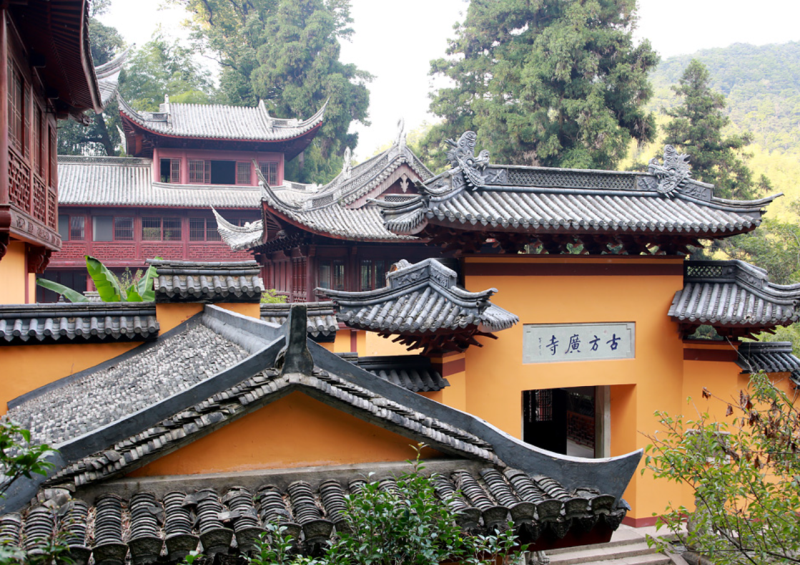
Guoqing Temple was first built in the 18th year of the Kaihuang reign of the Sui Dynasty (598). It was originally named Tiantai Temple and later renamed Guoqing Temple, implying "if the temple is completed, the state will be pure." In the Southern Song Dynasty, it was listed as one of the Ten Famous Monasteries of Jiangnan. The existing buildings were rebuilt by imperial order in the 12th year of the Yongzheng reign of the Qing Dynasty (1734). The temple covers a total area of 73,000 square meters and is divided into five vertical axes. It has more than 20,000 square meters and over 800 rooms, with complete halls and strict, magnificent architecture. Guoqing Temple is a cultural ancient monastery with an extremely profound cultural accumulation. It is the birthplace of the Chinese Tiantai school of Buddhism and also the ancestral court of the Tiantai school of Buddhism in Japan and Korea. In the temple there is the "Sui Mei," a plum tree planted by Master Zhang'an in the year the temple was founded and now more than 1,400 years old. There are also many cultural relics and historic sites, such as the pattra-leaf scripture left by Master Zhiyi, the line-engraved stele of the Seven Bodhisattva Images taken from the Sui Pagoda, and Wang Xizhi's "Single-Stroke Goose" stele.
Shiliang Flying Waterfall
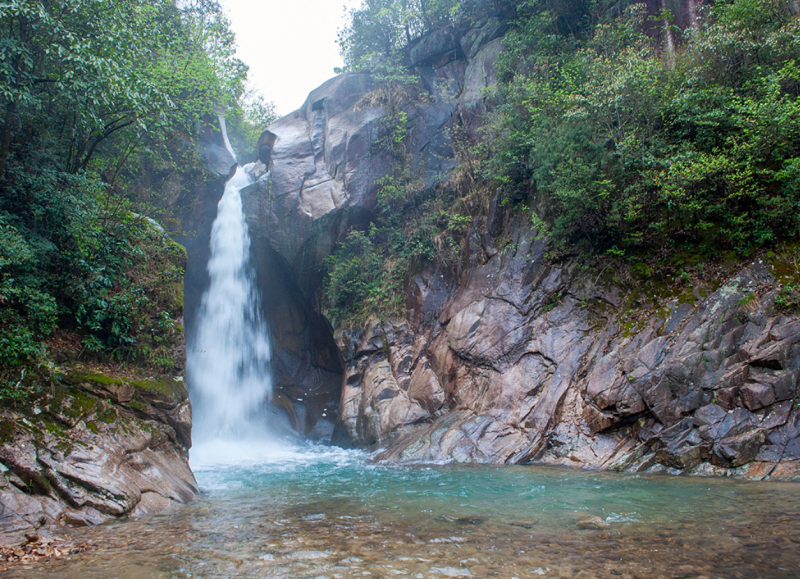
Shiliang Flying Waterfall combines the wonders of landscapes from across the world and is the essence of the "Tang Poetry Road" in eastern Zhejiang. Shiliang is a "granite natural bridge." The beam is about 7 meters long and less than a foot wide, like the ridge of a dark dragon, spanning the cliffs of two mountains. The "flying waterfall" passes through the beam after three turns, then surges down from a 40-meter-high cliff. Beside Shiliang is Zhongfangguang Temple, and inside the temple is Tanhua Pavilion, originally built by Jia Sidao, prime minister of the Southern Song Dynasty. On the left side at the bottom of the waterfall is Xiafangguang Temple, said to be the place where the Five Hundred Arhats manifested. Above and below Shiliang there are dozens of cliff inscriptions in all styles, including regular, cursive, clerical, and seal scripts. This place was also a main filming location for China's first martial arts film Shaolin Temple, as well as Shaolin Lay Disciples, The Legend of the Condor Heroes, and many other films and television productions.
Tiantai Mountain Grand Waterfall
Tiantai Mountain Grand Waterfall was originally named Tongbai Waterfall and also known as Sanjing Waterfall. It is 325 meters high and at its widest 90 meters, and can be called China's first-highest waterfall. Sun Chuo, a great literary figure of the Eastern Jin Dynasty, listed it together with Chicheng Mountain as landmark landscapes of Tiantai in his Rhapsody on Roaming Tiantai Mountain. On December 31, 2020, Tiantai Mountain Grand Waterfall was rated as a national 4A-level tourist attraction.
Qiongtai Xiangu
Qiongtai Xiangu is located within the Tiantai Mountain tourist scenic area. Here visitors can stroll among the mountains and enjoy wonderful scenery. In the valley, mountains and waters depend on each other, peaks and ridges are steep and beautiful, grotesque rocks jut out, and streams murmur. It is full of mysterious and charming natural scenery, like a fairyland on earth.
Chicheng Mountain
Chicheng Mountain is a famous place in China for both Buddhism and Daoism and has long been known as the symbol of Tiantai Mountain. The rocks on the mountain are all red, standing like walls. There are many temples and Daoist monasteries here, with a profound historical and cultural heritage, and from here one can also overlook the beautiful surrounding landscape and rural scenery.
Huading Forest Park
Huading is the main peak of the Tiantai Mountain range and is now a national forest park. It is a famous summer resort in the central-eastern Zhejiang region. Standing at the summit, one looks around at layer upon layer of surrounding peaks, shaped like a lotus about to bloom. Around the peak, clouds often surge and roll, vast and white, changing unpredictably, making one feel as if in a fairyland. Every May, the Yunjin Rhododendron Festival is also held, when Yunjin rhododendrons bloom in profusion.
Food
Caozai Niangao
The caozai is emerald green and the rice cake is jade white. Thick sauce mixed with caozai wraps around the rice cake. It is neither oily nor greasy on the palate and full of freshness. The color is full and bright, and steam rises from it. Oil and sauce flow down between the caozai and rice cake, and the delicious fresh fragrance wafts straight into the nose.
Jiaobing Tong
It is said that jiaobing tong was invented by Jigong. He wrapped the many leftover dishes from each meal into a flatbread and ate them again at the next meal, and thus jiaobing tong came into being. Its fillings are rich and varied. Various ingredients are cut into shreds and stir-fried, then rolled into a thin wrapper and pan-fried until the outer skin is golden and crisp. The texture is rich and the taste is delicious.
Shihu Medicinal Cuisine
Tiantai's shihu is quite famous, and the local shihu medicinal cuisine is a unique signature. Examples include shihu braised chicken, made by simmering free-range chicken with iron-skin shihu stems, and stomach-nourishing porridge, made by slowly stewing shihu flowers with goji berries. Then take a sip of iron-skin shihu flower tea, and the unique fresh fragrance and sweetness of iron-skin shihu burst forth in the mouth.
Qingbing Qingjiao
Fresh tender leaves are pounded and mixed with glutinous rice flour, carefully kneaded into green dough, then filled with either sweet or savory fillings, shaped into dumplings, and finally steamed in a steamer. In the past, there were stalls making qingjiao all year round, but now they are increasingly rare, and only at seasonal times do Tiantai people make them to eat.
Shangtang Xiaosun
Tiantai Mountain is rich in bamboo shoots, and shangtang bamboo shoots is a delicious vegetarian dish with "shoots" as the main ingredient. In addition to large mao bamboo shoots, Tiantai also has small bamboo shoots as a special raw material. They are abundantly produced in Sanzhou Township of Tiantai and can be pickled into salted shoots, sun-dried into shredded shoots or dried shoots, and fresh small shoots can also be made into various flavors.
Chaiye Tofu
Chaiye tofu can be eaten in many ways, divided into sweet and savory, and can be served cold, as a spoon dish, in soup, or stir-fried. The most common way to eat it is to cut it into small pieces, sprinkle on a layer of white sugar or add a small amount of honey and serve it cold, or add crushed fresh mint leaves. Its fresh fragrance is refreshing and invigorating.
Qingmac?
Freshly pounded qingmaci can be eaten directly, dipped in a little white sugar or yellow sugar. It is soft and spongy, sweet and glutinous, with a faint aroma of mugwort. It can also be pan-fried in a pot until both sides are slightly browned. The surface has a slight crispness, while the inside remains soft and glutinous.
Bianshi
Tiantai bianshi is made from wheat flour. It is somewhat like northern dumplings and southern wontons, but also has its own characteristics. It is more delicate than dumplings and plumper than wontons, and the diversity of its fillings is beyond comparison with dumplings or wontons.
Maibing
Tiantai maibing is one of the main types of wheat-based food, listed alongside jiaobing tong, hulatai, moci, and bianshi. It is mainly made from wheat flour and lean meat, supplemented with various seasonings. It is shaped like a round plate. A well-fried meat maibing is pale yellow in color, soft on the outside and fragrant and tender inside, with a wonderful taste.
Shijin Gao
Tiantai originally had a "Shijing Gao," on which the ten scenic spots of Tiantai Mountain were printed. Later it evolved into "Shijin Gao," with diverse varieties and a festive character.
Huladai
"Huladuo" is made by mixing wheat flour into a thin but still somewhat sticky paste, then using the hand to spread and drag it in a pan into a round thin pancake, one at a time, cooked in less than a minute. It is easy to make, fragrant and crisp, and is one of the everyday meals of Tiantai villagers.
Recommended Nearby Food
For farmhouse dishes, one can choose Xu Yi Fat Man Stir-Fry and Tuzaotou (recommended: sand worm braised with bean thread and Huadiao chicken); for restaurants, there are Yinlun Sunshine and New Sunshine; for coffee, one can go to Xide Coffee (at the entrance of Guoqing Temple, with specialties such as zen brown sugar latte and cinnamon gingerbread latte, and special latte art options that can only be made hot) and Sanmu Yu Shi (in front of the rapeseed field at Guoqing Temple; lunch starts at 11:00, and before that only coffee and bread are available; lunch offerings include pizza, baked rice, pasta, and more); for snacks, there are Juyuanfang, Tiantai Xu Family Snacks (a snack shop in the county town very popular with locals), Linhai Maixia, and Yuqingzhai (an old brand in the county town, with various Taizhou pastries and thick ice, that is, ice cream, located at No. 150 Tianyi Street).
Tickets:
Ticket prices for the various attractions in the Tiantai Mountain Scenic Area differ. For example, Guoqing Temple is currently open free of charge; Shiliang Flying Waterfall tickets are 60 yuan per person; Tiantai Mountain Grand Waterfall tickets are 100 yuan per person, and so on.
You can search for the official scenic area public account "Tiantai Mountain Scenic Area" on WeChat to obtain the latest updates or buy tickets online.
Opening Hours:
The Tiantai Mountain Scenic Area is open year-round from 8:00 to 17:00. However, different attractions may be adjusted under special circumstances, such as severe weather or scenic area maintenance. April to October is the best season for tourism, when the scenery in the scenic area is pleasant, and July to August is also a good time to escape the heat. In addition, every May, Huading Forest Park holds the Yunjin Rhododendron Festival, during which the opening hours of the scenic area may be appropriately adjusted according to activity arrangements. Visitors can follow scenic area announcements in advance.
Tour Routes:
If you only have one day, you can first go to Guoqing Temple in the morning to feel the tranquility of the ancient temple and its profound Buddhist culture, and visit the Sui Pagoda, Sui Mei, and other historic sites. The visit takes about 2 to 3 hours. At noon, taste local specialty food near Guoqing Temple. In the afternoon, go to Shiliang Flying Waterfall to admire the world wonder of Shiliang and the flying waterfall. The visit takes about 2 to 3 hours.
If you have two days, on the first day, visit Guoqing Temple in the morning, then go to Chicheng Mountain in the afternoon to enjoy the unique scenery of a holy place of both Buddhism and Daoism. On the mountain you can overlook the surrounding scenery, and the visit takes about 2 hours. In the evening, taste more food in the county town. On the second day, go to Qiongtai Xiangu in the morning, stroll among the mountains, and enjoy the wonderful landscape. The visit takes 3 to 4 hours. In the afternoon, go to Huading Forest Park to feel the coolness of the high mountains and the beautiful scenery shrouded in clouds and mist. If it happens to be May, you can also view the Yunjin rhododendrons. The visit takes 2 to 3 hours.
Transportation:
Self-driving: From surrounding cities, you can reach Tiantai County via expressways. For example, from Hangzhou, take the Hangzhou-Ningbo Expressway, transfer to the Changshu-Taizhou Expressway, exit at Tiantai, and then follow navigation to the scenic area. The whole journey takes about 2 hours. The scenic area has multiple parking lots, convenient for self-driving tourists to park, with parking fees generally 10 to 20 yuan per day.
High-speed rail: You can first take the high-speed rail to Tiantai Mountain Station, which has trains to Hangzhou, Ningbo, Wenzhou, and other cities. After leaving the station, you can take a bus to the scenic area, with a fare of about 5 to 10 yuan; you can also choose to take a taxi, costing about 30 to 50 yuan, with a travel time of about 20 to 30 minutes.
Long-distance bus: Surrounding cities such as Ningbo, Shaoxing, and Jinhua all have long-distance buses to Tiantai Bus Station. After arriving at Tiantai Bus Station, you can transfer to the scenic area shuttle bus, with a fare of about 5 to 10 yuan; or take a taxi to the scenic area, costing about 20 to 40 yuan.
Must-Visit Attractions:
Guoqing Temple: As the ancestral court of the Tiantai school of Buddhism, it has a long history and profound cultural heritage. It has many ancient buildings and precious cultural relics, such as the Sui Mei and Sui Pagoda. The temple environment is quiet and is an excellent place to experience Buddhist culture.
Shiliang Flying Waterfall: The unique granite natural bridge paired with the majestic flying waterfall makes the landscape very spectacular. There are also cliff inscriptions and ancient temples nearby. It is the essence of the "Tang Poetry Road" in eastern Zhejiang and also a filming location for many film and television works.
Tiantai Mountain Grand Waterfall: China's first-highest waterfall, 325 meters high and at its widest 90 meters, with a stunning scene. The scenic area is well developed with complete supporting facilities, allowing visitors to fully appreciate the majesty and beauty of the great waterfall.
Travel Suggestions:
When visiting Guoqing Temple, you can learn some Buddhist etiquette and cultural knowledge in advance so as to better feel the atmosphere of the ancient temple.
When visiting the scenic area in summer, take sun protection and mosquito prevention measures, and carry sunscreen, a sun hat, mosquito repellent spray, and other items.
When visiting Shiliang Flying Waterfall, pay attention to safety. The ground around the waterfall is slippery, so do not approach dangerous areas.
If you want to view the Yunjin rhododendrons in Huading Forest Park, it is best to go during the Yunjin Rhododendron Festival in May and follow flowering information in advance.
When tasting local food, try more specialty snacks to experience Tiantai's unique food culture, but pay attention to food hygiene.
Notes:
Respect religious beliefs and customs. Keep quiet in temples and other religious places, and do not talk loudly or play noisily.
Protect the scenic area environment. Do not litter, and do not damage vegetation or cultural relics and historic sites at will.
Some attractions have complex terrain, such as Qiongtai Xiangu and Shiliang Flying Waterfall. Watch your step when walking and do not leave designated tour routes.
Mobile phone signal may be poor in some areas of the scenic area. Inform family members of your itinerary in advance so you can keep in contact.
When buying souvenirs in the scenic area, pay attention to distinguishing product quality and prices to avoid unnecessary consumption disputes.