Tiger Leaping Gorge is located in Tiger Leaping Gorge Town, Shangri-La City, Diqing Tibetan Autonomous Prefecture, Yunnan Province, China. It lies in the Jinsha River section between Yulong Snow Mountain and Haba Snow Mountain. It is a national 4A-level tourist attraction. The terrain of the scenic area is high in the northwest and low in the southeast, with peaks ranging from 3,000 to 5,596 meters above sea level. The gorge is 23 kilometers long in total. The narrowest point of the river surface is just over 20 meters. The average flow rate is 1,800 cubic meters per second. The gradient is 213 meters, and the elevation difference is 3,900 meters. The relative height of the gorge shoulders of the "V"-shaped valley in the scenic area is 1,600 to 1,700 meters. The rock walls on both sides of the gorge have steep slopes, and within 200 meters above the water surface, they are almost entirely 90 degrees.
History and Culture
Before the Yuan Dynasty, Tiger Leaping Gorge was called Yuemiegen Pass. During the Yuan Dynasty, it was called Xueshanmen Pass. During the Ming and Qing Dynasties, it was called Tiger Leaping Stream. During the Republic of China period, it was called Tiger Leaping Beach. In 1958, when the people's commune was established, it was renamed Tiger Leaping Gorge, and the name has been used ever since. This is a settlement of the Naxi people. The Naxi people have a long history and unique culture. Their writing is one of the only surviving pictographic scripts in the world and has been listed by UNESCO as a World Cultural Heritage. Tiger Leaping Gorge is also one of the important sections of the Ancient Tea Horse Road. In ancient times, people used tea to exchange for horses and other goods along this ancient road, promoting exchanges and integration among various ethnic groups. In 1931, the American-Austrian scholar洛克 became the first Western explorer to trek through the entire gorge. In the 1940s, Mr. Li Lincan and his friend Li Chenlan crossed Tiger Leaping Gorge, and Li Lincan even wrote "Poem on Crossing the Gorge."
Main Attractions
Upper Tiger Leaping Gorge
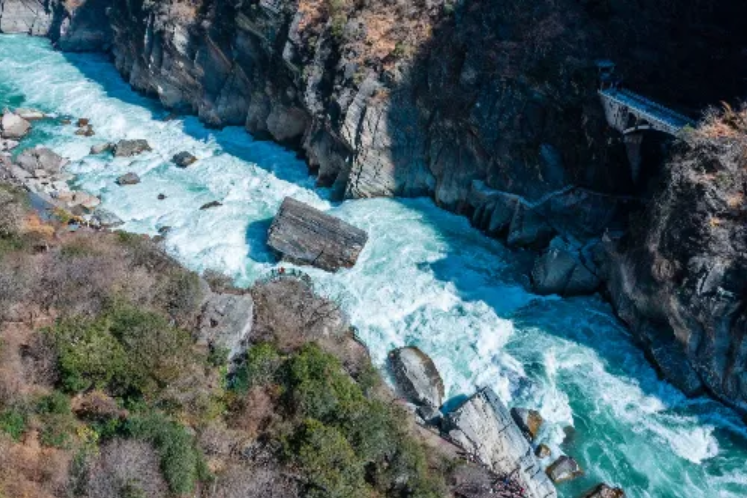
It is well developed with complete supporting facilities. The main highlight is Tiger Leaping Stone. From the scenic area entrance, visitors can take a sightseeing bus to the viewing platform and follow the boardwalk to enjoy the surging river. The whole trip takes about 1 to 2 hours.
Middle Tiger Leaping Gorge
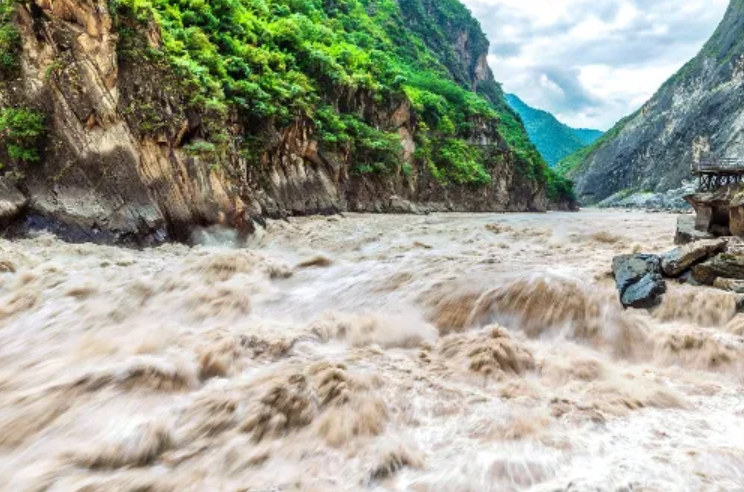
It is one of the world's top ten classic hiking routes. The full route is about 20 kilometers and generally takes two days to complete, though hikers may also choose to walk only the essential section in one day. The scenery along the way is stunning. Visitors can see spectacular gorges and waterfalls and also experience the fun and challenges of hiking. There is a popular check-in spot called Halfway, which is excellent for photos.
Lower Tiger Leaping Gorge
Compared with Upper and Middle Tiger Leaping Gorge, Lower Tiger Leaping Gorge has fewer tourists. The river here is relatively gentle, and the gorge scenery has its own unique charm. It is suitable for visitors who like to enjoy the scenery quietly.
Suggested Routes:
Upper Tiger Leaping Gorge is suitable for visitors bringing elderly people or children, or for those with limited time. Visitors can take the sightseeing bus from the scenic area entrance to the viewing platform and enjoy the river along the boardwalk. Those who do not want to climb can take the escalator. For hiking in Middle Tiger Leaping Gorge, there are multiple route options. A beginner-friendly route can start from Chama Guesthouse, pass the popular check-in spot Halfway and Longdong Waterfall, and finally reach Teacher Zhang's Guesthouse. The whole route is 7 to 8 kilometers and takes about 5 to 6 hours. An advanced route can be done in two days. On the first day, start from Naxi Family Guesthouse, pass the 28 Bends, reach Chama Guesthouse, and then stay overnight at Halfway. On the second day, depart from Halfway, pass Tina's and Yixiantian to reach Middle Tiger Leaping Gorge, and finally return via the Heavenly Ladder or Teacher Zhang's Guesthouse. The whole route is 12 to 15 kilometers and takes about 8 to 10 hours.
Travel Tips:
Choose a suitable route according to your own physical strength and time. If you are a beginner, you can choose Upper Tiger Leaping Gorge or the beginner-friendly route in Middle Tiger Leaping Gorge.
When hiking, prepare suitable equipment, such as mid-to-high-top non-slip hiking shoes, quick-dry clothing and pants, waterproof and windproof jackets, trekking poles, and knee pads.
Check the weather forecast in advance and avoid hiking during the rainy season (July to September) to prevent geological disasters such as mudslides and landslides. From December to March, the water color of the Jinsha River is beautiful, but the temperature is relatively low, so pay attention to keeping warm.
Precautions:
Some sections of Middle Tiger Leaping Gorge are steep, narrow, and close to cliffs. Be sure to pay attention to safety. Do not take photos while walking. Tourists with a fear of heights should choose carefully.
When taking photos, do not take risks just to get a good picture, especially in dangerous locations.
Observe the regulations of the scenic area, protect the environment, and do not litter.
Transportation:
Carpooling: The most convenient way. Departing from Lijiang or Shangri-La, the round trip costs about 140 to 160 yuan. The driver will take you directly to the hiking starting point and can also store luggage for free. It can be booked on major travel platforms or at local guesthouses.
Bus: Buy tickets through the "Lijiang Transportation" official account. Departing from Lijiang, it costs about 30 to 50 yuan. After arriving at Tiger Leaping Gorge Town, transfer to a local van or taxi to reach the hiking starting point.
Self-driving: Navigate to the Shangri-La Tiger Leaping Gorge Visitor Service Center. In peak season, set off early. Some sections of the road are narrow, so drive carefully.
Opening Hours:
Opening hours are 08:30 to 17:30, with last entry at 17:00. Please refer to the scenic area announcement for specifics.
Tickets:
Scenic area ticket: 45 yuan per person.