Guifeng Scenic Area is located in Yiyang County, Shangrao City, Jiangxi Province. It is a World Natural Heritage Site, a Global Geopark, and a National 5A-level Tourist Attraction. It is centered on unique Danxia landform landscapes and combines natural and cultural scenery. The scenic area covers a total area of 136 square kilometers, of which the core scenic area covers 48 square kilometers and consists of the main Guifeng Scenic Area, Nanyan Scenic Area, Qingshui Lake Scenic Area, and others. Its Danxia landform was formed about 135 million years ago in the Late Cretaceous. It is notable for the feature that "no mountain is not a turtle, no rock is not a turtle." It has 36 peaks and 13 rocks of various Danxia forms, with peculiar shapes and a high degree of resemblance. It is known as a "Danxia specimen" and a "natural potted landscape." The forest coverage rate in the scenic area is over 80%, and the ecological environment is excellent. It integrates peak forests, karst caves, lakes, ancient temples, and other landscapes, making it an ideal destination for science education, sightseeing, and leisure vacations.
Historical Culture
Guifeng has a profound historical and cultural heritage, dating back to the Neolithic Age. Multiple Neolithic sites have been discovered in the scenic area, and artifacts such as pottery and stone tools have been unearthed, proving that humans were active here thousands of years ago.
During the Eastern Han Dynasty, Daoist activities began in the Guifeng area. It is said that Ge Xuan once practiced alchemy and cultivated himself here, leaving relics such as the Alchemy Well. After the Tang Dynasty, Buddhism spread here, and Nanyan Temple (originally named "Nanyan Buddha Grotto") came into being. Built against natural rock caves, it is one of the important Buddhist grottoes in southern China. During the Northern Song Dynasty, famous officials Wang Anshi and writer Su Shi visited Guifeng and left excellent inscriptions and poems, adding cultural color to the scenic area.
During the Ming and Qing Dynasties, the religious culture of Guifeng further developed. The number of temples and Daoist monasteries increased, forming a cultural pattern of coexistence of Buddhism and Daoism. Among them, the cliff statues in Nanyan Temple were carved in the Tang Dynasty. More than 10 statues remain today and have high artistic value. In modern times, because of its unique natural landscape and cultural connotations, Guifeng has become a favored place for writers and artists to gather inspiration and create. Relevant poems, travel notes, and other documents are rich in records. Today, the historical relics in the scenic area and the Danxia landform set each other off, forming a unique composite landscape of humanity and nature.
Main Attractions
Sandie Guifeng
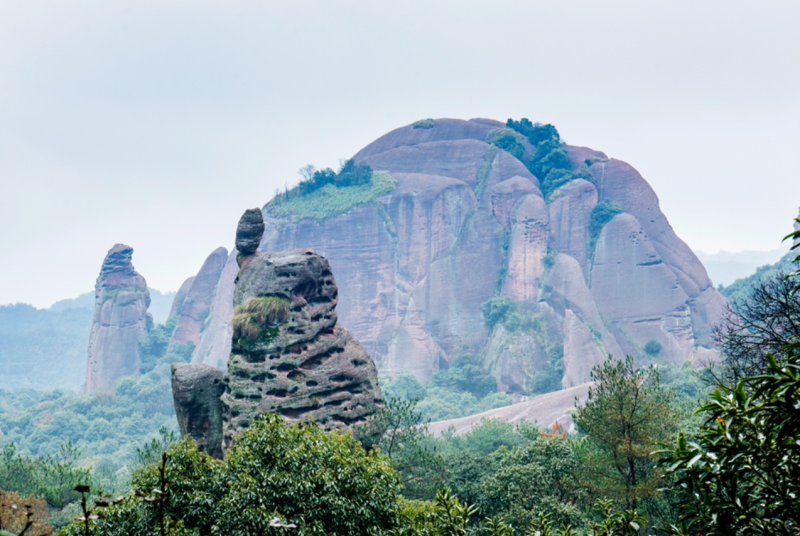
Sandie Guifeng is the landmark landscape of Guifeng Scenic Area. It is formed by three peaks shaped like turtles stacked together, with an altitude of about 418 meters and a relative height of 110 meters. The three "turtle peaks" are arranged in order from bottom to top, with realistic shapes, as if three giant turtles are raising their heads toward the sky. It can be called a classic work of figurative landscape in Danxia landform. Tourists can reach the viewing platform through mountain trails to observe its unique shape up close, and can also enjoy the full view from the distant viewing point at the entrance of the scenic area, experiencing the uncanny workmanship of nature.
Nanyan Temple
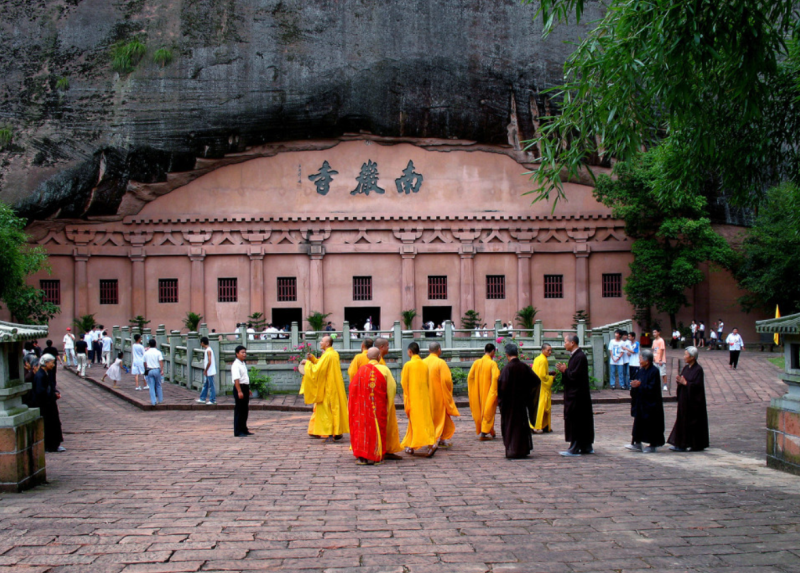
Nanyan Temple is located in Nanyan Scenic Area. It is a Buddhist temple built against a huge natural rock cave. It was first built in the Tang Dynasty, and the existing buildings were rebuilt during the Ming and Qing Dynasties. It covers an area of about 3,000 square meters. The cave is about 30 meters high, about 60 meters wide, and about 50 meters deep. The temple contains halls such as the Mahavira Hall and the Guanyin Hall, enshrining various Buddha statues. On the cave walls, cliff statues and inscriptions from the Tang Dynasty to the Qing Dynasty are preserved. Among them, the Amitabha statue from the Tang Dynasty is the most famous, about 5 meters high and exquisitely carved. Because of the unique layout of "the mountain is a Buddha, the Buddha is a mountain," Nanyan Temple is called the "First Buddhist Grotto in Jiangnan."
Qingshui Lake
Qingshui Lake is a natural lake in Guifeng Scenic Area, with an area of about 300 mu. It is formed by mountain streams converging. The lake water is clear, surrounded by Danxia peak forests, and the scenery is beautiful. Cruise boats and bamboo rafts are available on the lake. Tourists can boat on the lake and enjoy the artistic conception of "the boat travels in the water, people sit in a painting." Along the way, they can see landscapes such as Camel Peak and Old Man Peak reflected in the lake, forming a symmetrical beauty. A waterside boardwalk and viewing pavilions are set up by the lake, making it a good place for leisure walks and photo-taking.
Camel Peak
Camel Peak is one of the representative figurative peaks in Guifeng. It has an altitude of 486 meters and a relative height of 200 meters. It is named because the mountain resembles a camel. The peak is composed of several huge Danxia rocks, with clearly defined head, humps, and body, vivid and lifelike. Climbing to the top of Camel Peak requires ascending about 1,800 steps. Viewing platforms are set up along the way, where visitors can enjoy the scenery of surrounding peaks competing in beauty. The view from the summit is broad, making it one of the best positions to overlook the full view of Guifeng.
Natural Three Stacks
Natural Three Stacks is located in the central part of the main Guifeng Scenic Area. It is a landscape formed by three huge Danxia rocks naturally stacked together. The three rocks connect from top to bottom, shaped like stacked eggs, yet stable as Mount Tai. It can be called a wonder of nature. The total height of the rocks is about 30 meters. The top rock has a diameter of about 10 meters, and the contact area between its bottom and the rock below is only dozens of square centimeters. It seems precarious, yet has stood for tens of millions of years through wind and rain, demonstrating the peculiar mechanical balance of Danxia landform.
Food
Yiyang Rice Cake
Yiyang Rice Cake is a traditional specialty food of Yiyang County, Jiangxi Province. It is sold in restaurants and specialty stores around Guifeng Scenic Area. It is made from local high-quality late rice through processes such as soaking, grinding into powder, steaming, and pounding. It has a chewy and resilient texture and does not stick to the teeth. Yiyang Rice Cake can be stir-fried, boiled, or steamed. Common methods include stir-fried rice cake with green vegetables and stewed rice cake with pork ribs. It is delicious and is an important food in local festivals and daily diet, as well as a fine gift for tourists to give to relatives and friends.
Guifeng Braised Pork
Guifeng Braised Pork is a specialty dish around the scenic area. It uses local free-range pork belly. After blanching, frying, and slicing, it is steamed in a bowl together with preserved mustard greens. The finished meat is fatty but not greasy. The preserved mustard greens absorb the oil from the meat, giving it a rich aroma and a layered taste. This dish is named because it originated in the Guifeng area. It reflects the characteristics of Jiangxi cuisine, which emphasizes seasoning and cooking heat, and is a common dish at local banquets.
Fried Rice Noodles
Yiyang Fried Rice Noodles is a common local snack. It can be seen everywhere in restaurants and breakfast shops in Guifeng Scenic Area. It uses indica rice noodles as the main ingredient, paired with eggs, green vegetables, shredded pork, bean sprouts, and other ingredients, and is quickly stir-fried over high heat. The rice noodles are smooth and chewy, the ingredients are rich, and the taste is fresh and fragrant. Fried rice noodles are quick to make and affordable, making them a convenient choice for tourists to replenish energy while visiting. There is a local saying, "Eat fried rice noodles for breakfast, and you will be energetic all day."
Scenic Area Restaurants
There are several restaurants in Guifeng Scenic Area, mainly distributed near the visitor center and various attractions. They provide Jiangxi cuisine, home-style dishes, and other meals, such as steamed Qingshui Lake fish, farmhouse tofu, and stir-fried wild vegetables. The ingredients in the restaurants are mostly sourced locally, fresh and natural. Among them, Qingshui Lake fish is the most famous, with tender meat and delicious taste. The per capita consumption is about 60-100 yuan, which can meet the dining needs of tourists.
Tickets:
Ticket 60 yuan/person; combined ticket (including ticket, sightseeing bus, and boat) 148 yuan/person.
You can search for the official WeChat public account "Jiangxi Guifeng Tourism" to obtain the latest updates or buy tickets online.
Opening Hours:
Opening hours are 8:00-17:00 daily (April 1-October 31) and 8:30-16:30 (November 1-next year March 31). Ticket sales stop 1 hour before closing. Tourists are advised to arrange their time reasonably to avoid missing the visiting period.
Tour Route:
Tourists can enter from the scenic area gate, take the sightseeing bus (about 10 minutes) to the entrance of the main scenic area, first view the panorama of Sandie Guifeng and take photos (about 20 minutes); then walk to Natural Three Stacks and admire the peculiar rock stacking landscape (about 30 minutes); next go to Camel Peak and climb to the summit to overlook the panorama (about 2 hours); after descending, go to Qingshui Lake and take a boat tour of the lake and surrounding landscapes (about 1 hour); have lunch at the lakeside restaurant (about 1 hour); in the afternoon, go to Nanyan Scenic Area and visit Nanyan Temple and the cliff statues (about 1.5 hours). The entire tour takes about 6-7 hours. Tourists can adjust the itinerary according to their physical strength. Those with insufficient strength can reduce climbing activities and increase boat tour time.
Transportation:
Self-driving: From Nanchang, drive along the Shanghai-Kunming Expressway to the Yiyang exit, then drive about 10 kilometers along National Highway 320 toward Guifeng to reach the scenic area. The whole journey takes about 2.5 hours. From Shangrao, drive along the Shanghai-Kunming Expressway to the Yiyang exit. The drive takes about 1 hour. The scenic area parking lot charges 10 yuan/day for small vehicles and 20 yuan/day for large vehicles.
High-speed rail: Take the high-speed rail to Yiyang High-speed Railway Station. After leaving the station, you can take the scenic area shuttle to Guifeng Scenic Area. The ride takes about 20 minutes, the fare is 10 yuan/person, and departure times are coordinated with high-speed rail arrival times.
Bus: In Yiyang County, take Bus No. 5 to reach Guifeng Scenic Area directly. The ride takes about 30 minutes, the fare is 2 yuan/person, operating hours are 6:30-18:00, and there is one bus every 30 minutes.
Must-Visit Attractions:
Sandie Guifeng: The landmark landscape of the scenic area, composed of three stacked turtle-shaped peaks, with an altitude of 418 meters and a very high degree of resemblance. It is the core representative of Guifeng's Danxia landform and must not be missed.
Nanyan Temple: The "First Buddhist Grotto in Jiangnan," built against a natural rock cave. It has Tang Dynasty cliff statues and Ming and Qing Dynasty buildings, integrating natural and cultural landscapes, with profound cultural heritage.
Camel Peak: A Danxia peak shaped like a camel, with an altitude of 486 meters. Climbing to the top offers a panoramic view. The climbing process is both challenging and scenic, suitable for tourists who like hiking.
Travel Suggestions:
It is recommended to visit on sunny days. The colors of the Danxia landform are more vivid in the sunlight, and photos turn out better. On rainy days, mountain roads are slippery, so climbing requires caution.
Wear comfortable sports shoes when climbing, carry an appropriate amount of drinking water and dry food. Some sections of the scenic area are steep, so trekking poles can be prepared for assistance.
In summer, pay attention to sun protection and carry a sun hat and sunscreen. In winter, pay attention to keeping warm, as some sections may have frost.
The guide maps and signs in the scenic area are clear. You can download an electronic tour guide app in advance or rent a scenic area audio guide (30 yuan/device) to gain an in-depth understanding of the geological and cultural stories behind the landscapes.
Precautions:
Smoking and littering are prohibited in the scenic area. Protect the Danxia landform and ecological environment. Do not climb undeveloped peaks and rocks at will.
When climbing, follow the principle of "walk without looking at the scenery, look at the scenery without walking," especially on steep sections such as Camel Peak. Pay attention to safety and do not chase or play around.
When visiting religious places such as Nanyan Temple, observe etiquette, do not make noise, do not touch Buddha statues or cultural relics, and respect religious beliefs.
When taking a cruise boat or bamboo raft, wear a life jacket, do not stand or sway on the boat, and follow the instructions of the staff.
Mobile phone signal is good in the scenic area, but may be weak in some valley areas. It is recommended to keep in contact with companions to avoid getting separated. The scenic area has an emergency help telephone. In case of emergency, call it promptly.