Hunan Botanical Garden is located in Dongjing Subdistrict, Yuhua District, Changsha City, Hunan Province. It is a national 4A-level tourist attraction and a national science education base. The scenic area covers about 140 hectares, with a forest coverage rate of over 90%. It is home to more than 3,000 species of rare plants and is a comprehensive botanical garden integrating plant conservation, scientific research, science education, and sightseeing. The scenic area is characterized by the theme of "nature, science, and culture," and features more than 20 specialized gardens, including the Cherry Blossom Garden, Azalea Garden, and Rare Plant Garden. Every spring, when cherry blossoms, tulips, and other flowers are in full bloom, it attracts a large number of visitors.
Historical Culture
Hunan Botanical Garden was established in 1985 with joint investment by the Hunan Provincial People's Government and the Ministry of Forestry of the People's Republic of China, and was officially opened to the public in 1994. In its early years, its main goal was to collect and preserve subtropical plant resources. After years of development, it has gradually become an important plant germplasm resource preservation bank in central-southern China.
The scenic area retains part of its original vegetation and landforms, while also incorporating elements of Huxiang culture. For example, the garden design reflects the artistic conception of the "Eight Views of Xiaoxiang," and there is also a Hunan Native Plant Exhibition Area, showcasing Hunan's unique plant ecology and regional culture. In 2012, the scenic area was recognized as a "Hunan Provincial Environmental Education Base," hosting more than 200 science education activities each year and serving as an important window for spreading botanical scientific knowledge.
Main Attractions
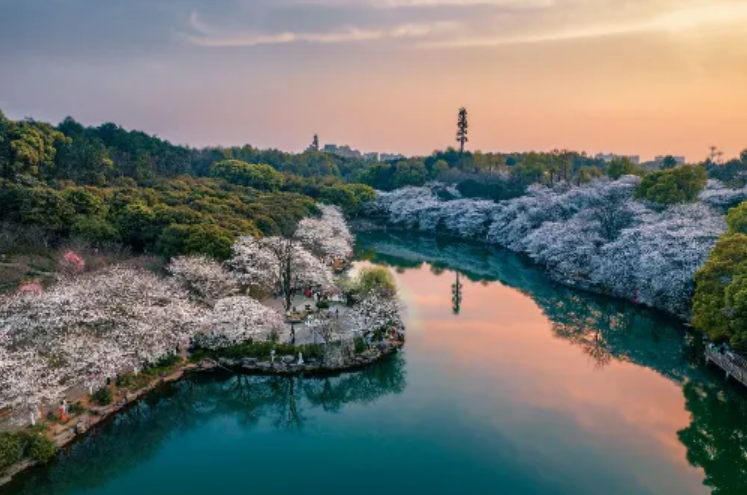
Cherry Blossom Garden
The Cherry Blossom Garden covers about 30 mu and features more than 20 cherry blossom varieties and 5,000-plus trees, including Somei Yoshino cherry, Kanzan cherry, and weeping cherry. From mid-to-late March to early April each year, the cherry blossoms bloom, forming a 400-meter-long Cherry Blossom Avenue. It is a popular spring flower-viewing spot in Changsha, receiving more than 10,000 visitors per day on average.
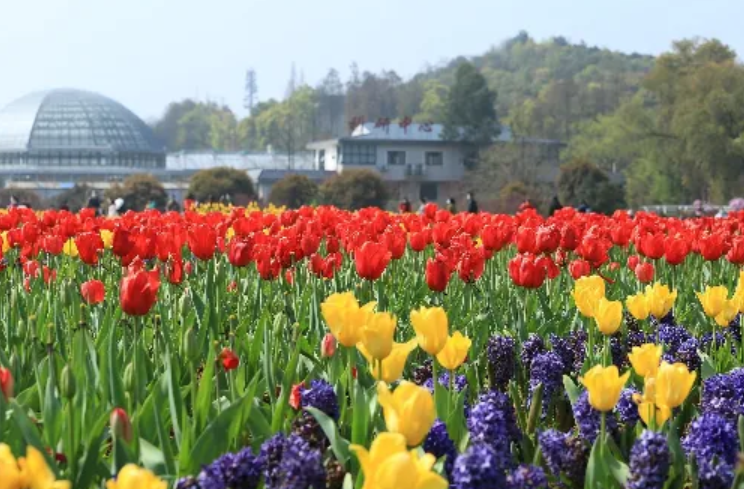
Tulip Garden
The Tulip Garden covers 20 mu. From winter to spring each year, it displays more than 50 tulip varieties and about 100,000 plants, complemented by bulb flowers such as hyacinths and daffodils, forming a colorful flower field landscape. The garden features landscape ornaments such as a Dutch windmill, creating a strong European style and making it a popular photo spot.
Rare Plant Garden
The Rare Plant Garden covers 15 mu and preserves more than 10 species of national first-class protected plants, including dove tree, Cathaya argyrophylla, and Bretschneidera sinensis, as well as more than 30 species of plants unique to Hunan, such as Hunan persimmon and Hunan azalea. The garden has greenhouses to provide suitable growing environments for rare plants and is an important place for scientific research and science education.
World Famous Flower Garden
The World Famous Flower Garden covers 25 mu and has introduced more than 1,000 species of ornamental flowers from around the world, divided into areas such as the European Garden, American Garden, and Asian Garden. There are flowers in all four seasons: peonies in spring, water lilies in summer, chrysanthemums in autumn, and plum blossoms in winter, showcasing the floral culture and garden art of different regions.
Hydrangea Garden
Built in 2017, it covers 7,000 square meters and is concentrated under the Puxian Elephant cherry forest. The Hydrangea Garden collects more than 40,000 plants of 41 Hydrangea varieties, including panicle hydrangea and hardy hydrangea. Well-known varieties include "Bigleaf Hydrangea," "Bodensee," "Pearl," "Jewel," "Jade," "Diamond," "Classic Red," "Cat's Eye," and "Endless Summer."
Peach Blossom Garden
Established in 2017, it covers an area of 2 hectares. It currently preserves 35 peach varieties from China and abroad, including Mantianhong, Zhaoshouhong, Renmian Taohua, and Taohua Xianzi. Among them are 24 upright peach varieties, 3 weeping peach varieties, 4 dwarf peach varieties, and 4 broom-type peach varieties. The peach blossom season is mainly from late February to mid-to-late April.
Suggested Tour Route:
Recommended tour route: Enter from the North Gate of the scenic area, first visit the Cherry Blossom Garden (a key viewing spot from March to April), then go to the Tulip Garden (December to April), then visit the Rare Plant Garden to learn about endangered plants, then walk to the World Famous Flower Garden to enjoy flowers from various countries, have lunch at the Hunan Flavor Snack Street at noon, visit the Science Popularization Hall in the afternoon (to learn about botanical science), and finally exit from the West Gate. The whole tour is recommended to take 4-5 hours. If visiting in autumn, focus on the Osmanthus Forest (September to October) and Sweetgum Forest (November to December).
Tour Suggestions:
Spring (March to May) is the peak flower-viewing season. It is recommended to arrive before 9 a.m. on weekdays to avoid crowds; in autumn (September to November), you can enjoy osmanthus and red maple, and there are relatively fewer visitors.
Carry a lightweight backpack and comfortable sports shoes, as there is a long walking route in the scenic area; spring is rainy, so a folding umbrella can be brought; in summer, take sun protection measures, as there is little shade in the park.
Dining in the scenic area is concentrated at the "Hunan Flavor Snack Street" near the North Gate and the "Ecological Restaurant" at the West Gate. The per capita consumption at the snack street is 20-30 yuan, and at the ecological restaurant it is 50-80 yuan. You can also bring your own lunch for a picnic on the lawn.
Follow the scenic area's official WeChat public account "Hunan Botanical Garden" to check real-time flower conditions and event notices. During peak season, free guided tour services can also be reserved.
Notes:
Pets are prohibited from entering the park. Smoking and littering are prohibited in the park. Violators will be fined 50-200 yuan.
Flower viewing areas are equipped with warning lines and notice boards. Entering flower fields for photos is prohibited, and picking flowers or climbing trees is prohibited to avoid damaging plant growth.
The temperature inside the greenhouses is high, and in summer it can reach above 35°C. Visitors should take precautions against heatstroke; some exhibits in the Science Popularization Hall are fragile cultural relics and should not be touched.
There are many water areas in the scenic area, especially the artificial lake beside the Cherry Blossom Garden. Visitors with children must keep a close watch to prevent drowning.
Traffic congestion is common around the scenic area on weekends and holidays. It is recommended to give priority to public transportation; when leaving by car, follow the parking lot instructions and drive in an orderly manner to avoid scratches.
Transportation:
Bus: Take routes 7, 17, 102, 103, 120, 123, 140, 141, 147, 209, 210, 229, 230, 239, 276, 27, 502, 702, 801, 802, or 806 to the "Provincial Botanical Garden" stop and walk about 200 meters.
Subway: Take Changsha Subway Line 5 to "Maozhutang" Station, exit from Exit 1, transfer to buses 210 or 239 to the "Provincial Botanical Garden" stop, or take a taxi for about 5 minutes.
Self-driving: Navigate to "Hunan Botanical Garden North Gate." There is a parking lot at the scenic area. The charging standard is 5 yuan/hour, with a maximum of 30 yuan per day. Parking spaces are relatively tight on weekends and holidays, so it is recommended to arrive before 9 a.m.
Opening Hours:
The scenic area is open all year round from 7:30 to 18:00 daily (last entry at 17:30). Among these, the greenhouses are open from 9:00 to 17:00, and the Science Popularization Hall is open from 9:30 to 16:30. Every year from March 1 to May 31 and from September 1 to November 30 is the scenic area's peak tourist season. On weekends and holidays, opening hours are extended to 18:30 (last entry at 18:00).
Tickets:
Admission is free, but reservations are required. Some projects inside the garden require separate charges.