The Kashgar Old City is located in the center of Kashgar City, Xinjiang Uygur Autonomous Region, bounded by Renmin Road to the south, Seman Road and Yawag Road to the north, Yumulake Xiehaier Road to the west, and the Tuman River sightseeing belt to the east. The scenic area is rated as a National 5A-level Tourist Attraction. It is one of the largest existing rammed-earth architectural complexes in the world and the only preserved traditional historic district in China with typical ancient Western Regions characteristics. The scenic area covers an area of 8.36 square kilometers, with a total of 28 sections and a population of 221,000 residents.
Historical Culture
The earliest original record of Kashgar Old City dates back more than 2,100 years, recorded by Zhang Qian, when it was called "Shule City." At the end of the Qin Dynasty and the beginning of the Han Dynasty, Kashgar was the territory of Shule and other states among the Thirty-Six States of the Western Regions. In 138 BC and 119 BC, the Western Han Dynasty sent Zhang Qian on two missions to the Western Regions, establishing communication between Kashgar and the Central Plains. In 60 BC, the Han Dynasty established the Protectorate of the Western Regions in Xinjiang, and Kashgar, as part of the Western Regions, was formally incorporated into the territory of the motherland. During the Ming Dynasty, Kashgar was one of the four great Hui cities of the Western Regions. Before the opening of the sea route in the 15th century, Kashgar, as a key transportation hub on the Silk Road, had always been an international commercial port where merchants from China and abroad gathered. After the Qing Dynasty established the Grand Minister in Kashgar in 1760, Kashgar became the political, economic, cultural, and transportation center south of the Tianshan Mountains. In 1986, Kashgar was designated by the State Council as the only National Historical and Cultural City in Xinjiang.
Main Attractions
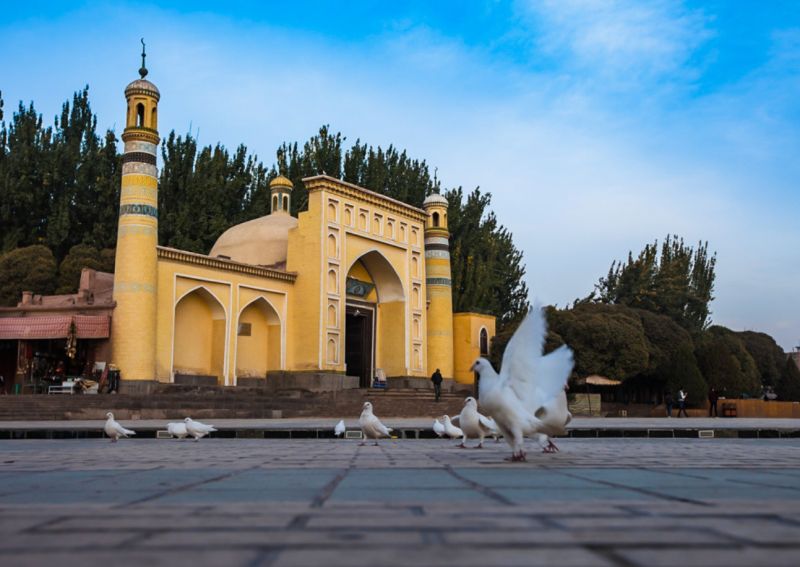
Id Kah Mosque
Built in 1442, it is the largest mosque in Xinjiang, measuring 140 meters from north to south and 120 meters from east to west, with a total area of 16,800 square meters. It is a typical Muslim architectural style, with the main gate built of yellow bricks and white gypsum pointing. On both sides of the gate are brick cylindrical columns half-embedded in the walls, and the small towers on top can be used by worshippers to climb up and pray, solemn and impressive. The courtyard inside the temple is a Muslim-style garden architecture, divided into seven parts: the "Main Hall," "Outer Hall," "Scripture Teaching Hall," "Courtyard," "Gongbaizi," "Minaret," and "Gate."
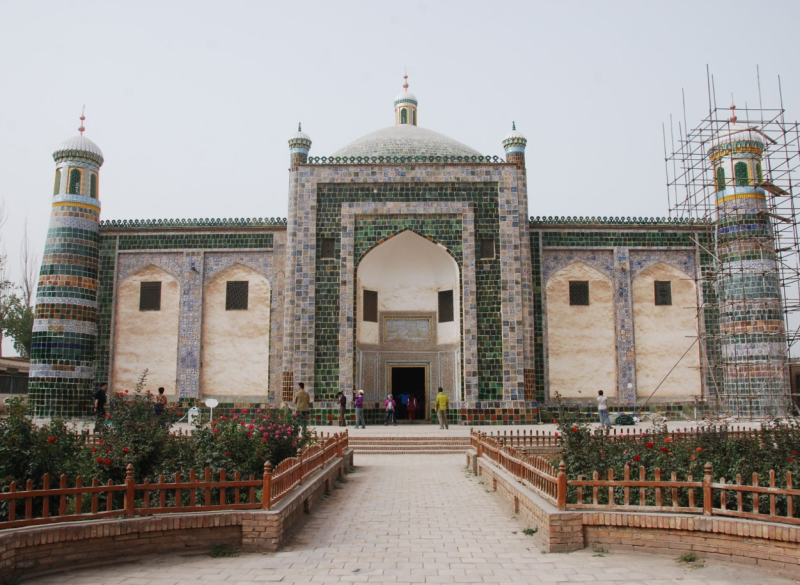
Xiangfei Tomb
Located in Haohan Village, 5 kilometers east of Kashgar City, the entire mausoleum is a group of exquisitely constructed and magnificent ancient buildings, covering about 72 mu. It consists of the Scripture Teaching Hall, High and Low Prayer Halls, Gate Tower, Main Tomb Chamber, Orchard, and several other major parts. It is the most magnificent cemetery in Xinjiang and also the largest dome-style building in all of Xinjiang.
Panto City
Also called Aisikesa City, it is located in the southeast of Kashgar City, Xinjiang, on the high ground on the west side of Duolaitebage Road. The site covers an area of 58,835 square meters, with earthen city walls about 5-9 meters thick, and only more than 10 meters of ruined walls remain. During the Western Han Dynasty, Panto City was the capital of Shule State. In 73 AD, when Ban Chao served as the Protector of the Western Regions, the Protectorate was established here. It is a key cultural relic protection unit of the autonomous region.
Fule Zhihui Garden
Also known as the Tomb of Yusuf Has Hajib, it is located at No. 54 Tiyu Road, Kashgar City, covering an area of 12,000 square meters. It has a unique and magnificent layout, simple and solemn decoration, and is a building complex rich in traditional Uygur architectural art characteristics.
Three Immortals Caves
They are the earliest existing Buddhist caves from the Eastern Han Dynasty in China.
Mo'er Temple Site
Located about 33 kilometers northeast of Kashgar City, it is a large Buddhist temple site composed of relics such as Buddhist pagodas, Buddhist halls, and monks' quarters. In 2001, it was listed as the fifth batch of National Key Cultural Relics Protection Units.
Food
Grilled Mutton Skewers
Fresh mutton is selected, cut into small pieces, skewered on iron sticks, grilled over charcoal fire, and sprinkled with cumin, chili powder, and other seasonings. The outer skin is golden and crispy, while the inside is tender and juicy, full of aroma.
Baked Buns
Made mainly from flour, mutton, onions, and other ingredients, the filling is wrapped in dough, shaped into buns, and baked in a tandoor. The outer skin is crispy, and the filling is fresh and fragrant. With one bite, the fragrance of meat and onions blends together, leaving an endless aftertaste.
Pilaf
Made by simmering rice, mutton, carrots, raisins, and other ingredients together. The rice grains are distinct and have absorbed the broth of the mutton, becoming oily and delicious. Paired with tender mutton and sweet carrots and raisins, it has a rich texture and is nutritious and tasty.
Gangzi Meat
Mutton chunks are placed in enamel mugs, added with side ingredients such as carrots, onions, and potatoes and an appropriate amount of water, and slowly stewed over fire. The meat is tender, the soup is fresh and delicious, and it is nutritious. It is one of the local specialty foods.
Tickets:
The Kashgar Old City Scenic Area is free of admission. However, some attractions within the scenic area, such as the Id Kah Mosque and Maimaiti's Old House, require separate tickets. The adult ticket for the Id Kah Mosque is 29 yuan, and the elderly and student tickets are 15 yuan; the ticket for Maimaiti's Old House (including photos) is 29 yuan for adults.
You can search for the official WeChat public account of the scenic area, "Kashgar Old City Scenic Area Official," to obtain the latest updates.
Opening Hours:
The daily opening hours of the scenic area are 00:00-24:00. The city-opening ceremony is held twice daily, at 10:30 and 18:00 respectively.
You can obtain the latest updates from the official WeChat public account of the scenic area.
Tour Routes:
East District: Old City East Gate → Sky Garden → Iron Industry Commune → Maimaiti's Old House → Kashgar Old City Medicine Tea House → Impression One Street → Geng Gong Temple → Kashgar Spring Festival Gala Sub-venue → Khan Bazaar.
West District: Century-Old Tea House → Bagqi Homestay Alley → Oil Painting Street → Atlas Intangible Cultural Heritage Hall → Rainbow Alley & Cloth Bag Alley → Grandpa's Grandpa's Dad's Naan → Antique Street → Nurbekh Food Street → Thousand Doors and Ten Thousand Windows Street.
Transportation:
Airplane: Kashgar Airport is 10 km from the city center. You can take a taxi from the airport to the scenic area. Taxis in Kashgar city start at 8 yuan.
Bus: There are multiple bus routes in the city that can reach the vicinity of Kashgar Old City. Specific routes can be obtained by checking local bus information.
Must-Visit Attractions:
Id Kah Mosque: The largest mosque in Xinjiang, with a unique architectural style and a strong religious and cultural atmosphere. It is an important place to experience Muslim culture.
Kashgar Old City Old Street: Full of rich ethnic customs. There are various specialty shops and traditional handicraft shops on both sides of the street, where you can buy souvenirs with local characteristics and also appreciate the exquisite Uygur architecture.
Gaotai Residential Houses: Showcase Uygur folk customs. The houses are built against cliffs, layered and staggered. Here you can gain an in-depth understanding of the Uygur lifestyle and traditional culture.
Travel Suggestions:
It is recommended to spend 2-3 days to fully experience the charm of the old city.
In the morning, you can attend the city-opening ceremony and feel the lively atmosphere of the old city; in the evening, you can go to the Khan Bazaar night market to taste various foods.
When touring, pay attention to observing the floor tiles under your feet. Remember the mnemonic "four-corner bricks, dead end; six-corner bricks, all roads lead through" to avoid getting lost.
You can choose to take local pedicabs, which allow you to enjoy the scenery while saving energy.
Precautions:
There is a 2-hour time difference between Xinjiang time and inland time. Local 10 a.m. is equivalent to 8 a.m. inland, and it does not get dark until 11 p.m. Arrange your travel time reasonably.
There is a large temperature difference between day and night in Kashgar urban area, and the sunshine duration is long. Prepare sunscreen, sunglasses, hats, and other sun protection items, and also carry a long-sleeved jacket to prevent catching cold in the morning and evening.
Respect local religious beliefs and customs. When entering religious places such as mosques, pay attention to dressing appropriately and keep quiet.