Dule Temple is located in Jizhou District, Tianjin, and is a national 4A-level tourist attraction. It is also one of the famous ancient Buddhist temples surviving in China. The scenic area is renowned for its long history, unique Liao Dynasty architectural style, and profound cultural heritage, and it is an important physical relic for the study of ancient Chinese architectural history and Buddhist culture. Dule Temple covers an area of about 16,000 square meters. The existing Mountain Gate and Guanyin Pavilion in the temple are Liao Dynasty buildings, dating back nearly a thousand years. Among them, the Guanyin Pavilion is one of the oldest surviving wooden multi-story pavilion-style buildings in China, and the Mountain Gate is the earliest surviving mountain gate with a hipped roof in China. Both demonstrate superb ancient architectural techniques and possess extremely high historical and artistic value.
Historical Culture
The history of Dule Temple can be traced back to the Tang Dynasty. According to historical records, it was first built in the tenth year of the Zhenguan era of Emperor Taizong of Tang (636 AD). However, the existing main buildings, the Mountain Gate and the Guanyin Pavilion, were rebuilt in the second year of the Tonghe era of Emperor Shengzong of Liao (984 AD), supervised by Han Kuangsi of Jizhou. There are different explanations for the origin of the temple name "Dule." One theory is that it comes from An Lushan raising troops here to rebel against the Tang and thinking of enjoying pleasure alone; another theory holds that it takes the meaning of "rejoicing in one's own joy," related to Buddhist practice.
Over the long course of history, Dule Temple has undergone multiple repairs, including various degrees of renovation in the Ming Dynasty, Qing Dynasty, and modern times, but the main buildings still retain the architectural style of the Liao Dynasty. In 1961, Dule Temple was announced by the State Council as one of the first batch of Major Historical and Cultural Sites Protected at the National Level. Its architectural layout and structure play an irreplaceable role in the study of Liao Dynasty architectural techniques, Buddhist art, and the history and culture of the northern region. The sculptures and murals in the temple also reflect the artistic standards and religious beliefs of that time.
Main Attractions
Mountain Gate
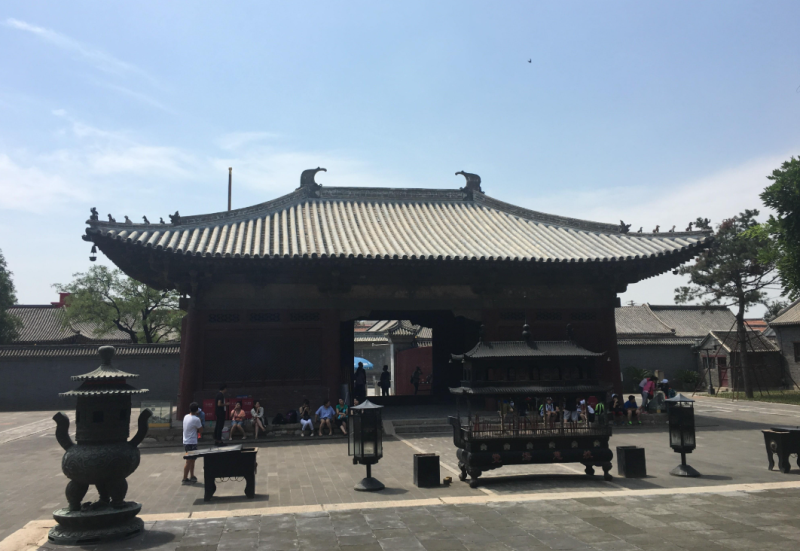
The Mountain Gate is the entrance to Dule Temple. It is a Liao Dynasty building, five bays wide and two bays deep, about 10 meters high, and adopts a hipped roof design. It is the earliest surviving mountain gate with a hipped roof in China. The roof is covered with green tiles, and both ends of the main ridge are decorated with chiwen. The style is simple and dignified. On both sides inside the Mountain Gate stand two tall Heavenly King statues, known as the "Heng and Ha Two Generals." Both are Liao Dynasty painted sculptures, about 4.5 meters high, with solemn expressions and majestic momentum, and are among the earlier surviving Heavenly King statues in China. The architectural structure of the Mountain Gate adopts a post-and-lintel frame, with large dougong brackets arranged sparsely, reflecting the typical characteristics of Liao Dynasty architecture.
Guanyin Pavilion
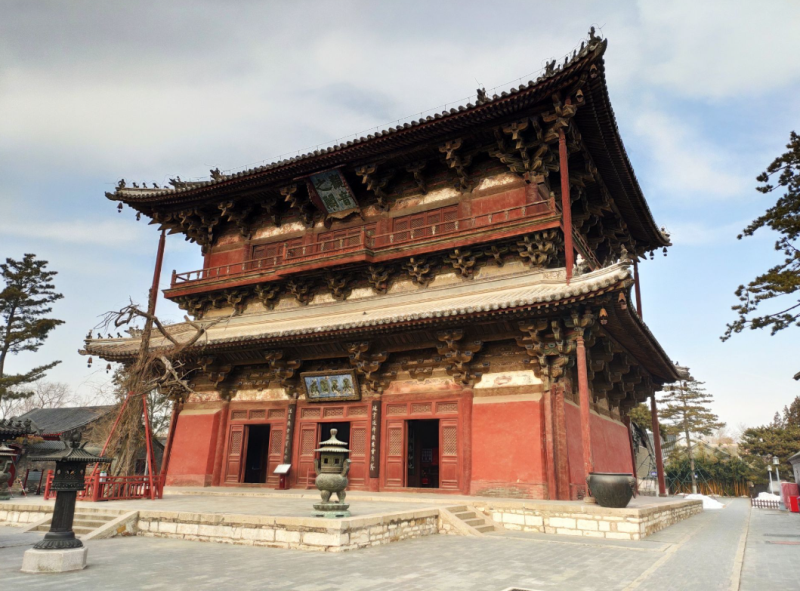
The Guanyin Pavilion is the core building of Dule Temple. It is a Liao Dynasty wooden multi-story pavilion-style building, 23 meters high, five bays wide and four bays deep. It appears as two stories from the outside but is actually three stories inside, using a "two bright, three hidden" structural method. Inside the pavilion is enshrined a 16.08-meter-high clay sculpture of an Eleven-Faced Guanyin, one of the largest surviving clay sculptures in China. The head of the Guanyin statue has ten small heads, and together with the main face there are eleven faces in total, hence the name. The interior of the statue has a wooden frame, with the exterior covered in clay sculpture. The form is graceful and the expression solemn. The architectural structure of the Guanyin Pavilion is ingenious, using a combination of 24 types of dougong brackets, layered one upon another. They are both beautiful and load-bearing. Having withstood multiple earthquakes, it still stands safely, demonstrating the outstanding wisdom and skill of ancient architects and serving as a model of ancient Chinese wooden architecture.
Weituo Pavilion
The Weituo Pavilion is located on the north side of the Guanyin Pavilion. It is a Ming Dynasty building, a small pavilion with a four-corner pyramidal roof, about 8 meters high. Inside the pavilion is enshrined a statue of Weituo. Weituo is a protective deity in Buddhism, holding a vajra club and with a solemn expression. The architectural style of the Weituo Pavilion is simple and lively, forming a contrast with the ancient simplicity and dignity of the Mountain Gate and Guanyin Pavilion, enriching the architectural layout of the temple.
Bao'en Hall
The Bao'en Hall is located in the northeast part of Dule Temple. It is an expansion built on the basis of the original temple during the Qianlong period of the Qing Dynasty and consists of a screen wall, mountain gate, front hall, rear hall, and other buildings in a courtyard-style layout. Most of the buildings in the courtyard have flush gable roofs, reflecting the stylistic characteristics of Qing Dynasty architecture. The Bao'en Hall was once a place for the monks in the temple to live and carry out activities. Today it is also open to tourists as part of the display of Dule Temple's history and culture.
Food
Jizhou Wantuo
Jizhou Wantuo is a local specialty snack. It uses buckwheat flour as the main ingredient. During preparation, the buckwheat flour is mixed into a paste, placed in a bowl, and steamed. After cooling, it is removed from the mold and cut into small pieces. It can be eaten cold with dressing or pan-fried. When eaten cold, garlic paste, vinegar, chili oil, and other seasonings are added, giving it a smooth, chewy texture; after pan-frying, it is crispy on the outside and tender on the inside, full of aroma. It is one of the foods tourists often taste around Dule Temple.
Gezhi Box
Gezhi Box is a traditional flavored snack in the Jizhou area of Tianjin, with a long history of preparation. It mainly uses mung bean flour, with an appropriate amount of wheat flour added. After mixing into a batter, it is spread into thin pancakes, then cut into diamond-shaped small pieces and deep-fried until golden and crisp. Gezhi Box can be eaten directly or used in stir-fries. It has a crisp texture and rich aroma and is deeply loved by local people and tourists.
Tie Bingzi
Tie Bingzi is a common farmhouse food in the north and is also quite popular in the Jizhou area. It uses cornmeal as the main ingredient. After adding an appropriate amount of water and salt and kneading into dough, it is stuck to the inner wall of an iron pot. Vegetables or porridge are usually cooked at the bottom of the pot, and the heat in the pot is used to steam the cakes. The bottom of Tie Bingzi is crisp, while the upper part is soft, with the fresh fragrance of corn. Eaten with local stewed dishes, the flavor is very authentic.
Tickets:
Tickets are 33 yuan per person.
You can search for the official public account "Tianjin Jizhou District Cultural Heritage Protection Center" on WeChat to get the latest updates or buy tickets online.
Opening Hours:
Opening hours are adjusted according to the season. In summer (April 1-October 31), opening hours are 8:00-18:00; in winter (November 1-March 31 of the following year), opening hours are 8:30-17:00. Ticket sales stop one hour before closing. Tourists need to arrange their time reasonably before visiting.
Tour Route:
After entering Dule Temple, visitors can first enter through the Mountain Gate and admire the Liao Dynasty architectural style of the Mountain Gate and the "Heng and Ha Two Generals" statues, staying for about 20 minutes; then go to the core building, the Guanyin Pavilion, to carefully view the Eleven-Faced Guanyin statue inside and the ingenious architectural structure, with a recommended stay of 40-60 minutes; after leaving the Guanyin Pavilion, go to the Weituo Pavilion on the north side to see the Weituo statue, taking about 10 minutes; then go to the Bao'en Hall in the northeast to experience the Qing Dynasty architectural style and learn about the living scenes of the monks in the temple, staying for about 30 minutes. The entire tour takes about 2-3 hours. Tourists can adjust the stay time at each attraction according to their own interests.
Transportation:
Bus: Within Jizhou District, you can take bus routes such as Jizhou Route 1 and Jizhou Route 2 and get off at the "Dule Temple" stop, then walk to the scenic area.
Self-driving: Starting from downtown Tianjin, drive along the Jinji Expressway, exit at the Jizhou urban area exit, and follow navigation instructions to Dule Temple. There are parking lots around the scenic area.
Train: After taking lines such as the Beijing-Qinhuangdao Railway to Jizhou Station, you can transfer to a local bus or taxi to Dule Temple. The distance is about 5 kilometers, and the taxi ride takes about 15 minutes.
Must-Visit Attractions:
Guanyin Pavilion: One of the oldest surviving wooden multi-story pavilion-style buildings in China, 23 meters high, with a 16.08-meter-high Eleven-Faced Guanyin statue inside. Its architectural structure is ingenious and its dougong brackets are diverse. It is the core highlight of Dule Temple and demonstrates the superb architectural and sculptural art of the Liao Dynasty.
Mountain Gate: The earliest surviving mountain gate with a hipped roof in China, a Liao Dynasty building, five bays wide and two bays deep, about 10 meters high, with 4.5-meter-high "Heng and Ha Two Generals" Liao Dynasty painted sculptures inside. It has important historical and artistic value.
Travel Suggestions:
It is recommended to arrange the visit in the morning, when the light is suitable for viewing architectural details and taking photos.
Before visiting, you can consult relevant materials to understand the historical background and architectural knowledge of Dule Temple so as to better understand the meaning of the scenic area.
There is a guide service in the scenic area. You can choose it according to your needs. The guide fee is about 50 yuan per time, allowing you to gain an in-depth understanding of the stories of the buildings and cultural relics.
There are also nearby attractions such as Jizhou Confucian Temple and White Pagoda Temple. You can plan a one-day tour and visit them together to enrich your itinerary.
Notes:
Smoking, spitting, and littering are prohibited in the scenic area. Please protect cultural relics and buildings, and do not touch or carve on statues and murals.
Keep quiet when entering the temple, respect religious beliefs and customs, and do not make noise or roughhouse.
Pay attention to sun protection when visiting in summer and keep warm in winter. Comfortable shoes will help you better tour the scenic area.
Observe the opening hours of the scenic area and plan your itinerary in advance to avoid missing visiting times.
Some areas in the scenic area may be narrow. When there are many visitors, pay attention to safety and visit in an orderly manner.