Yaoshan Scenic Area is located in the west of Lushan County, Pingdingshan City, Henan Province. It is a national 5A-level tourist attraction and a national geopark. The scenic area is situated in the eastern section of the Funiu Mountains, with a total area of about 268 square kilometers and a core scenic area of 57 square kilometers. The main peak, Yuhuangding, has an elevation of 2,153.3 meters, making it the second-highest peak in the Funiu Mountains. Yaoshan is known for its grotesque peaks and rocks, hot springs and sea of clouds, and primitive forests. It has more than 240 scenic spots of various types, including 10 special-grade spots and 30 first-grade spots. The forest coverage rate is over 95%, and the negative oxygen ion content exceeds 100,000 per cubic centimeter, making it a natural forest oxygen bar. The scenic area has a height difference of 1,600 meters, creating a unique climate of "four seasons in one mountain, different weather within ten li." It is a comprehensive mountain-type scenic area integrating landscape sightseeing, hot spring wellness, and leisure vacation.
Historical Culture
Yaoshan got its name because Liu Lei, a descendant of Emperor Yao, built a Yao ancestral temple here to worship his ancestors, and its history can be traced back to the Xia Dynasty. According to records in the Records of the Grand Historian, Liu Lei once raised dragons here, and the stone tablet "Liu Lei Dragon-Taming Site" still exists. The scenic area preserves cultural relics such as the Qingyun Temple from the Tang Dynasty and the Yingfeng Palace from the Ming Dynasty. Among them, Qingyun Temple was first built during the Wude period of the Tang Dynasty and was once a Buddhist holy site in the Central Plains. The existing buildings were rebuilt in the Qing Dynasty, and the temple preserves cultural relics such as Ming Dynasty bronze Buddha statues and Qing Dynasty stone inscriptions.
Yaoshan is also the hometown of Mozi. According to research, Mozi's birthplace "Luyang" is present-day Lushan County. Relics such as Mozi's lecture site and Mozi Cave remain in the scenic area. In addition, Yaoshan was a military fortress during the Northern Song Dynasty. Niu Gao, a famous general of the Southern Song Dynasty, once resisted the Jin here, and the "Niu Gao Ridge" site still exists. In modern times, Yaoshan was an important part of the Western Henan Revolutionary Base Area, leaving behind many red cultural sites.
Geologically, Yaoshan was formed 2.5 billion years ago in the Archean Era. It was shaped by the Yanshan Movement and the Himalayan Movement, forming a unique granite peak forest landform. Landforms such as Shiren Peak and Dajiangjun Peak in the scenic area are typical collapse accumulation landscapes, and geologists call it a "natural geological museum."
Main Attractions
Shiren Peak
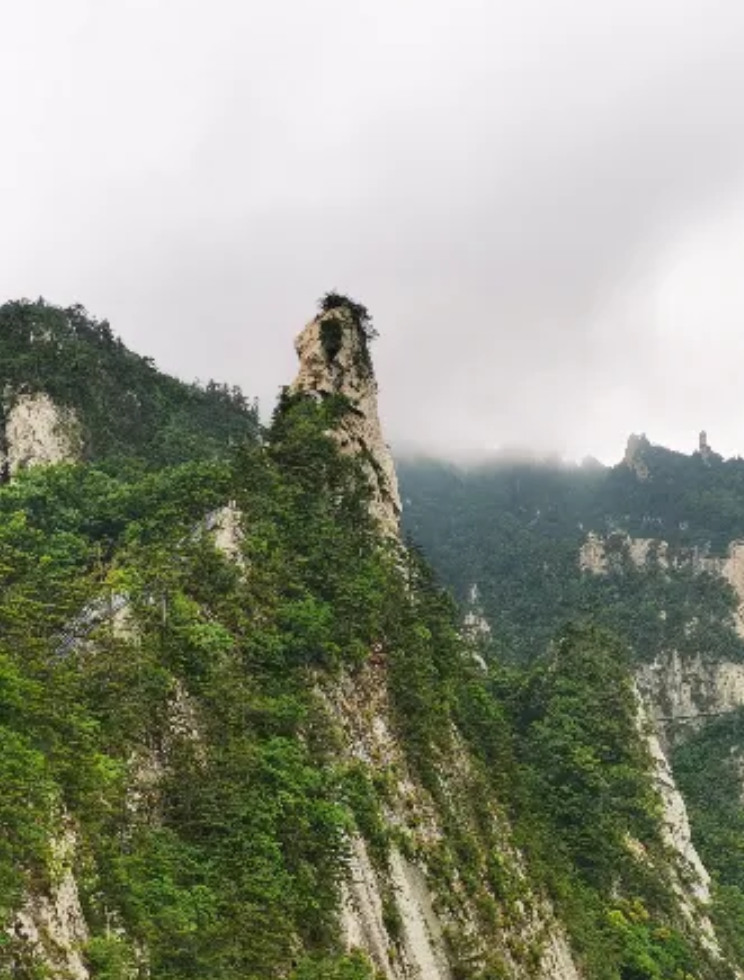
A landmark landscape next to Yuhuangding, the main peak of Yaoshan, named because the giant rock resembles an ancient warrior standing. It is about 70 meters high and about 20 meters in diameter. It is a natural stone pillar formed by weathering and erosion of granite. Shiren Peak has cliffs on three sides, with only a small path on the northwest side for climbing. From the top, visitors can overlook the panoramic view. It is the most representative geological wonder in the scenic area and has been listed as one of the "Most Beautiful Geological Landscapes in Henan."
Qinglong Ridge
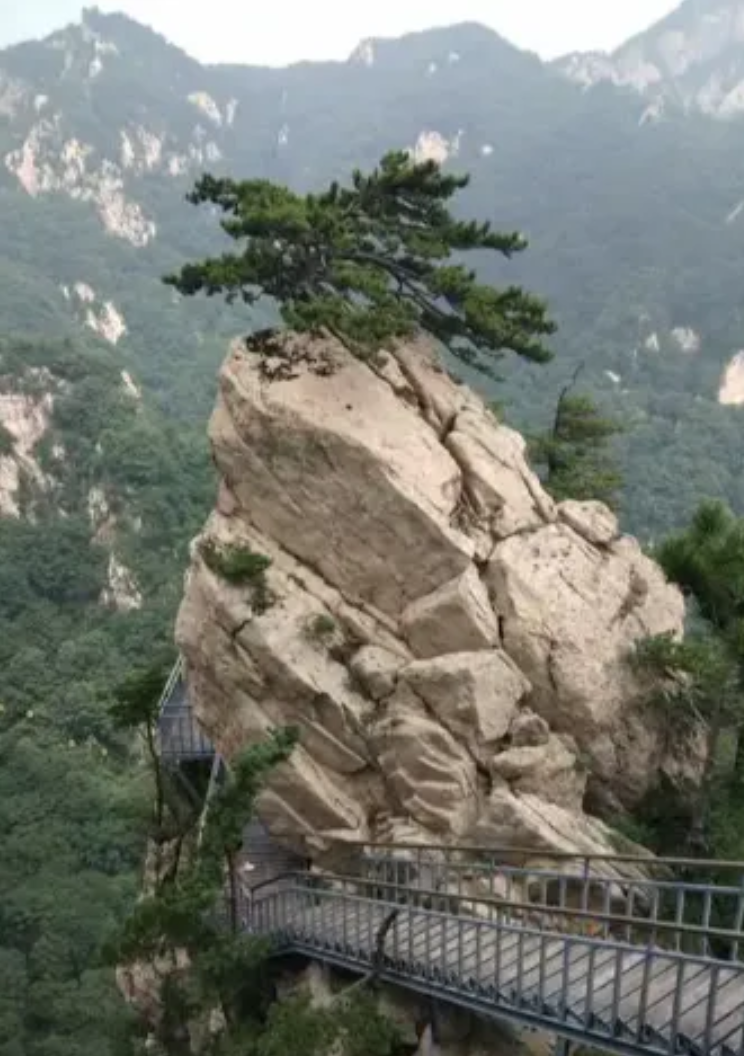
A ridge about 400 meters long and only 2-3 meters wide, with cliffs hundreds of meters deep on both sides. It is named because it resembles a green dragon coiling. The ridge has exposed rocks and sparse vegetation, and the narrowest point allows only one person to pass. It is the most thrilling hiking route in Yaoshan. Along the way, visitors can view pictographic rock landscapes such as "Crocodile Emerging from the Sea" and "Golden Turtle Gazing at the Moon." At the end, there is an observation deck from which visitors can look far toward Yuhuangding.
Jiuqu Waterfall
The largest waterfall in Yaoshan, more than 70 meters high and about 10 meters wide. It is named because the water flows through nine bends. The waterfall falls in three tiers. In summer, when the water volume is abundant, the flow pours down like the Milky Way, shaking the valley with its sound. In winter, it forms an ice waterfall wonder, with ice pillars reaching up to 30 meters, a rare winter landscape in the Central Plains. Beside the waterfall, there are a viewing pavilion and wooden boardwalk, making it convenient for tourists to view it up close.
Yaoshan Hot Springs
Located at the northern foot of the scenic area, it is a famous hot spring group in the Central Plains. The water temperature remains at 60-65°C year-round and is rich in more than 20 minerals such as fluorine, silicon, and strontium, with significant therapeutic effects on skin diseases and rheumatism. The existing hot spring resort covers 150 mu, with more than 50 outdoor soaking pools and hot spring hotels. Its daily reception capacity reaches 5,000 people, making it a core leisure vacation project in Yaoshan.
Primitive Forest
The area above 1,600 meters in elevation in Yaoshan covers about 100,000 mu and is one of the best-preserved primitive forests in Henan Province. In the forest, ancient trees tower, and there are more than a thousand large trees with a diameter at breast height of more than 1 meter. Among them are more than 50 rare tree species such as ginkgo and oak that are over a thousand years old. The forest is inhabited by nationally protected animals such as leopards and golden pheasants. The negative oxygen ion concentration can reach up to 120,000 per cubic centimeter, making it a natural forest bath.
Tour Routes:
Recommended one-day tour route: Mountain Gate → Yaoshan Cableway → Qinglong Ridge → Shiren Peak → Yuhuangding → Jiuqu Waterfall → Tongtian Gate → Scenic Area Exit. The whole journey takes about 6 hours and involves about 8 kilometers of walking, suitable for tourists with relatively good stamina. If time is limited, visitors can take the Yuhuangding Cableway directly to the main peak, tour the core attractions, and return, taking about 4 hours in total. For a two-day tour, it is recommended to visit the mountain attractions on the first day and experience the hot springs on the second day. Accommodation can be chosen at Fuquan Hotel inside the scenic area or nearby homestays.
Travel Suggestions:
Best times to visit: April-May (azaleas in full bloom) and October-November (red leaves covering the mountains). Summer is good for escaping the heat (the temperature on the mountain is 5-8°C lower than in the city), and winter is good for viewing ice waterfalls.
Wear comfortable hiking shoes. There are many steps in the scenic area, and a single day's walking distance can reach 10 kilometers. Bring sun protection in summer and a down jacket in winter (the temperature at the summit is low).
Buy package tickets in advance on the official website (admission cableway), which are 10-20 yuan cheaper than on-site tickets. There are few dining spots in the scenic area, so visitors may bring convenient food.
For the hot spring area, bring your own swimsuit; buying one in the scenic area is relatively expensive. Soaking time should not exceed 1 hour, and avoid soaking on an empty stomach or after drinking alcohol.
Precautions:
Smoking and fire use are prohibited in the scenic area. During the mountain fire prevention period (November to March of the following year), bringing fire sources is strictly prohibited, and violators will be fined 200-500 yuan.
Roads at attractions such as Qinglong Ridge and Shiren Peak are steep, so pay attention to safety. Climbing non-tour areas is prohibited, and children must be accompanied by adults.
The ground in the hot spring area is slippery, so anti-slip slippers are recommended. Patients with high blood pressure or heart disease should soak in hot springs according to medical advice, for no more than 30 minutes.
Mobile phone signal in the scenic area is weak. It is recommended to travel in groups and inform family members of the itinerary in advance.
Some farmhouse restaurants support cash payment, so it is recommended to carry a small amount of cash. When buying local specialties, bargaining is possible. For fresh fruits such as kiwi, pay attention to the shelf life.
Transportation:
High-speed rail: Take the Zhengzhou-Chongqing High-speed Railway to Lushan Station, then transfer to the scenic area tourist shuttle. It departs daily from 8:00 to 16:00, once every hour, with a fare of 20 yuan per person and a travel time of about 1.5 hours.
Long-distance bus: There are direct long-distance buses to Yaoshan from Zhengzhou and Pingdingshan. Departure times from Zhengzhou West Station are 7:30, 9:30, and 11:30, with a fare of 65 yuan per person and a travel time of 3 hours. Departure times from Pingdingshan Bus Station are 6:30-17:00, once every 30 minutes, with a fare of 35 yuan per person and a travel time of 1.5 hours.
Self-driving: From Zhengzhou, take the Zhengzhou-Yaoshan Expressway directly to Yaoshan Station, with a total distance of 180 kilometers and a travel time of 2.5 hours. From Luoyang, take the Erguang Expressway and transfer to the Zhengzhou-Yaoshan Expressway, with a total distance of 160 kilometers and a travel time of 2 hours. From Pingdingshan, take the Zhengzhou-Yaoshan Expressway, with a total distance of 70 kilometers and a travel time of 1 hour. The scenic area parking lot covers 30,000 square meters, can park more than 2,000 vehicles, and charges 10 yuan per vehicle.
Opening Hours:
Yaoshan Scenic Area is open year-round, with opening hours from 7:00 to 18:00 (last entry at 17:00). In summer (June-August), due to an increase in tourists seeking to escape the heat, opening hours are extended to 18:30 (last entry at 17:30). In winter (November-February of the following year), the park closes at 17:30. Opening hours remain unchanged on statutory holidays. During the April Azalea Festival and October Red Leaf Festival each year, themed activities are held, and the specific times are subject to scenic area announcements.
Tickets:
Admission is 65 yuan per person.