The Huanglong Cave Scenic Area is located in Jundi Ping Subdistrict, Wulingyuan District, Zhangjiajie City, Hunan Province. It is an important part of Wulingyuan, a World Natural Heritage Site and World Geopark. It features typical karst landforms and is one of China's first batch of 5A-level tourist attractions. The scenic area consists of three parts: Huanglong Cave, known as the "Wonder of the World's Karst Caves," the beautiful pastoral scenery of the Ecological Square, and the new ethnic music show "Misty Rain Zhangjiajie." The explored floor area of Huanglong Cave reaches 100,000 square meters, with a total length of 7.5 kilometers and a vertical height of 140 meters. It is divided into four levels, with 1 reservoir, 2 rivers, 3 pools, 4 waterfalls, 13 large halls, 98 corridors, as well as thousands of white jade pools and tens of thousands of stalactite peaks. The Huanglong Cave Ecological Square covers an area of 119,200 square meters and includes ten major landscape areas, including the Huanglong Concert Hall, Pastoral Songs, and the Cultural Corridor. It won the national "Environmental Art Award" in 2008.
History and Culture
Huanglong Cave is also known as Huanglong Spring. Legend has it that during the Qianlong period of the Qing Dynasty, there was a severe drought lasting a hundred days. The famous magician He Junru led his disciples into the cave to pray for rain, and all of them died. Before dying, Master He left behind the words, "Let the field in front of the gate dry up, but do not strike Huanglong Spring." From then on, Huanglong Cave became widely known. In 1983, Huanglong Cave was discovered and explored by eight local young militia members, and it was officially opened to the public on October 1, 1984. After years of construction and development, it has become the first scenic area in Hunan Province to hold the "China Well-Known Trademark," and it is also one of China's tourist caves with the greatest global visibility and reputation.
Main Attractions
Dragon Palace
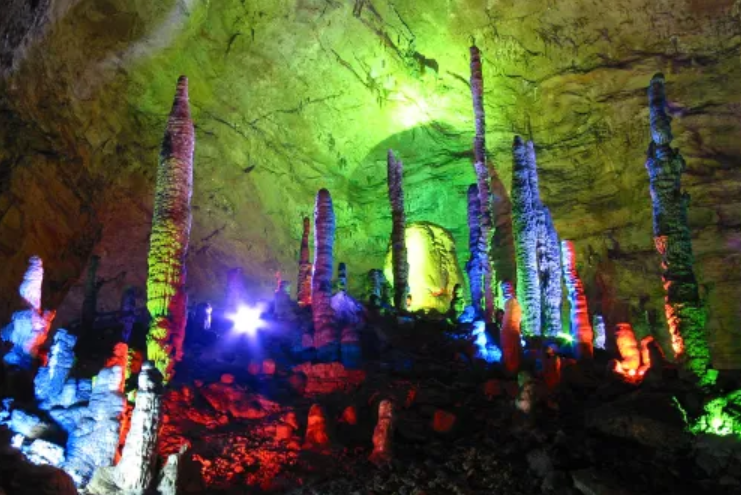
The Dragon Palace is the largest and oldest hall in Huanglong Cave, formed 200,000 years ago. It has an average height of 40 meters and a floor area of 14,000 square meters. It contains more than 1,705 stalagmites and stalactite columns. The "Sea-Calming Divine Needle," the "Dragon King's Throne," and the "Ten-Thousand-Year Snow Pine" are known as the three great wonders of the Dragon Palace. The "Sea-Calming Divine Needle" is 19.2 meters tall, the tallest stalagmite in Huanglong Cave, and also the landmark attraction of the scenic area. It is thick at both ends and thin in the middle, growing on a slope. The "Dragon King's Throne" is 12 meters high, with a base diameter of 10 meters, and has a huge hollow space in the middle that can accommodate 15 adults. The "Ten-Thousand-Year Snow Pine" is completely white throughout, 17 meters tall, grows quickly, and stands majestically on the western slope of the Dragon Palace Hall.
Xiangshui River
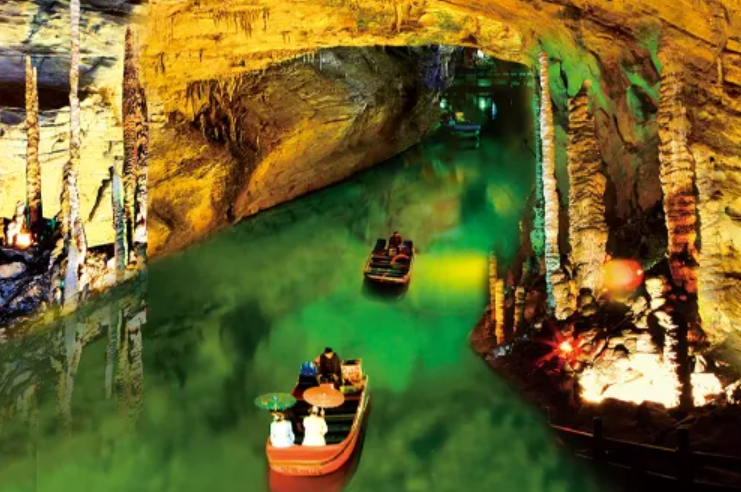
The Xiangshui River is located on the second level of Huanglong Cave. It is one of the three underground rivers in the cave, with a total length of 2,800 meters, an average water depth of 6 meters, and a maximum depth of 12 meters. At present, the boat tour covers a section of 800 meters and takes about 8 minutes. The average water temperature is around 16°C all year round. It is rich in the national second-class protected animal, the giant salamander, and the transparent "glass fish."
Sea-Calming Divine Needle
Located in the "Dragon Palace Hall" on the fourth level of Huanglong Cave, it is 19.2 meters tall and was formed 200,000 years ago. It is thick at both ends and thin in the middle, growing on a slope. It is extraordinarily spectacular and crystal clear throughout, and can be called the "treasure of the cave." In 1998, it was insured for 100 million yuan, creating a precedent in the world for insuring resource-based assets.
Tianxian Water
Tianxian Water is the suspended waterfall with the largest flow and greatest drop among developed karst caves in China. Its drop is as high as 27.3 meters. It pours straight down from the stone grotto at the top of the cave, sending up splashing pearls and jade, with magnificent momentum, flowing continuously all year round.
Thousand Fields
The scientific name of Thousand Fields is "flowstone dam," also called "acid field." It is a calcium carbonate deposit formed by horizontally flowing water during its movement along the cave floor. There are countless thousand fields in Huanglong Cave, crisscrossing like field paths.
Tour Route:
The regular route starts from the entrance. First visit the Dragon Dance Hall, then go to the Xiangshui River for a boat ride. After landing, visit Tianxian Water and Tianzhu Street, and finally reach the Dragon Palace. If time is sufficient and you have good stamina, you can add a visit to the Maze on the basis of the regular route.
Tour Suggestions:
Try to arrive early (before 9:00) to avoid the peak time of tour groups.
The cave floor is slippery, and the temperature is around 16°C all year round. It is recommended to wear non-slip shoes and bring a light jacket.
Follow the signs during the visit and do not touch the stalactites.
Keep your phone and other belongings safe while boating.
Precautions:
The lighting in the cave is dim. When taking photos, you can increase the camera's ISO sensitivity or use a tripod. Flash is prohibited to protect the stalactites.
There are many steps. People with limited mobility or elderly people should be cautious. Children are not recommended to enter the Maze area alone.
Do not easily trust "free guides" or low-priced private cars. Buy tickets through official channels.
Transportation:
Bus: From the main entrance of the Wulingyuan Scenic Area or the bus station, take Bus No. 3 to the terminal stop, Huanglong Cave. After getting off, walk for 15 minutes to reach the cave entrance.
Self-driving: Navigate to "Huanglong Cave Scenic Area." The scenic area parking lot charges about 10-20 yuan per day.
Opening Hours:
Peak season (April-October): 8:00-17:30. Off-season (November-March): 8:30-17:00.
Tickets:
The ticket price is 118 yuan per person.