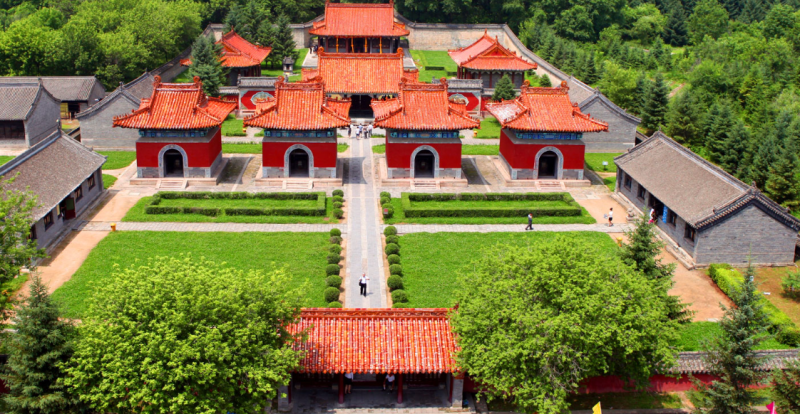
Yongling Tomb is the ancestral mausoleum of the Qing emperors and one of the "Three Tombs Outside the Great Wall." It is located at the southern foot of Qiyun Mountain in Yongling Town, Xinbin Manchu Autonomous County, Liaoning Province. Specifically, it sits beneath Hulan Hada (Chimney Mountain) on the north bank of the Sukesu Hobira (Suzi River). It lies 22 kilometers east of the county seat and 2 kilometers from Yongling Town. To the southeast, it is about 5 kilometers from Hetu Ala, the old capital of Xingjing, and about 3 kilometers west from the Xiayuan Temporary Palace.
Together with Fuling and Zhaoling, Yongling forms the "Three Tombs of Shengjing." Since it was built long before the Qing Dynasty established its capital in Beijing, and because its occupants are of the highest seniority, Yongling is known as the "Head of the Three Tombs" and the first imperial mausoleum of the Qing Dynasty outside the pass. Originally named Xingjing Tomb, it was renamed Yongling in the 16th year of the Shunzhi reign (1659), implying the wish for the Qing Dynasty's rule to be "eternally solid."
The tomb houses the remains of Nurhaci's ancestors, including his sixth-generation ancestor Mengtemu (posthumously honored as Emperor Zhaoozu) and his primary consort, as well as his great-grandfather Fuman (Emperor Xingzu), grandfather Giocangga (Emperor Jingzu), and father Taksi (Emperor Xianzu), along with their respective empresses and other relatives like Lidun and Tacapiangu. Construction began in 1598 during the Ming Dynasty. From 1682 to 1829, emperors such as Kangxi, Qianlong, Jiaqing, and Daoguang personally visited Yongling nine times to pay homage to their ancestors.
Architecturally, Yongling absorbs the central plain imperial tomb style—featuring a sacrificial hall in the front, a treasure mound in the back, and a square wall surrounding the area in a balanced, symmetrical layout. However, it maintains its own unique characteristics in form, layout, and craftsmanship. On January 13, 1988, it was listed as a Major Historical and Cultural Site Protected at the National Level. On July 1, 2004, the Three Tombs of Shengjing, including Yongling, were inscribed as an extension of the "Imperial Tombs of the Ming and Qing Dynasties" on the UNESCO World Heritage List.