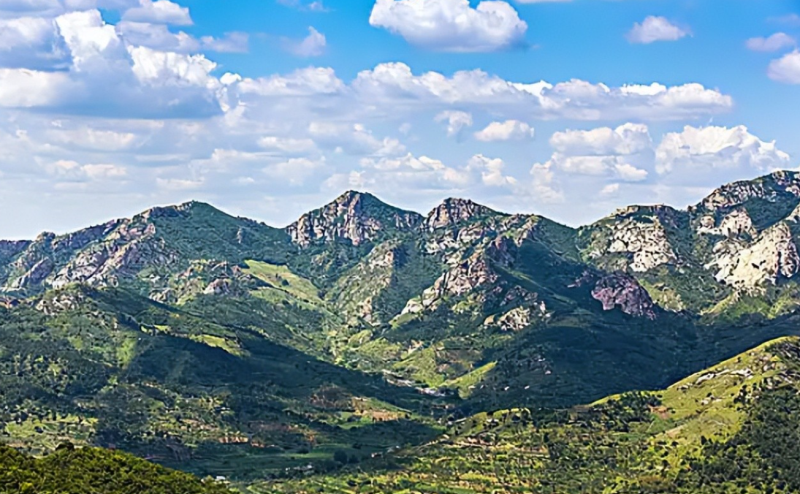
Yiwulü Mountain, historically known by names such as Yuweilü, Wulü, Yiwulü, and Fuli Mountain, is now commonly referred to as Lüshan. The name originates from the Donghu language, meaning "big mountain," while in Manchu, it signifies "emerald green mountain." Located in Beizhen City, Jinzhou, Liaoning Province, the scenic area covers 45 square kilometers.
As a renowned mountain of historical and cultural significance, Yiwulü Mountain boasts a civilization history spanning four thousand years, from the era of Emperor Shun of Yu to the Ming and Qing dynasties. Throughout history, imperial courts bestowed titles upon the mountain. Ancient emperors would dispatch high-ranking officials or personally visit to offer sacrifices, praying for favorable weather and national prosperity. The mountain reached its peak prominence during the Liao, Yuan, Ming, and Qing dynasties. The Liao Dynasty, in particular, regarded Yiwulü as the cradle of their rise, with imperial mausoleums nestled among its peaks and valleys. As many know, Empress Dowager Xiao Yanyan of the Liao Dynasty was laid to rest in the Qianling Mausoleum on Yiwulü Mountain after her death.