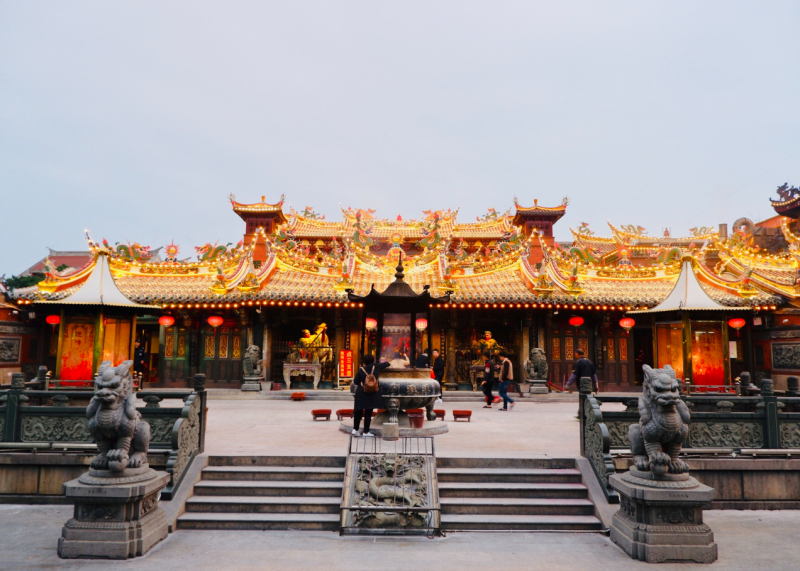
Guanyue Temple, also known as "Tonghuai Guanyue Temple" and commonly referred to as "Tumen Guandi Temple," is located on Tumen Street in Licheng District, Quanzhou City, Fujian Province. It was called "Guanwang Temple" during the Ming Dynasty and "Guandi Temple" in the Qing Dynasty. In the third year of the Republic of China (1914), the patriotic hero Yue Fei was enshrined there alongside Guan Yu, and it was renamed "Guanyue Temple." While the exact founding date remains unknown, the temple has undergone multiple renovations throughout the Ming, Qing, and Republican eras.
Facing south, the temple features a layout of three halls arranged side by side. From west to east, they are the Zhongyi Hall, the Wucheng Hall (Main Hall), and the Chongxian Hall. There is a brick courtyard in front of the halls, bordered by a screen wall. Each of the three halls consists of three sections; the first two sections are single-story, while the third section is a three-story building. The temple covers a total area of approximately 1,333.4 square meters, with a total floor area of 1,294 square meters.
Constructed from a mix of brick, wood, and stone, the architecture showcases traditional Minnan (Southern Fujian) craftsmanship. The roofs are primarily single-eave hard-gable styles, covered with red cylindrical tiles. The ridges feature the distinctive "swallowtail" shape and are adorned with exquisite porcelain cut-out sculptures (Jianci Diao). The structural framework mainly utilizes the Chuandou (column-and-tie) wooden system. Guanyue Temple houses a rich collection of historical artifacts, serving as valuable physical resources for researching temple history, calligraphy art, and Minnan culture.
In 2005, Guanyue Temple was designated as a Provincial Cultural Relic Protection Unit by the People's Government of Fujian Province.