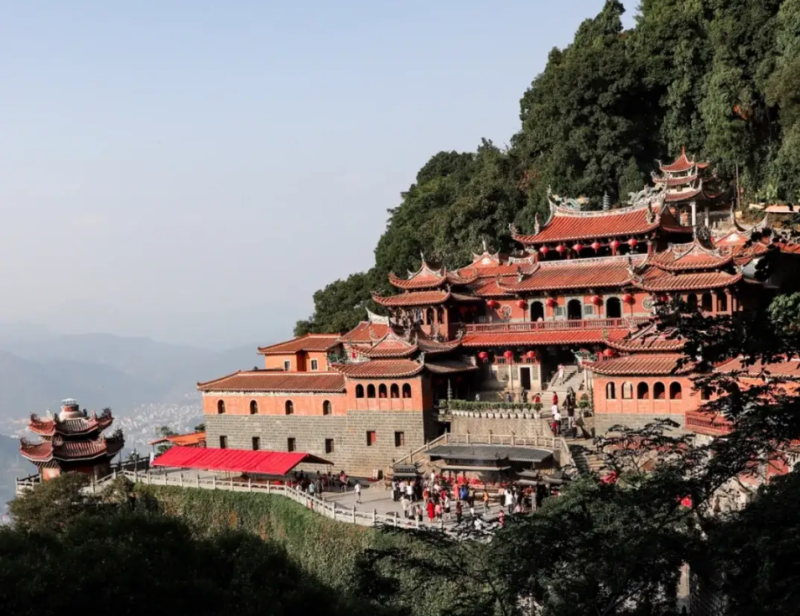
The Qingshuiyan Scenic Area is located on Penglai Mountain in Penglai Town, Anxi County, Fujian Province. It is a National AAAA Tourist Attraction, a Major Historical and Cultural Site Protected at the National Level, and one of the first batches of national cultural relics protection projects involving Taiwan. The scenic area covers a total area of 11.1 square kilometers, with its main peak rising 767 meters above sea level. Often shrouded in mist and floating clouds, it presents a breathtaking view reminiscent of a “Penglai Fairyland.”
Qingshuiyan Temple was originally built in the sixth year of the Yuanfeng era of the Northern Song Dynasty (1083). The existing structures were rebuilt in the Jihai year of the Guangxu era of the Qing Dynasty (1899), following the architectural layout recorded on the Song Dynasty “Yan Tu” (Rock Map) stele. It features the only main hall in China designed in the shape of the Chinese character “帝” (Di, meaning Emperor). The main complex includes Haotian Kou, the Zushi Hall, and the Shijia Building. The “Qingshui Zushi Belief and Customs” within the scenic area has been listed as a National Intangible Cultural Heritage, while “Qingshuiyan” and the “帝” character design have been recognized as Famous Trademarks of Fujian Province. In 2020, Qingshuiyan was approved as a Cross-Strait Exchange Base. As the birthplace of Qingshui Zushi culture, its branch temples number over a thousand worldwide, with more than 100 million followers.
The scenic area boasts attractions such as the “Zhizhi Chaobei” (Branches Facing North) tree, the Holy Spring, and the Song Dynasty “Yan Tu” stele. The “Yan Tu” stele is the earliest complete “stone blueprint” in existence, documenting the architectural form of the temple during the Song Dynasty. The thousand-year-old camphor tree, “Zhizhi Chaobei,” stands approximately 31 meters tall and is about 940 years old. Legend has it that it was planted by Qingshui Zushi himself. In 2025, “Qingshuiyan Temple · Zhizhi Chaobei” (referring to the National Major Historical and Cultural Site Protected at the National Level, Qingshuiyan Temple, and the ancient camphor tree) were jointly selected for the first batch of the “National Protection Unit · Ancient and Famous Trees” collaborative protection list. Among the existing cultural relics at Qingshuiyan Temple, there are 29 sites from the Song Dynasty, 2 from the Yuan Dynasty, 8 from the Ming Dynasty, and 5 from the Qing Dynasty. The scenic area is equipped with an ecological parking lot and a Pilgrimage Avenue. Direct shuttle buses are available from the Anxi Hengxing Bus Station, and nearby attractions include Hong’en Yan and Fengshan Temple.