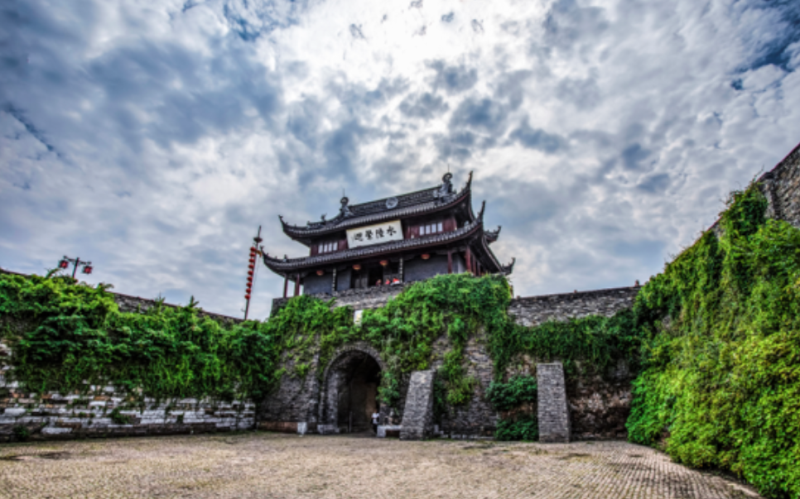
Panmen, historically known as Panmen (Coiled Gate), is located at No. 49 East Street, Gusu District, Suzhou, Jiangsu Province. Originally built in 514 BC by Wu Zixu under the order of King Helü of Wu, it served as one of the eight gates of the ancient Wu capital. The gate derived its name from the wooden coiled dragon once hung above it to symbolize the suppression of the State of Yue, as well as from its winding waterways described as "half water and half land, meandering and twisting."
The overall layout and architectural structure of Panmen largely retain the appearance from the late Yuan and early Ming dynasties. Its water and land gates are arranged side-by-side in a north-south staggered formation, creating a total plan in the shape of a carpenter's square, facing 10 degrees east of south. As a structure successively built and renovated during the Yuan, Ming, and Qing dynasties, Panmen is the only completely preserved ancient city gate in China with parallel water and land entrances. It holds immense historical and cultural value, giving rise to the famous saying: "In the north, admire the grandeur of the Great Wall; in the south, admire the elegance of Panmen."
On May 25, 2006, Panmen was listed by the State Council of the People's Republic of China as a Major Historical and Cultural Site Protected at the National Level (Batch 6).