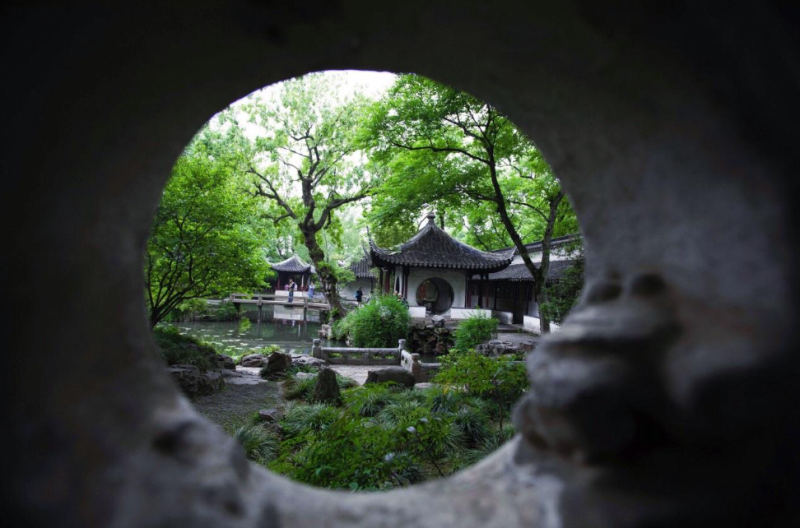
Located at No. 178 Dongbei Street in Gusu District, Suzhou, Jiangsu Province, the Humble Administrator’s Garden covers an area of 78 mu (52,000 square meters). Together with the Summer Palace in Beijing, the Mountain Resort in Chengde, and the Lingering Garden in Suzhou, it is honored as one of the Four Great Gardens of China.
The garden was originally built in 1509 during the Zhengde era of the Ming Dynasty by Wang Xianchen, an imperial censor. He invited the renowned painter Wen Zhengming, a representative figure of the Wumen School of Painting, to participate in the design. It took 16 years to complete. Over the centuries, the garden changed owners many times and underwent periods of prosperity and decline. From 1860 to 1863, it served as part of the residence of the Taiping Heavenly Kingdom's loyal prince. It underwent renovation in 1951.
The entire garden is divided into four sections: the East, the Central, the West, and the Residential area. The residential section features typical Suzhou-style architecture and now houses the Garden Museum.
The Eastern Section is bright and open, characterized by gentle hills, pine forests, lawns, bamboo groves, and winding streams. Key attractions include Lanxue Hall, Zhuiyun Peak, Furong Pavilion, Tianquan Pavilion, and Shuxiang Hall.
The Central Section is the essence of the garden. Water covers one-third of the area, creating a natural landscape with a wide pond and lush trees. Various buildings are arranged along the water, distinct in shape and height. Major sites include Yuanxiang Hall, Xiangzhou, the Lotus Breeze Pavilion, Jianshan Tower, the Little Flying Rainbow bridge, and the Loquat Garden.
The Western Section features the Thirty-Six Mandarin Ducks Hall near the residential area. Its pond is L-shaped, creating a unique atmosphere with separate pavilions, winding corridors, and beautiful reflections. The decoration is exquisite and ornate. Highlights include the Thirty-Six Mandarin Ducks Hall, Daoying Tower, the "Who Shall I Sit With" Pavilion, and the Water Corridor.
In 1961, it was listed as one of the first National Key Cultural Relics Protection Units. In December 1997, as a classic example of classical Suzhou gardens, it was inscribed on the UNESCO World Heritage List alongside the Lingering Garden, the Master of the Nets Garden, and the Mountain Villa with Embracing Beauty. In 2007, the Suzhou Gardens (including the Humble Administrator’s Garden, the Lingering Garden, and Tiger Hill) were rated as a National AAAAA Tourist Attraction.