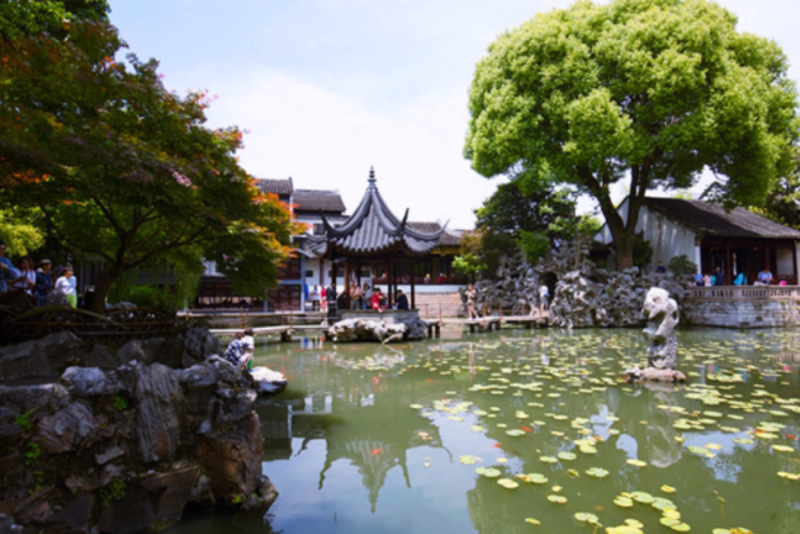
Located at 23 Yuanlin Road in Gusu District, Suzhou, Jiangsu Province, the Lion Grove Garden is one of the Four Great Gardens of Suzhou and a masterpiece of Yuan Dynasty landscape architecture. It covers an area of 1.1 hectares, with an open area of 0.88 hectares.
The garden was originally built in 1342 (the second year of the Zhizheng era of the Yuan Dynasty) by disciples for their master, Monk Tianru. After Tianru passed away in the late Yuan and early Ming dynasties, the disciples dispersed, and the garden gradually fell into disrepair. It was later purchased by Huang Xingzu, the prefect of Hengzhou and father of Huang Xi, who named it "She Garden." In 1771 (the 36th year of the Qianlong reign of the Qing Dynasty), Huang Xi achieved the top rank in the imperial examinations and extensively renovated the residence and garden, renaming it "Wusong Garden" (Garden of Five Pines). In 1917, Bei Runsheng, a Shanghai pigment merchant, acquired the garden from Li Zhongyu, the Minister of Civil Affairs, and spent nearly seven years restoring it. After Bei passed away in 1945, the garden was managed by his grandson, Bei Huanzhang. In 1953, Bei Huanzhang and his family donated the Lion Grove Garden to the new China. Following renovations to the main structures of the garden and ancestral hall, it opened to the public in 1954.
The garden is characterized by its rockeries and piled stones. It features over 20 architectural structures, including halls, pavilions, and studios, 16 of which bear plaques inscribed by Emperor Qianlong. Key attractions include the Yanyu Hall, the Flower Basket Hall, the Wenmei Pavilion, the Stone Boat, and the Ancient Wusong Garden. The rockeries in the Lion Grove Garden are considered one of the most intricate and complex examples of hill-stacking in classical Chinese gardens. They serve as a detailed illustration of the interaction between Zen Buddhism and Chinese gardening, as well as a model of the influence of imperial gardens on private Suzhou gardens, reflecting the historical, cultural, and economic characteristics of the time.
In December 1997, the Lion Grove Garden was included in the supplementary list for World Cultural Heritage nomination. In 2000, it was inscribed on the UNESCO World Heritage List. Home to the largest surviving ancient rockery group in China, its limestone rockeries are acclaimed as the "Kingdom of Rockeries." On September 9, 2025, the Suzhou Lion Grove Garden established a friendship garden partnership with the Butchart Gardens in Canada.