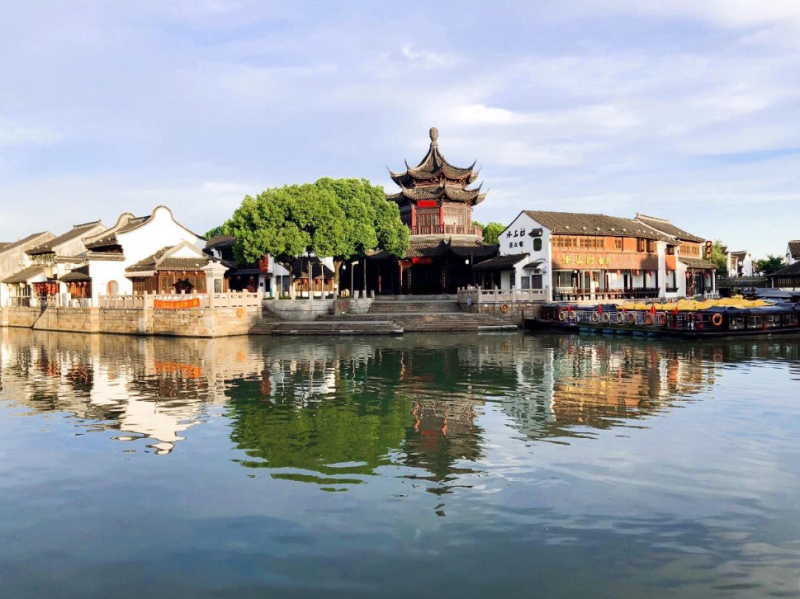
Shantang Street, also known as "Qili Shantang," is a historic and cultural district located in the northwest corner of Suzhou's ancient city, just outside the Changmen Gate. Stretching from Duseng Bridge in the east to Tiger Hill in the west, it spans over 3,700 meters in length and 30–100 meters in width, covering a construction control area of approximately 30.94 hectares.
The street was originally built in 825 AD during the Tang Dynasty by Bai Juyi, who served as the governor of Suzhou at the time. Hence, it is also referred to as "Bai Gongdi" (Bai's Embankment). Although it suffered damage during the Jin invasion in the Song Dynasty and again in the Yuan Dynasty, it underwent major renovations in the Ming Dynasty. In 1860, the street was burned down by Qing troops. Later, due to lagging transportation and a shift in commercial centers, Shantang Street began to decline. After several rounds of restoration following the founding of the People's Republic of China, it has evolved into a commercial street featuring the architectural style of the Ming and Qing dynasties.
Centered around "Bai's Embankment," the street forms a "T-shaped" layout, flanked primarily by commercial buildings. It can be divided into two sections: the eastern part consists mostly of shops and residences, while the western part extends from Bantang Bridge to Tiger Hill. This section features a unique layout where the street runs parallel to the river. Most of the ancient buildings line the streets, and seven ancient stone bridges span the Shantang River within the district. Key attractions include the Shantang Old Street, Yifeng Garden, the Memorial Hall of the Southern Society, and the Gangzhou Guild Hall. The area is also vibrant with activities such as the "Tiger Hill Opera Gathering," "Shantang River Dragon Boat Races," and the "Three Festivals Parade." While visiting, tourists can also savor local Suzhou delicacies like Mashengyuan sesame cakes, Jiangnan crab-shell pastries, and Madongpei shaomai.
Shantang Street was not only the place where the Tang Dynasty poet Bai Juyi served as an official but also the hometown of Wu Yipeng from the Ming Dynasty. In 2010, it was named a "China Historic and Cultural Street." In 2014, it was inscribed on the World Heritage List as a heritage site of the Grand Canal's Suzhou section. In 2015, it was rated as one of the first batches of "China Historic and Cultural Districts." Today, it serves as a distinctive cultural tourism card for Suzhou and is a National AAAA Tourist Attraction. As of July 2024, it had received a cumulative total of 11.2779 million visitors.