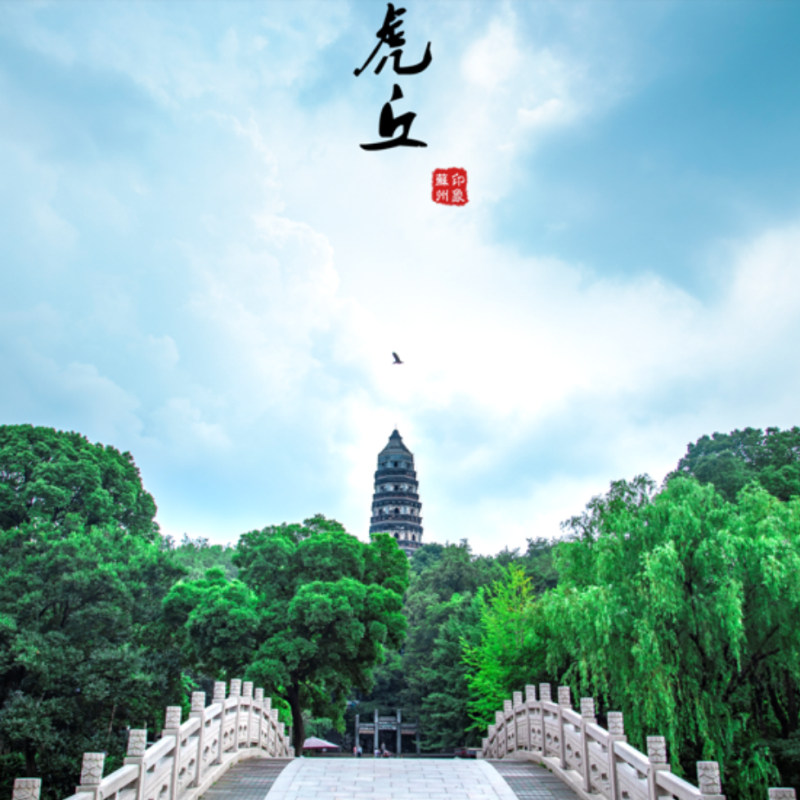
Tiger Hill Scenic Area is located at No. 8, Tiger Hill Gate, Gusu District, Suzhou, Jiangsu Province. Situated 3.5 kilometers northwest of the ancient city of Suzhou, it stands 34.3 meters above sea level. The scenic area covers 72.8 hectares, with a core area of 15.97 hectares, and boasts a long history of over 2,500 years.
The mountain is composed of Jurassic volcanic magma. Also known as "Sea Surge Hill," it was here that Wang Xun, a Minister of War during the Eastern Jin Dynasty, and his brother Wang Min, a Minister of Works, built villas on both sides of the Sword Pool. They later donated their residences to establish a temple named Tiger Hill Temple. The temple buildings were constructed along the mountain, creating a unique feature known as "a mountain hidden within a temple." The rear hill is said to be even more scenic than the front, featuring existing bluestone bridges, stone archways, and rockery made of lake stones. As one of the representative attractions of Suzhou, Tiger Hill enjoys a mild climate with abundant rainfall. The average annual precipitation is 1,100 mm, and the average annual temperature is 15.7°C (with January averaging 2.5°C and July averaging 28°C). Key attractions within the scenic area include Yongcui Villa, the Sword Pool, the Tiger Hill Pagoda, and the Broken Beam Hall.
Tiger Hill has been recognized as one of the first batches of National Top 10 Civilized Scenic Area Demonstration Sites and a National Civilized Unit. In 1996, it was approved as a provincial-level scenic area by the provincial government. In 2007, Tiger Hill, along with other Suzhou gardens, was designated as a National AAAAA-level Tourist Attraction. In 2014, the Yunyan Temple Pagoda within the Tiger Hill Scenic Area was inscribed on the UNESCO World Heritage List as part of the Grand Canal.