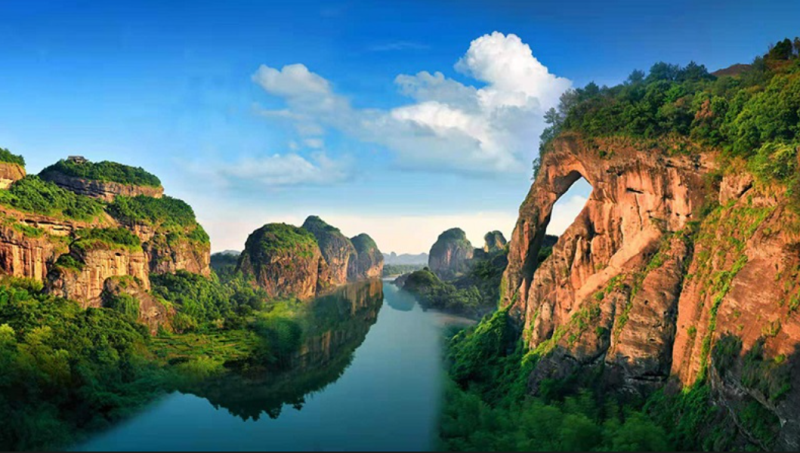
The Longhu Mountain Scenic and Historic Area in Yingtan City is located within the jurisdiction of Shangqing Town and Longhushan Town in Guixi County, Yingtan City, Jiangxi Province. It is 18 kilometers from the city center and covers an area of 200 square kilometers. Longhu Mountain was originally named Yunjin Mountain. In the mid-Eastern Han Dynasty, Zhang Daoling, founder of the Zhengyi Dao, once refined elixirs here. Legend has it that "when the elixir was completed, a dragon and a tiger appeared, and the mountain was thus named."
The Longhu Mountain Scenic and Historic Area in Yingtan City belongs to the mid-subtropical warm and humid monsoon climate zone. Its characteristics are distinct four seasons, mild climate (annual average temperature 17.9°C), abundant sunlight, plentiful rainfall, and a long frost-free period. The terrain of the Longhu Mountain Scenic and Historic Area in Yingtan City gradually decreases from south to north, with great elevation differences and varied forms, forming three types of terrain: mountains, hills, and river-lake plains. The plants in the area number more than 460 species belonging to 250 genera and 100 families. There are more than 40 species of mammals, accounting for about 40% of the 106 species in the province. Longhu Mountain is known as the "Danxia Fairyland," with 52 scenic spots and more than 230 natural and cultural landscapes. The main scenic areas include the Shangqing Palace Scenic Area, the Tianshi Mansion Scenic Area, the Longhu Mountain Scenic Area, the Zhenyi Temple Scenic Area, the Tianmen Mountain Scenic Area, the Xianren City Scenic Area, and the Xiangbi Mountain Paiya Stone Scenic Area.
Longhu Mountain is the birthplace of Chinese Taoism and one of the four famous Taoist mountains in China. Its Taoist holy land, emerald waters and vermilion mountains, and ancient cliff tombs are known as the "Three Wonders." During the Song, Yuan, and Ming dynasties, successive Celestial Masters were conferred the rank of "First Grade," and Longhu Mountain governed Taoism in Jiangnan, becoming the center of Taoist dissemination in China and the "place where a hundred gods received their offices." During the heyday of Taoism, Longhu Mountain had 10 Taoist palaces, 1 Taoist temple, and 836 Taoist courtyards. The Longhu Mountain Scenic and Historic Area in Yingtan City is a Global Geopark, a National Natural and Cultural Dual Heritage Site, a National AAAAA-level Tourist Attraction, and a National Key Scenic and Historic Area.