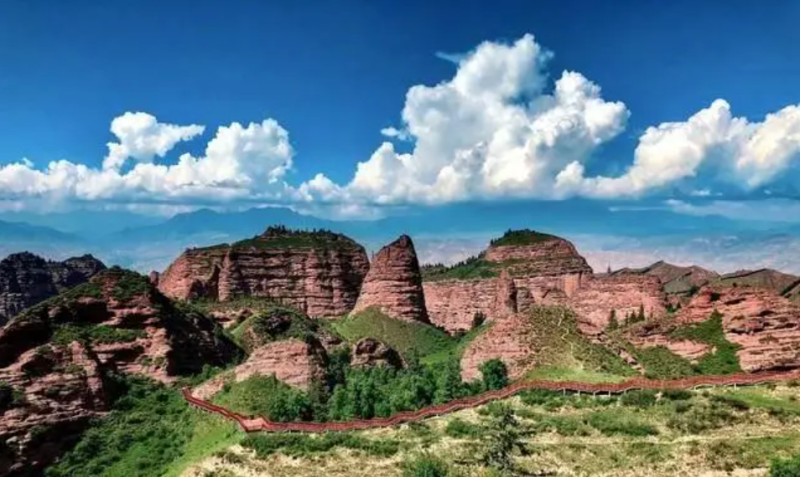
Huoshi Zhai is located in the northern part of Xiji County, Guyuan City, Ningxia Hui Autonomous Region. It stretches 17 kilometers from north to south and 10 kilometers from east to west, covering a total area of 97.95 square kilometers, with an elevation of 1,960–2,650 meters. It integrates a national geopark, a national forest park, a national AAAA-level tourist attraction, and a national-level nature reserve, and is the most typically developed and highest-altitude Danxia landform cluster in northern China. The mountain body gets its name because the dark red rocks resemble flames against the backdrop of green trees. The landform is characterized by red cliffs and vermilion precipices, forming a special morphology with flat tops, steep slopes, and gentle foothills. Strange mountains, grotesque rocks, perilous peaks, and lush trees are known as the "Four Wonders" of Huoshi Zhai. Major landscapes include the Qingtian Pillar, Shisi Mountain, and the Yingshe Peak, which resembles a male eagle confronting a cobra. Special species such as arrow bamboo grow in the vegetation-covered areas. More than 10 cave temple clusters with over 120 caves dating from the Northern Wei to the Qing Dynasty are preserved among the Danxia mountain bodies, among which the Saozhuling Caves contain statues from the Northern Wei period. A geological exhibition hall has been built in the park, displaying geological specimens and animal models. The Huoshi Zhai Danxia landform cluster was approved as a national geopark in 2004 and was listed as a national-level nature reserve in 2013.
In 2018, the scenic area was shortlisted among the "Magical Northwest 100 Scenic Spots" and selected as a national summer tourism route. Its scenery across the four seasons presents the unique features of spring mist, summer glow, autumn maples, and winter snow. The Yuntai Golden Summit features experience projects such as a glass suspension bridge and a high-altitude zipline. In 2025, equipment procurement was carried out for infrastructure construction projects, and in 2026 it was included in Ningxia's intangible cultural heritage cuisine tourism route.