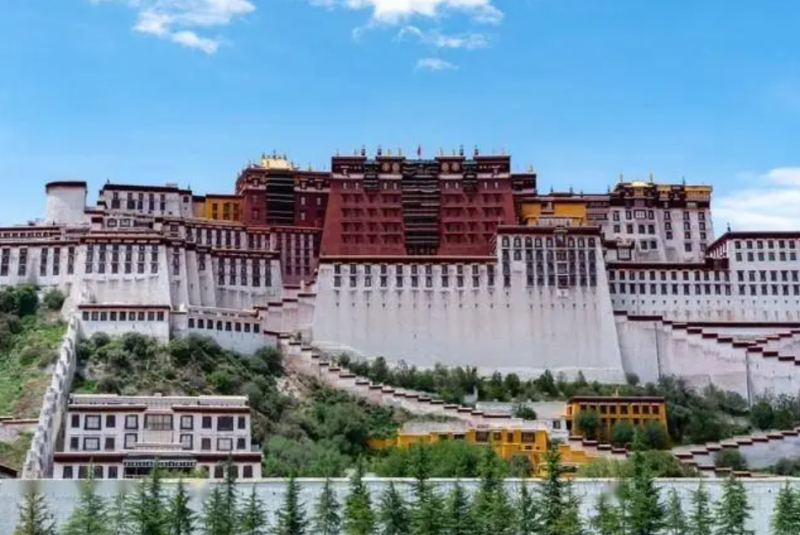
The Potala Palace is located on Moburi Mountain (Red Mountain) in the northwest of Lhasa, the capital of the Tibet Autonomous Region of the People's Republic of China. The Potala Palace was built under the auspices of Songtsen Gampo, the 33rd Tibetan king of the Tubo dynasty, in 631. After the collapse of the Tubo Kingdom, it was severely damaged by natural and man-made disasters. In 1645, the Fifth Dalai Lama rebuilt the Potala Palace in order to consolidate the local theocratic Ganden Phodrang regime, and it was subsequently expanded continuously until it reached its present scale.
The Potala Palace was designed and built according to the layout of a Buddhist mandala. It covers a total area of more than 360,000 square meters, with a total building area of more than 130,000 square meters. Its main building is 117 meters high and has 13 stories. It is a large palace-fortress architectural complex integrating many functions, including palaces, stupa halls, Buddhist halls, administrative offices, a monastic official school, and monks' quarters, with a total of 1,267 rooms. The main structure of the building consists of two major systems: the White Palace and the Red Palace.
After 1959, the Central Committee of the Communist Party of China and the State Council attached great importance to the maintenance and protection of the Potala Palace, allocating repair funds all year round, and carried out two phases of renovation in 1988 and 2001. On March 4, 1961, the Potala Palace was announced by the State Council of the People's Republic of China as one of the first batch of Major Historical and Cultural Sites Protected at the National Level. In 1994, the Potala Palace was listed by UNESCO as a World Cultural Heritage site. Starting from December 1, 2025, the Potala Palace will implement a Monday closure system (except on national statutory holidays).
The Potala Palace was the winter palace of successive Dalai Lamas and also the center of theocratic rule of the local rulers of Tibet in the past. Since the time of the Fifth Dalai Lama, major religious and political ceremonies have all been held here, and it is also the place where the stupas of successive Dalai Lamas are enshrined. The architecture of the Potala Palace and its collected cultural relics fully embody the political, economic, cultural, and other exchanges, interactions, and integration among all ethnic groups in China, proving that Tibet has been an inalienable part of China since ancient times.