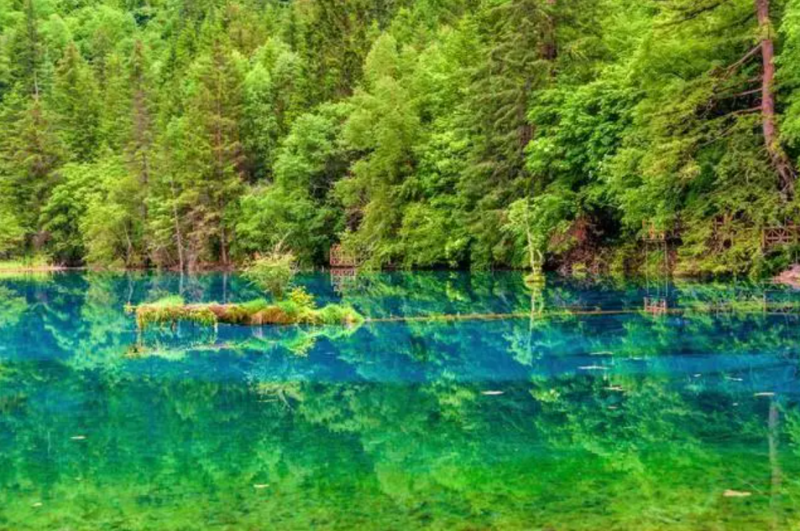
Jiuzhaigou National Nature Reserve is located in Zhangzha Town, Jiuzhaigou County, Aba Tibetan and Qiang Autonomous Prefecture, in the southern section of the Minshan Mountains in northwestern Sichuan Province. It lies on the northeast side of Gongganling in the southern section of the Minshan Mountains and is a major tributary of the source of the Baishui River, an upstream tributary of the Jialing River in the Yangtze River system. The watershed area it covers is approximately 642.97 square kilometers.
The Jiuzhaigou National Nature Reserve contains four scenic areas: Shuzheng Valley, Zechawa Valley, Rize Valley, and Zharu Valley. It is dominated by water landscapes such as plateau travertine lake groups, travertine waterfall groups, and travertine shoal flows. Its water landscapes are huge in scale, diverse in type, numerous in quantity, beautiful in form, exquisite in layout, and excellent in environment. The forest coverage rate of the reserve exceeds 80%, with 38 species of lianas and 74 species of nationally protected rare plants. There are 122 species of terrestrial vertebrates, including 21 species of mammals, 93 species of birds, 4 species of reptiles, and 4 species of amphibians. In the Jiuzhaigou earthquake on August 8, 2017, many natural scenic areas within the reserve were severely damaged. After four years of reconstruction, it reopened on September 28, 2021. Jiuzhaigou National Nature Reserve is the core area and corridor zone of the Minshan Mountain System Giant Panda Population A. It has a typical natural ecosystem and is one of the core areas for biodiversity conservation in China. It is rich in animal and plant resources and has high value for ecological protection, scientific research, and aesthetic tourism.
In 1982, the reserve was announced by the State Council of the People's Republic of China as one of the first batch of national-level scenic spots; in 1984, it was officially opened to the public. In December 1992, the reserve was inscribed by UNESCO on the World Natural Heritage List. In 1994, Jiuzhaigou National Nature Reserve was established. In 2007, the scenic area was officially approved as a National AAAAA-level tourist attraction. On March 29, 2026, Jiuzhaigou National Nature Reserve captured on camera for the first time after the earthquake live footage of a wild giant panda.