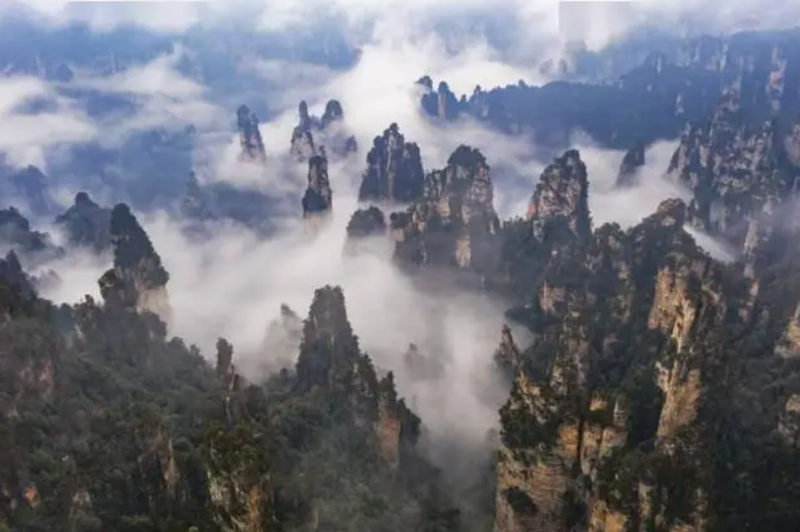
Zhangjiajie City, formerly known as "Dayong", is a prefecture-level city under the jurisdiction of Hunan Province. It is located in the northwest of Hunan Province, in the middle and upper reaches of the Lishui River, and in the hinterland of the Wuling Mountain area. It has abundant sunlight and heat and ample rainfall, with a total area of 9,533 square kilometers. As of September 2025, Zhangjiajie City administers 2 districts and 2 counties. As of the end of 2024, the permanent resident population of Zhangjiajie City was 1,486,900. The People's Government of the city is located at No. 2 Nanzhuang Road, Nanzhuangping Subdistrict, Yongding District.
Zhangjiajie City is a national key ecological function area and an important ecological barrier in the middle and lower reaches of the Yangtze River. It is the birthplace and central area of the Hunan-Hubei-Chongqing-Guizhou Revolutionary Base Area. It is a city built because of tourism and possesses the "six golden calling cards": a World Natural Heritage site, one of the first Global Geoparks in the world, the place where the world's "Zhangjiajie landform" is named, China's first National Forest Park, one of China's first batch of 5A-level tourist attractions, and a national civilized scenic area. It is also the fixed venue for the World Wingsuit Flying Championship. It has formed a comprehensive three-dimensional transportation network of aviation, high-speed rail, and expressways. Hehua International Airport is the first international airport in the Wuling Mountain area and the earliest national first-class air port. In 2017, it was awarded the honorary title of "National Forest City". Within its territory are the national AAAAA-level tourist attraction Zhangjiajie National Forest Park, which has been included in the "World Natural Heritage List", as well as Tianmen Mountain National Forest Park.
In 2025, the city achieved a gross domestic product of 66.78 billion yuan, a year-on-year increase of 3.0%.