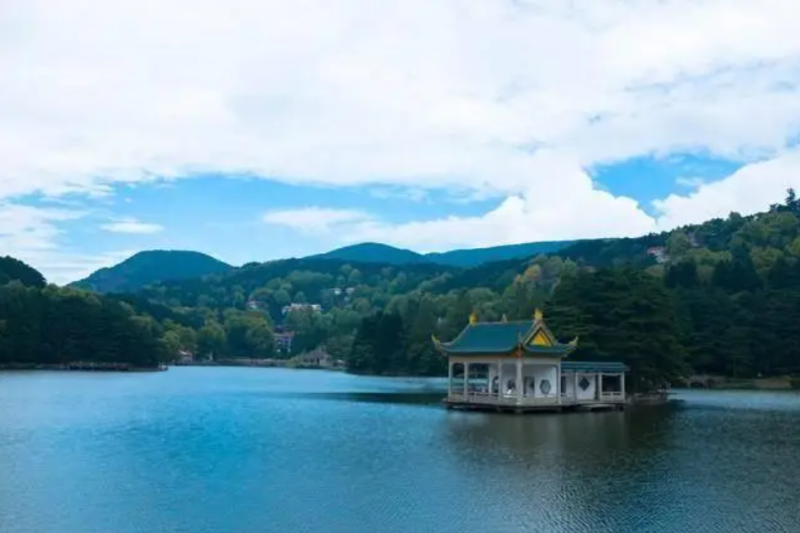
Lushan, also known as Kuangshan or Kuanglu, is located within Lushan City, Jiujiang City, Jiangxi Province. Lushan stands on the Middle and Lower Yangtze Plain, bordering the Yangtze River to the north and adjoining Poyang Lake to the east. The great mountain, the great river, and the great lake form an integrated whole, creating a magnificent landscape rarely seen in the world. It lies between longitude 115°52′–116°8′E and latitude 29°26′–29°41′N, approximately 25 kilometers long and 10 kilometers wide. Its main peak, Hanyang Peak, stands at 1,474 meters above sea level. The mountain body is oval in shape and is a typical horst-type fault-block mountain.
Lushan is renowned throughout the world for its majesty, wonder, steepness, and beauty, and has long enjoyed the reputation of "Kuanglu's extraordinary beauty being the finest under heaven." With its profound historical and cultural heritage, Lushan is hailed as the "Holy Mountain of Humanities." "The flying stream plunges down three thousand feet, as if the Milky Way were falling from the ninth heaven," and "I cannot tell the true face of Lushan, only because I am within the mountain" — more than 3,500 men of letters left over 16,000 poems here. Since ancient times, 171 peaks have been named, and among the clustered peaks are distributed 26 ridges, 20 valleys, 16 rock caves, and 22 curious rock formations. Where water flows develop knickpoints in the river valleys, many rapids and waterfalls are formed, including 22 waterfalls, 18 streams and ravines, and 14 lakes and pools. The most famous is the Three-Step Spring Waterfall, with a drop of 155 meters, enjoying the reputation that "one who has not visited the Three-Step Spring cannot be considered a true visitor to Lushan." Lushan lies in the eastern monsoon region of China's subtropical zone and has a distinct monsoon climate, characterized by short summers and long winters and late springs and early autumns, and is known as a "cool world." Lushan has more than 650 species of plants in 150 families, of which more than 100 species have medicinal value.
In 1982, Lushan was designated by the State Council as one of the first batch of national key scenic areas. On December 6, 1996, it was inscribed by UNESCO on the World Cultural Heritage List. In 2003, it was selected as one of China's Top Ten Famous Mountains. On February 13, 2004, it was included in the first batch of World Geoparks. On March 7, 2007, it was rated as a National 5A-level Tourist Attraction. In May 2022, the Lushan sea of clouds was included in the first batch of 15 "Weather and Climate Landscape Viewing Sites" announced by the China Meteorological Service Association.