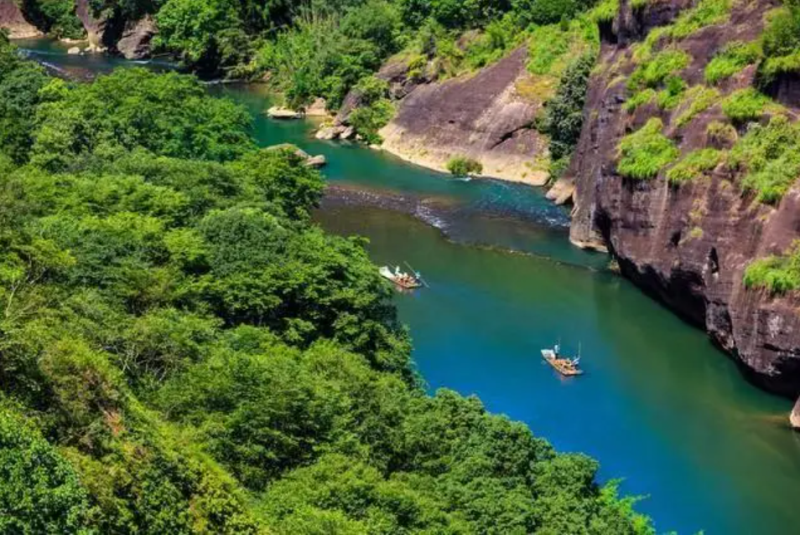
Mount Wuyi, with a total area of 99,975 hectares, is located at the border between northwestern Fujian Province and Jiangxi Province, forming the watershed between the tributaries of the lower Yangtze River in the north and the Min River basin of Fujian Province in the south. It is the highest mountain range in southeastern China and is known as the "Roof of East China." It has more than 110 peaks exceeding 1,000 meters (the highest peak, Huanggangshan, is 2,158 meters above sea level). The property consists of four protected areas: the Wuyishan Nature Reserve, the Jiuquxi Ecological Protection Area, the Wuyishan National Scenic and Historic Interest Area (i.e., the Natural and Cultural Landscape Protection Area), and the Ancient Hancheng Site Protection Area.
Mount Wuyi has a subtropical monsoon climate and possesses numerous clear springs, waterfalls, mountain streams, and brooks, as well as forest belts of basically intact diversity. It is the largest and most representative example of subtropical forest and southern China rainforest diversity in China, and is of great importance for biodiversity conservation. The area contains no fewer than 35 ancient Confucian academies dating from the Northern Song to the Qing dynasties (10th–19th centuries), which provided a favorable environment for the development and spread of Zhu Xi's Neo-Confucianism. In addition, the area also contains a large number of tomb sites, cliff inscriptions, and rock caves containing wooden boat coffins dating back to the Shang Dynasty, more than 60 remains of Taoist temples and Buddhist monasteries, as well as the administrative capital established by Han Dynasty rulers in the 1st century AD, all of which are of great archaeological value. Its main scenic spots include: Wuyi Palace, Shuilian Cave, Dawang Peak, Huxiao Rock, Yulinting, etc.
In December 1999, according to World Heritage selection criteria (III)(VI)(VII)(X), Mount Wuyi was inscribed by UNESCO on the World Heritage List (No. 911) as a World Cultural and Natural Dual Heritage site, becoming one of China's World Heritage sites. On May 8, 2007, it was approved as a National AAAAA-level Tourist Attraction. On May 29, 2026, Mount Wuyi was awarded the title of "World Famous Tourism Mountain" by the International Mountain Tourism Alliance.