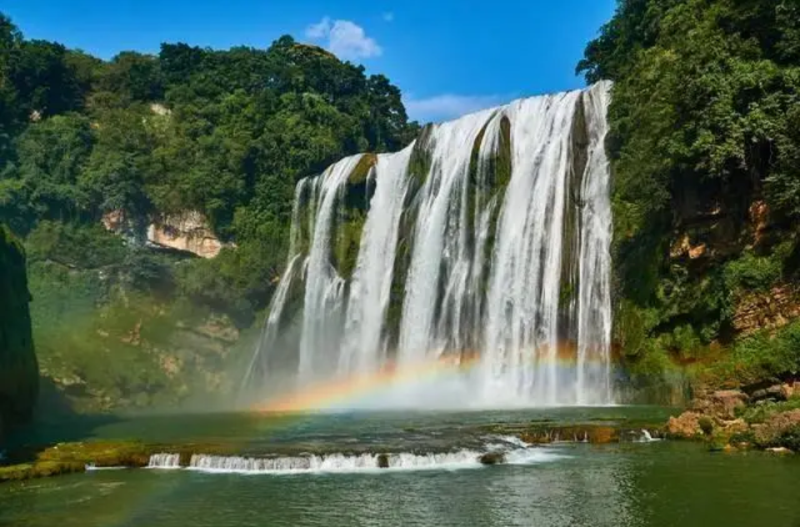
Huangguoshu Waterfall, also known as Huangguoshu Grand Waterfall. In ancient times, it was called Baishui River Waterfall, and was also named "Huanggeshu" Waterfall or "Huanggeshu" Waterfall. Myths and legends about Huangguoshu Waterfall have been passed down among the people of Guizhou since ancient times, and the name of Huangguoshu Waterfall comes from the tree that bears "yellow fruit" in this myth. It is located in Zhenning Buyei and Miao Autonomous County, Anshun City, Guizhou Province, China. It belongs to the Baishui River section water system in the lower reaches of the Kebu River, a tributary of the Dabang River, which is a tributary of the Beipan River, a tributary of the Nanpan River on the main stream of the Xijiang River in the Pearl River system. It is the largest first-level waterfall in the Huangguoshu Waterfall Group and one of the world's famous great waterfalls. It is known for its massive water flow. The waterfall is 77.8 meters high, of which the main waterfall is 67 meters high; the waterfall is 101 meters wide, of which the top of the main waterfall is 83.3 meters wide. Huangguoshu Waterfall is an erosion knickpoint-type waterfall in karst landforms.
Huangguoshu Waterfall began to gain fame with the Ming Dynasty traveler Xu Xiake, and through the travels and dissemination of celebrities over successive dynasties, it became a well-known scenic spot.
On June 20, 2024, according to measured data from the Hydrology and Water Resources Bureau of Anshun City, Guizhou Province, the flow of Huangguoshu Waterfall reached a maximum of 381 cubic meters per second, the largest water volume in 2024.