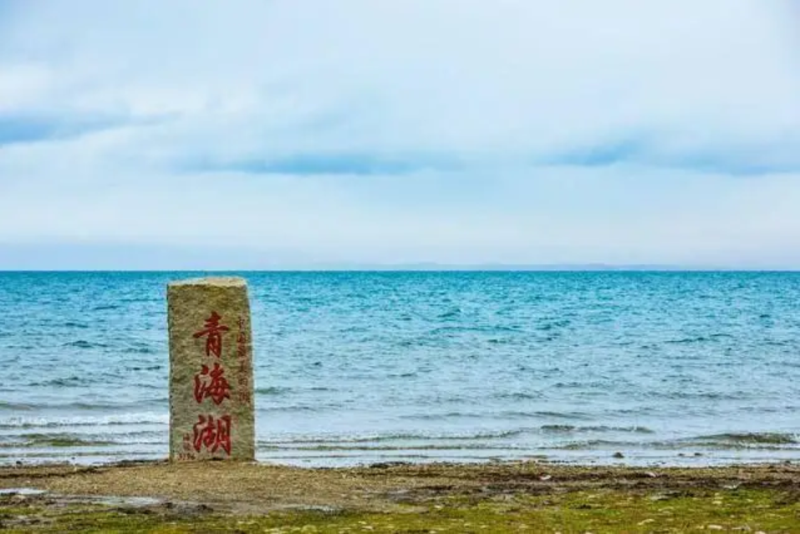
Qinghai Lake, located in the northeastern part of the Qinghai-Tibet Plateau and spanning the three counties of Haiyan, Gangca, and Gonghe in the Haibei and Hainan Tibetan Autonomous Prefectures, is the largest lake in China. The lake stretches 106 kilometers from east to west at its longest and 63 kilometers from north to south at its widest, with a circumference of about 360 kilometers. Qinghai Lake is the largest plateau inland saltwater lake in China, with a water area of 4,625.6 square kilometers and a water volume of 74.3 billion cubic meters. On December 20, 2024, the latest monitoring showed that the water body area of Qinghai Lake continued to expand to 4,650.08 square kilometers, an increase of 28.1 square kilometers compared with the same period last year.
Qinghai Lake is one of the highest lakes in the world, with a lake surface elevation of 3,196 meters. The overall outline of the basin is elliptical, sloping from northwest to southeast, and it is a closed inland basin; it has a plateau continental climate. Qinghai Lake is a slightly saline lake with a relatively high degree of mineralization. Its water supply comes mainly from river water, followed by springs at the bottom of the lake and precipitation.
Qinghai Lake is part of the Tibetan cultural region. It not only has the common characteristics of the Tibetan cultural region, possessing the ethnic customs and cultural origins shared by the Tibetan cultural region, but also has its own unique characteristics of water culture. The Qinghai Lake area is one of the important livestock production bases in Qinghai Province, and planting, tourism, and industrial production all have a certain scale. In terms of the economy, the counties in the lake area are mainly based on the secondary industry, supplemented by the primary industry, while the tertiary industry is mainly concentrated along the roads around the lake.
Qinghai Lake is a typical representative of plateau inland lake wetland types in the world, an important breeding ground for waterbirds and a major node on migration routes, an important water conservation area and water-vapor circulation channel in western China, an important water body for maintaining ecological security on the Qinghai-Tibet Plateau, and a natural barrier preventing the eastward spread of desertification in the west. It is known as the "climate regulator," "air humidifier," and "species gene pool of the Qinghai-Tibet Plateau" in northwestern China.
In 2025, the total area of Qinghai Lake (including Gahai and Erhai) during the wet season is 4,657.92 square kilometers.