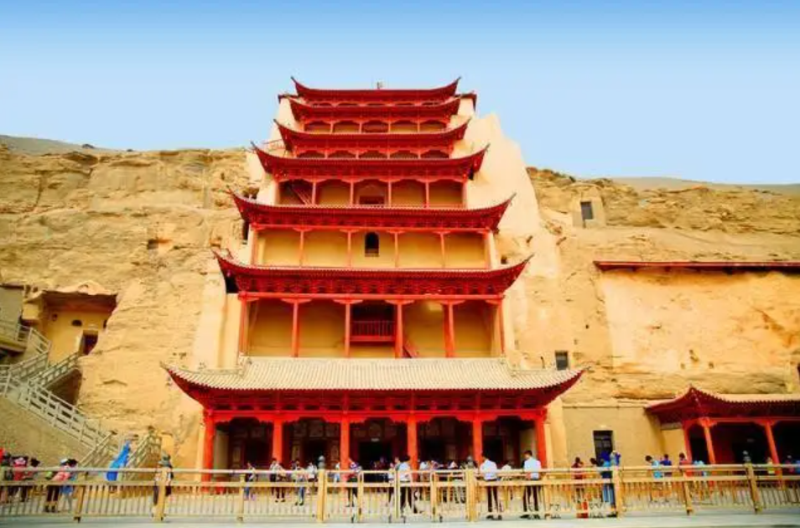
The Mogao Caves, commonly known as the Thousand Buddha Grottoes, are located on the cliffs at the eastern foot of Mingsha Mountain southeast of Dunhuang City, Gansu Province, facing Dangquan in front and extending 1,680 meters from north to south. They are the representative of the Dunhuang Grottoes and one of the largest surviving Buddhist art treasure houses in the world. The excavation began in the second year of the Jianyuan era of the Former Qin dynasty (366 AD), and continued through more than ten dynasties from the Sixteen Kingdoms period to the Yuan dynasty, forming a rich and magnificent group of caves. Together with the Maijishan Grottoes in Tianshui, Gansu, the Yungang Grottoes in Datong, Shanxi, and the Longmen Grottoes in Luoyang, Henan, they are known as the "Four Great Grottoes of China."
The Mogao Caves were built entirely against the mountain, divided into five levels from top to bottom. There are 735 existing caves, 5 surviving wooden structures from the Tang and Song dynasties, 45,000 square meters of preserved murals, more than 2,400 painted sculptures, and more than 4,000 flying apsaras. Among them, the tallest painted sculpture is the Northern Great Buddha in Cave 96, with a total height of 35.5 meters; the largest mural is the Wutai Mountain Panorama in Cave 61, covering about 47 square meters. Each cave of the Mogao Caves is a comprehensive art of cave architecture, painted sculpture, and painting. Its mural content covers numerous subjects and not only reflects the high level of ancient Chinese exquisite art, but also provides, to varying degrees, visual materials for studying the development and evolution of ancient religious beliefs, folk customs, and related aspects in China, especially in the Hexi and Dunhuang regions. It possesses precious artistic, historical, and scientific and technological value. Therefore, it is internationally acclaimed as a "museum on the walls," "the longest gallery in the world," and a "visual history" spanning a thousand years.
In the 26th year of the Guangxu era of the Qing dynasty (1900), the Library Cave was discovered at the Mogao Caves, yielding more than 50,000 cultural relics, including documents and paper paintings from the 4th to the early 11th centuries. These are known as the "Dunhuang Manuscripts." The Dunhuang Manuscripts are important materials for studying cultural exchanges between China and Central Asia.
On March 4, 1961, the Mogao Caves (including the Western Thousand Buddha Caves) were announced by the State Council of the People's Republic of China as one of the first batch of Major Historical and Cultural Sites Protected at the National Level. On December 11, 1987, at the 11th session of the UNESCO World Heritage Committee, the Mogao Caves were inscribed on the World Heritage List.